Showing posts with label aviation. Show all posts

Thursday, December 24, 2009

'Twas the Flight Before Christmas

A Moss family tradition--reading this poem at Christmas time. My grandfather, a pilot, was particularly fond of this one...

'Twas the Flight Before Christmas

by Capt. R.C. Robson, December 1952


‘Twas the flight before Christmas and all through the sky,
Not a creature was stirring, ‘cept the Captain and I.
The throttles were set on the quadrant with care,
In hopes of beating St. Nicholas there.

The passengers were nestled all snug in their seats,
The purring of engines had lulled them to sleep.
And Captain at the wheel and I on his right,
Had just leveled off for a long winter’s flight.

When out of the sky there arose such a clatter,
We jumped in our seats to see what was the matter.
We checked each engine quick as a flash,
Glanced at the dials all over the dash.

The moonlight reflecting from the cloud bank below,
Showed nothing amiss in the cold white glow.
When what to our wondering eyes should appear,
But a miniature sleigh and eight tiny reindeer.

With a little old pilot, so lively and quick,
We knew in a moment it must be St. Nick.
More rapid than our ship his courses they came,
And he whistled and shouted and called them by name.

"Now Pratt! now Whitney! Now Curtiss and Wright!
On Franklin! On Allison! On, on though the night!
"To the top of the clouds, to the top of them all,
Now, dash away, dash away, dash away all!"

And then in a twinkle on our wing we did here,
The prancing and pawing of each little dear.
Flying swift as the wind over a cloud,
They passed right by us, nodded and bowed.

He was dressed in goggles and helmet and boot,
And snow flakes were clinging to his flying suit.
A bundle of toys was strapped to his back,
He looked like a paratrooper in his jumping pack.

His goggles now frosted, his dimples now merry,
The wind burned his cheeks and his nose like a cherry.
He had on the earphones of his radio,
And he was flying the course straight as an arrow.

The smoke from his pipe his teeth held tight,
Streamed out behind him into the night.
He had tightened his seatbelt over his belly,
But it shook underneath like a bowl full of jelly.

He was sure a good flyer, that jolly old elf,
He flew better than the Captain – or even myself.
With a burst of speed from his tiny sled,
He was out in front and pulling ahead.

He was looking for a break in the dense overcast,
For he’d stockings to fill – al all night task.
When off to the south he saw a big hole,
And banked to his right and started to roll.

He pushed forward his stick, to his team gave a whistle,
And towards it they flew, like the down on a thistle.
But we heard him exclaim as he dove out of sight,
Merry Christmas to all and to all a good flight!


-t

Wednesday, December 16, 2009

Flight Northwest 188

Remember back in October when those two pilots overshot their destination airport by 150 miles? They were going from San Diego to Minneapolis and went out of contact with flight controllers for 77 minutes. Many were afraid the plane had been hijacked.

After the plane landed (safely) there was a great deal of speculation that the pilots had fallen asleep. The actual explanation is less interesting. They were distracted by their laptops! According to report just issued by the FAA, the two pilots had their laptops out and were trying to figure out a flight scheduling system that was new to the captain.
Mr. Cheney, 53, with 24 spotless years with the airline, and Mr. Cole, 54, who started flying at 14 and also had a spotless record, were going over Mr. Cheney’s schedule. Applying for a schedule under new computer procedures at Delta, the airline that acquired Northwest earlier in the year, Mr. Cheney had received a schedule that he did not like and that would have him at work for three additional days a month, the two men told investigators. They had both pulled out their laptops as Mr. Cole tried to help Mr. Cheney understand how to work the new system.

The documents contained a summary of interviews with Mr. Cheney and Mr. Cole, and added some fresh details. For example, the crew members reported hearing “radio chatter” but no calls for them; the reason, they told investigators, was that Mr. Cole had apparently tuned the radio to the frequency for an air traffic control center in Winnipeg, Manitoba. After the flight, investigators discovered that when a flight attendant used an on-board telephone to ask the pilots when the plane would be landing, the crew first spoke to the Winnipeg controllers. (source)


No recommendations for change, yet, but that will probably come. The New York Times, for instance, speculates that perhaps the Airbus A320 will a chime or other noise when text messages are sent to the aircraft.

Sadly, there have been a number of accidents caused by pilots being distracted. Most famously, perhaps, in the tragic crash of Easter Air Flight 401 in the Florida Everglades. Both pilots and the flight engineer were trying to troubleshoot a burned out landing gear indicator light and didn't notice that they had switched the autopilot mode to maintain pitch rather than maintain altitude. Then the pilot accidentally pushed the yoke forward and didn't notice the slow descent this caused.


The last words of the crew were these:
(1st Officer) Stockstill: We did something to the altitude.
(Captain) Loft: What?
Stockstill We're still at 2,000 feet, right?
Loft: Hey — what's happening here?

These days, pilots are trained in what's known as Cockpit Resource Management. The gist of which is: "One guy flies while the other guy fixes."

(As an interesting aside, there were numerous reported ghost sightings in planes that received salvaged parts from EA 401.)

-t

Saturday, December 5, 2009

US Air Force Acknowledges New Aircraft


Little know fact, the United States Air Force spends more now on Unmanned Ariel Vehicles (such as Predator Drones) than on traditional, piloted aircraft. Of course, UAV's do, in fact, have pilots. It's just that the pilots fly the vehicles remotely from bases. There are a lot of advantages of this besides lowering the risk in operations over hostile territory. Without the weight of pilot, human interface (cockpit), or the life-support/survival equipment associated with pilots, these airplanes can have incredible range and time-over-target. If pilots become tired, no problem, they just get up and another pair takes their place in the command centre! The current (declassified) record for a single Predator flight is 40 hours and 5 minutes (source).

The existence of the "RQ-170 Sentinel" has just been declassified. It looks like a smaller version of a B-2 Bomber: flying wing with no tail. Few details have been released, but the aircraft is obviously designed to minimize radar signature. It is believed that it does not carry weapons (but that assumption is really just based on the RQ designation declassified by the Air Force). Aviation Week says that it is probably a "tactical, operations-oriented platform and not a strategic intelligence-gathering design" (source). But a lot bloggers point out features of the design that suggest an internal weapons bay.

I have a great story, incidentally, that an USAF officer told me about a Predator giving operational support during the invasion of Iraq. I don't think it's a classified story, but I'm not going to share it online. Suffice it to say that these things are amazing. I imagine that the new "Sentinel" has made major advancements over the late-90's-era Predator.

Capt Richard Koll, left, and Airman 1st Class Mike Eulo pilot a Predator UAV from a base in Iraq before handing control off to a team in the United States. The guy on the left flies while the one on the right operates sensors and weapons systems. (source)


-t

Monday, November 30, 2009

Ice Pilots NWT

My new favourite show is "Ice Pilots: NWT" on the history channel. It's a reality TV show about a small airline (Buffalo Air) in the Canadian North that keeps some very remote villages and towns supplied. These are the sorts of places that are only reachable by road three months of the year! One of the things that makes Buffalo Air unique is that they rely mostly on piston-powered airplanes, many of WWII vintage. We're talking PBY's, C-46's, DC-3/C-47's, C-54's. The extreme cold, poor weather, rough runways, and short hauls make these tough, un-pressurized propeller aircraft ideal.

Good times for you aviation buffs out there!


-t

Thursday, October 29, 2009

Mission Church--like building a plane in the air

I was at the Fresh Expressions Working Group meeting today. This is the Diocesan Committee that looks after church planting. I'm new to the committee, which is an Episcopal Appointment, and found it very exciting to hear about many of the new churches which are being founded around the Diocese. I knew about most, but not all, of these projects.

Needless to say, Missional Church was much discussed, and we (like everybody else) are really learning how to do it as we go along. In relation to this, (Diocesan Missioner) Jenny Andison told us about this video:

Yep, that feels about right. We build airplanes in mid-flight in the church!

-t

Wednesday, October 28, 2009

The Search for Earhart


View Larger Map
With a new movie about aviation pioneer Amelia Earhart coming out, there have some interesting stories in the press about the effort to find her final resting place. When she went missing over the pacific on July 2, 1937, my grandfather was a young carrier pilot flying off a carrier (not sure which one--Perhaps the USS Lexington (CV-2)). His squadron participated in the search, and he maintained an interest in her fate ever since.

The most likely scenario currently proposed is that she ran out of fuel near Howland Island and made an emergency landing on a small, uninhabited island known as Nikumaroro Atoll. It had a smooth, flat reef that would have been possible to land on, however the waves and strong wind would have likely eventually have pulled her plane into the water. Radio transmissions were heard from Earhart after her landing, which would have required the plane to be able to run its engines (dry ground), which is further evidence for this theory.

Days later, one of the search planes piloted by at Lt Lambrecht flew over Nikumaroro Atol and saw signs of habitation, but couldn't spot the plane or Earhart. Recently researches tested how visible a person on the island would be to an observer in an aircraft (the answer--not very). It is very sad to think that Earhart may have been so close to rescue.

In 1940 British Colonial Service Officer Gerald Gallagher found a partial skeleton on the island of European descent and consistent with Earhart's build. Crabs had taken away the rest. He also found a woman's shoe. Unfortunately, the shoe and the remains were lost.

An expedition to Nikumaroro next summer will look for more evidence to help determine what happened to the famous aviator.

-t

Sunday, July 5, 2009

The Fighting Flying Boats


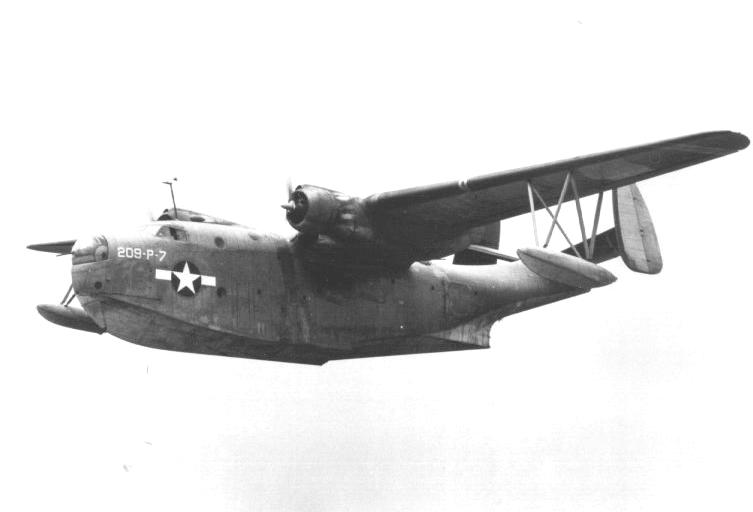
My father found this snippet about my grandfather in a book about Flying Boats in WWII.
The first known Mariner air-sea rescue "Dumbo" mission in the Pacific was performed by a NATS Pan American PBM.

At 0530 on 12 November 1943 the troop transport SS Cape San Juan was on its second voyage from San Francisco to Townsville, Australia, with 1,429 passengers. It was hit by a torpedo from a Japanese submarine. The explosion killed many of the U.S. Army troops on board and released oil that spread onto the surrounding water. A false word to abandon ship quickly spread and all but about two hundred men went over the side into the sea. They were immediately coated with a layer of oil. Survivors swam for jettisoned life rafts or clung to floating debris and kapok jackets. Cape San Juan listed on its starboard side as damage control tried shoring up the gaping hole and pumping out the incoming sea. The stricken ship remained afloat for another twenty-four hours.

The liberty ship SS Edwin T. Merideth rescued 443 people, including those remaining aboard the Cape San Juan. McCalla DD-488), Dempsy (DE-26), and minesweeper YMS-241 picked up 840 additional survivors. The sea then became rough as a storm system passed through the area, bringing swells that were up to fifteen feet high. These conditions exacerbated the situation for the men in th ewater.

A Pan American Mariner, just arriving in Suva, Fuji, on a cargo run, volunteered to assist in the rescue mission. Captain Moss gives his account in Lee Roy Way's "First PBM Rescue" article:

"We arrived at Suva at 1030 hours and were informed of the Cape San Juan's dilemma and the plight of the many survivors in the water. Our cargo was unloaded and we were airborne about noon. Our entire crew plus Navy Pharmacist Mate A. L. Burress volunteered for the mission and after three hours flying the Cape San Juan was sighted listing in 15 foot swells. We circled the ship three times without seeing anyone in the water. We were just about ready to give up when a New Zealand land plane was spotted circling some distance from the ship. Dropping lower and closer we sighted clusters of men in the water spread out for about 3 miles. Some were in life rafts, one life raft was drifting and the others were in life jackets in the middle of the oil slick.

"A landing was made in a relatively smooth area of the oil slick with 15 foot swells all around us. Unable to taxi very close to the survivors, we trailed life rafts behind the Mariner and survivors clambered in as the rafts passed by. In all, 48 survivors were brought aboard."

All known survivors were rescued when the Pan American Dumbo began its take-off. Not only was this the first Mariner open-sea rescue in the Pacific, no other aircraft ocean rescue before or since is known to have picked up so many people. (source)


My grandfather told me this story several times. It was his proudest achievement in a long career as a pilot. In fact, he kept the letters sent by grateful survivors and their families. In notes he made to me years later he noted, "the landing was pretty interesting but it didn't compare with the takeoff, which was one of the most spectacular and brutal takeoff I ever made. All in all an interesting but wild experience." I remember him telling me once that the sea gotten rougher in the time they were taking on passengers, so the takeoff was, in fact, quite dangerous. One newspaper report that the swells were between 30 and 50 feet! They were so heavy they dumped several tonnes of fuel. I think I remember him perhaps saying that they had to attempt that takeoff more than once.

It's a good story to tell around July 4th (or 1st, for that matter).

-t

Tuesday, June 2, 2009

Air France 447

I've been tracking the tragic loss of Air France flight 447 in the news. As usual, the major news outlets are only reporting a fairly broad overview, while more details are available for those who look. For instance, what about these automated message coming from the airplane before contact was lost. One aviation blog seems to have an inside source about these:
Sources within Air France reported, that the automatic message did not only report an electrical short circuit, but also the loss of cabin pressure. This information has been confirmed by FAB, who also stated, that the position of the airplane was given as N3.5777 W30.3744 in that message.

New information provided by sources within Air France suggests, that the ACARS messages of system failures started to arrive at 02:10Z indicating, that the autopilot had disengaged and the fly by wire system had changed to alternate law. Between 02:11Z and 02:13Z a flurry of messages regarding ADIRU and ISIS faults arrived, at 02:13Z PRIM 1 and SEC 1 faults were indicated, at 02:14Z the last message received was an advisory regarding cabin vertical speed. That sequence of messages could not be independently verified. (source)


ACARS is the data-link that also carries all kinds of useful information between the airplane and the ground. Many news reports seem to be surprised to discover that this exists, though actually it has been around for a long time and is now being phased out in favor of even more advanced communications systems.

Anyway, this series of messages has caused a lot of speculation in online forums devoted to airplane stuff. Many people are pointing to some previous problems with the ADIRU (Air Data Inertial Reference Unit) on the airbus A330 (same type aircraft as this recent crash). In the previous incident, the failure of one of three ADIRU caused the flight computer on Quantas Flight 72 to pitch down violently. 72 passengers were injured, some badly, but the airplane was able to make an emergency landing. There are are three such units onboard so that flight can proceed normally even if two of the three are rendered inoperable. Part of the mystery of flight 72 was why the flight computer didn't recognize and ignore the faulty data.

There other incidents involving "uncommanded" maneuvers as flight computers reacted to faulty data from ADIRU units, so this is naturally the first place people are looking. Yet many other things could have caused this sequence of system failures and messages--a fire being an obvious example (Cf. Swissair 111). We probably won't know the real cause for many months.

Reflecting on this today I thought about how much attention air safety gets compared to, say, car safety. So much more could be done to lessen traffic fatalities. Yet something about the horror of airplane accidents make them much more provocative. I just pray for the families and all who work and travel in the skies....

-t

Tuesday, December 23, 2008

Flight Delays

Betsy's parents arrived by car today from Pennsylvania with few difficulties except an hour delay at the border crossing. Her sister, brother-in-law, and nephew, however, have had to deal with airport delays. Luckily, I found a very cool website for tracking virtually real-time flight information. FlightAware.com uses real-time data from the ATC (Air Traffic Control) network to provide very detailed flight information. You can even see a track on a map based on transponder and Radar plots made every 60-90 seconds. As I write this I know that USAir flight 1782 is flying at 424 knots climbing through 23900 ft. At least, that's what the airplane's transponder is telling Air Traffic Control. They even overlay weather radar data on the track, so I'm curious to see whether they actually fly around some of the nasty weather in the region.

Today was a long day. Did some stuff at work, then came home to help Betsy get the house ready for family. Some of the finishing touches include hanging pictures that hadn't been hung since we moved in, installing a toddler gate to help keep our nephew managed, hauling in firewood, hauling out garbage, fixing the legs on the sofa, assembling some Ikea furniture Betsy bought today, installing a child seat in our car, etc., etc. Good thing we got so much done yesterday.

Did I mention that I had to adjust the tension for one of the belts in the engine of the car to stop it from squeaking? Doing it as the sun set in the cold was no fun at all--especially when a certain beautiful lady who shall remain nameless managed to drop the socket into an out-of-reach part of the engine compartment. Of course, she redeemed herself by making a tool to retrieve it. In the mean time, the next door neighbor lent me his socket set to complete the fix.

On mind, the Toronto Star article. Should be in tomorrow's paper. Today they asked me for a headshot. I retrieved one. I hope people like it. I worry that some people will feel that I either didn't do enough to defend Christmas from the creeping tide of secularism or just the opposite, that I failed to relate Christianity to the concerns of the wider culture. Actually, I tried to avoid both Scylla and Charybdis on this one by pulling a Hegel: two extremes always give rise to a synthesis that is both and neither. In other words, I tried to abide above the fray. "The Dude abides.. I take great comfort in that" (The Big Lebowski).

Anyway, enough philosophy for tonight. If people like the article I'll be pleased. If they don't, I'll try to be pleased with that, too.

-t

Thursday, December 11, 2008

A Restored Boing 40C


My dad pointed out a Boeing 40C recently restored by Addison Pemberton and his team after 8 years, 18,000 hours of work, and 62 volunteers. It's the oldest flyable Boeing airplane in existence (originally built in 1928). Neat story.


It reminds me of an article I read in the latest New Yorker about the near-obsessive level of commitment that John Coster-Mullen has used to learn the details of how the first nuclear weapons were built. Now, the mechanics of these bombs are relatively simple compared to the difficulty of obtaining weapon-grade material, so there isn't much danger in Coster-Mullen's publications. Further, he is working off of declassified photos and documents that are presumably available to any evildoer with a library card, but nonetheless he has had to work in an incredibly painstaking manner to discover all kinds of new things. Hard not to admire the focus of individuals like this.

-t

Monday, June 9, 2008

Birgenair 301

As regular readers of my blog know, I have a macabre interest in airline crashes. This probably stems for a healthy diet of such stories in my youth. Growing up as the son of a Boeing Project Manager and the grandson of a Pan Am Pilot will do that to you.

I saw a documentary about the sad case of Birgenair 301 the other day. The Boeing 757-225 had spent almost a month sitting on the Tarmac at the airport in Puerto Plata before being called into service in 1996. The Turkish crew was glad to finally be returning home, which may have been a factor in the Captain's decision not to abort takeoff when he and the co-pilot noticed that their airspeed indicators were disagreeing. Later, the investigation would determine that the pitot tube on the captain's side had been blocked and was giving false readings as a result. The co-pilot's system was correct all along.

At the point the two pilots noticed the problem, they still had room to abort, but instead the captain decided to proceed to acceleration and the take-off roll. Once in the air, he continued a string of mistakes that lead to the loss of the aircraft and 189 people. First, he activated the autopilot despite the faulty airspeed readings. By default the autopilot computer uses input from the captain's side pitot tube and therefore was misled. As the plane gained altitude, the pressure outside the blocked pitot tube went down, creating a differential between the inside and outside of the tube that was interpreted as data for the ASI (Air Speed Indicator). As they gained altitude the "speed" increased. The autopilot attempted to correct the problem by pulling the nose up and reducing power to the maximum of its authority.

In reality, the plane's speed was dropping precariously, but the pilots were being bombarded with warnings that they were traveling too fast. The pilots, confused about the source of the warnings, wasted precious seconds resetting the circuit breakers. This would only temporarily silence the alarms. Not trusting either ASI, the captain then made the critical mistake of pulling back on the throttles still further. This brought them to the edge of a stall. The computer sensed the stall and automatically disconnected the autopilot and made the pilot's control column shake as a warning of immanent stall.

Confused by the contradictory warnings (overspeed vs. stall) the captain failed to take action to avoid the stall. The co-pilot and a relief pilot in a jump seat behind the captain suggested that he maneuver to level flight. However, he maintained the nose-up attitude and the airplane began to enter the stall. Getting desperate, the pilot pushed the throttles to full power, but by that time the airspeed over the wing was too slow to support the setting and one engine failed. The asymmetrical power introduced yawl which exacerbated the stall. The airplane fell over on one wing and plummeted into the ocean. Everyone on-board died.

Several failures caused the accident. For one thing, the pitot tubes should have been covered to protect them on the ground. For another, the captain should have aborted take-off. Once in the air, he should have maintained awareness of what the aircraft was doing or delegate that task. Instead, he became preoccupied with the faulty instrumentation and failed to notice that the autopilot was taking them to the edge of the flight envelope. Then, once they were about the enter the stall, he ignored the advice of the two junior pilots. At that point, American crews are trained for the co-pilot to take over control. He should have taken hold of the control column and pushed forward. But remember, this was a turkish crew, and it is not culturally appropriate for a junior to usurp authority in this manner. These days, crews are trained in something called CRM (Crew Resource Management), which recognizes that crew members need to be smart about who pays attention to what as a crises looms. Too many people have died because pilots have been overwhelmed by the complexity of their aircraft.

To be fair to the captain, several crews put through a simulator failed this test. The contradictory warnings have a way of unnerving people. As a result, Boeing made changes in the warning systems and pilots are now required to go through at least one blocked-pitot tube scenario in simulator training.

That makes me feel better.

-t

Sunday, May 18, 2008

The Gimli Glider


The "Glimli Glider" was a Boeing 767 that was in service with Air Canada as Flight 143 from Montreal to Edmonton when it ran out of fuel at 28,000 feet on July 23, 1983. The airplane was still very new to the Air Canada fleet, and was thus one of a new generation of aircraft that had eliminated the Flight Engineer position in the cockpit and replaced it with sophisticated automation. Another new feature was the use of metric (litres and kilograms) rather than imperial (gallons and pounds). Both of these factors contributed to the accident.

The main cause of the accident was that both the ground crew and the flight crew used an incorrect conversion factor to calculate how much fuel to put on board. They ended up putting in 22,300 lbs of fuel, rather than 22,300 kg. So in fact they only had about 10,000 kg--half of what they needed.

Normally the crew would have been saved by the on-board "Fuel Quantity Indicator System." They would have noted the fuel gauge in the cockpit not matching what the ground crew told them. And even if they didn't notice until being the air, the flight management computer would indicate the available range given the FQIS reading. Naturally, the FQIS is important enough to have redundancy (and the airplane had made two flights in a fall-back mode), but in this case a distracted mechanic had neglected to configure the instrumentation to work correctly after trying to troubleshoot the problem. So the fuel gauge wasn't working at all for the flight in question.

The captain should not have taken off in this condition, but he was under the mistaken impression that the airplane had been flown without the fuel gauges for some time. The airplane was so new that the policies about what equipment were considered absolutely necessary was still in flux, so he went with the ground crew's recommendation to fly without a functional FQIS. But he was cautious enough to have the ground crew manually check the fuel level with a dipstick and to check the math done by the first officer and the ground crew. The math was right, it was the conversion factor that was wrong--so it did on good.

So it wasn't until they were halfway to Edmonton that a low-pressure warning told them they were trouble. They lost both engines, which meant also loosing most of the electronics and hydraulics. When this happens on a 767, a small propeller-driven generator pops out to give limited power, but as the airplane slows down the airplane's hydraulic power goes down, too.

So these pilots, Captain Robert (Bob) Pearson and First Officer Maurice Quintal, find themselves at 41,000 feet without engines, with only limited instrumentation or hydraulic power for controlling flight. They flipped the checklist book to "flight without engines" only to find that there was no such checklist! Nor was this a scenario they had tried in a simulator.

Gliding, they calculated that they would not manage to make the nearest airport and instead opted for a former military airfield, Gimli Field. They lined up on a runway that had actually been decommissioned and turned into a drag strip. It was family day, and the runway was lined with spectators on either side.

They were coming in fast and high, and there wasn't altitude to make a 360 degree turn (nor flaps or spoilers)--so Pearson made a move of genius. An experienced glider pilot, he executed a maneuver called a forward slip. Think turning the yoke to the right and pushing the left rudder pedal. Part of the airplane wants to turn left, part right. The result is the aircraft starts slipping sideways through the air. The bank angle (according to an interview I saw) was something near 60 degrees, which was incredibly scary to the passengers. The co-pilot reported later that it was disconcerting to be looking down at the pilot, rather than across at him. This maneuver creates enormous buffeting. The passengers were looking at a golf course below them through the windows in the left side. In this flight mode, the craft looses both altitude and airspeed quickly. At the last moment, Pearson straightened up the airplane and touched down. The forward gear hadn't locked, and thus collapsed immediately. Pearson could now see people on the runway and braked hard enough the blow all the tires. Partly thanks to the nose dragging on the runway, the plane came to a stop without hitting anyone.

The passengers and crew got off safely. Folks from the drag strip put out a minor fire starting where the cone section had dragged on the runway.

Here's the really great part--after making some repairs the airplane flew from Gimli to an airport with proper ground facilities. There it was repaired and put back in service for more than 25 years! It was known as the "Gimli Glider" and had no other problems. It was retired with much fanfare in January 2008. The same crew from the 1983 incident (including some of the original flight attendants) flew the airplane to a bone yard in the California Desert.

Note that several crews attempted to replicate the scenario in a simulator--all crashed.

Ultimately, a string of mistakes caused the near crash. The captain bears some responsibility for not catching the incorrect fuel calculations and for flying with insufficient equipment. And yet he performed some extraordinary flying to save the day. What lesson to take from that?

-t

Monday, April 14, 2008

Red Bull Air Racing


Check this out... a form of air racing in which pilots navigate their high-performance, single-engine planes through crazy obstacle courses at high speed. Imagine going through these "gates" or around the slalom at 200-350 KPH only 30-60 feet off the ground. Often they pulling in excess of 9 G's in the turns. It's pretty wild stuff.

Also check out the airplanes they use. The Zivko Edge 540 it's capable of a 420 degree per second roll rate and a 3,700 foot per minute climb rate. It only ways about 1000 lbs. dry and is fitted with a 340HP engine. It's rated to 10 G's and can perform maneuvers beyond what a human pilot could endure. Pretty cool, heh?

-t