Here is my sermon from Sunday. I was pleased with it, and the congregation certainly liked it. Here are the texts that we read on Sunday. On Reign of Christ Sunday it seems imperative to deal with eschatology and perhaps to unpack all this stuff about "kingdom" and its implications.
I don't love my use of the word "promise" is this sermon--I just couldn't think of the right word to express what I meant about the kingdom conceived in terms of this world. I probably should have thumbed through Rowan Greer's great book on eschatology, Christian Hope and Christian Life: Raids on the Inarticulate. It's been a while since I've read my former professors wonderful book, but people familiar with it will recognize the influences, even if I didn't mention any Patristic or Medieval examples. Anyway, I should have thumbed through the book to remind myself of the arguments and language, but I just ran out time in preparing.
Something positive I noticed giving this sermon is that I felt very fluid and dynamic with the words I was using. Sometimes I can stumble a bit when I'm actually stringing things together. I mean, the meaning will usually be clear enough, but it is hard to have the elegance and poetry of written rhetoric when you are preaching extemporaneously with only a brain tree of spacially arranged concepts in front of you and the memory of what you want to say within. I think what really marks great extemp preachers is their ability to be not merely coherent, but actually poetic and concise and elegant as they speak. I don't always manage that, but with practice I've certainly improved.
One last observation, the image of the cedar tree was something that occurred to me on Saturday during some pastoral counselling. I was trying to describe to someone what God's promises might mean for them--how it was something beyond the mere solution to today's problems--and this image of the tree popped into my head. Bishop Yu often talks about the connection between pastoral care and preaching, and this is another example of the truth of that.
One more point for aspiring preachers out there: notice that when I told the story of the New Yorker Cartoon, I didn't assume I would get a laugh out of people. Remember that the original joke was essentially a visual gag, and those are very hard to convey verbally in a way that will get real laughter out of people. But I didn't need people to guffaw to get immediately into this notion of the two conversations happening.
Showing posts with label eschatology. Show all posts
Showing posts with label eschatology. Show all posts
Monday, November 21, 2011


Wednesday, October 1, 2008
Sermon - Pentecost 19 2008
I preached this sermon on Pentecost 19 (September 21) 2008. It's a nice little homily, but I need to slow down when I'm preaching. It's hard to keep the pace down when I get excited, though!
Here's a direct link to the MP3 file...

BTW, I mention Rowan Greer in this sermon. I highly recommend his book Christian Hope and Christian Life: Raids on the Inarticulate. In it he explores Christian Hope (Eschatology) in particular as it manifests in two broad traditions of thought. He spends a lot of time with some of the Patristic Fathers and has a patience for understanding the mindset of others that is beautiful to behold.
I see that he has a new book out, as well, about miracles and our perception of them: The Fear of Freedom. If I ever chew through my current reading list I'll make room for that one...
-t
Here's a direct link to the MP3 file...
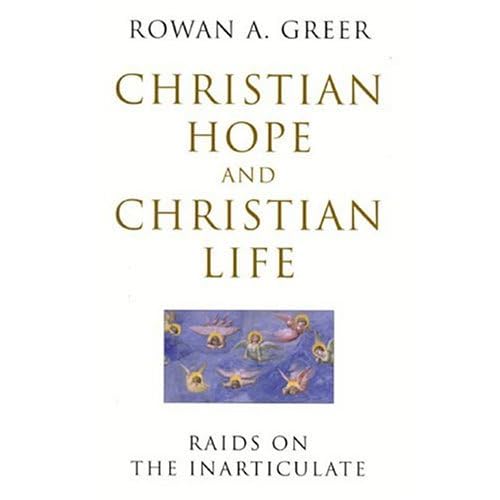
BTW, I mention Rowan Greer in this sermon. I highly recommend his book Christian Hope and Christian Life: Raids on the Inarticulate. In it he explores Christian Hope (Eschatology) in particular as it manifests in two broad traditions of thought. He spends a lot of time with some of the Patristic Fathers and has a patience for understanding the mindset of others that is beautiful to behold.
What is the destiny of the human soul in this life and the next? Dare we hope to “see God face to face,” or will our vision of God remain forever filtered “through a glass, darkly”? In this remarkable volume, Rowan A. Greer turns to the New Testament, the church fathers, and later writers to throw light on their own visions of the human soul. He suggests that Augustine of Hippo and Gregory of Nyssa represent two distinct strands of Christian thinking that find expression later in writers such as John Donne and Jeremy Taylor. Greer, who has trained two generations of historians and theologians in the rich thought of the early church, has succeeded in writing a volume that is both full of original scholarly insight and, by virtue of his elegant writing, accessible to laypeople and non-specialists. (Publisher's blurb)
I see that he has a new book out, as well, about miracles and our perception of them: The Fear of Freedom. If I ever chew through my current reading list I'll make room for that one...
-t
Thursday, November 15, 2007
Do Pets go to Heaven?
Two events bring this question to mind right now. First, I'm working with an artist on creating a huge mural of the Kingdom of Heaven for our primary Sunday School room. Second, a friend's faithful dog is dying and so my buddies asked, joking, whether I would give him last rites.
The idea that the animal kingdom participates in the Divine life of God has never been much of a question. Like us, they are created and have their providential path here on earth. In the Bible you can find bunches of passages that reflect God's care for the animals. The Kingdom of Heaven is described in the Hebrew Bible (aka "the Old Testament") as a kind of perfected, heavenly ecology where wolves and lambs live together (Isaiah 11:6-9).
The New Testament's conception of heaven also includes notions of all created animals participating in the New Order:
But I think some of the best arguments to be made are inspired by St. Gregory of Nyssa, who believed that heaven was kind of perfected nature in which change (i.e. growth) and even ecology/order are maintained and transformed into their perfected versions in heaven. In other words, yes, there are pets in heaven.
-t
The idea that the animal kingdom participates in the Divine life of God has never been much of a question. Like us, they are created and have their providential path here on earth. In the Bible you can find bunches of passages that reflect God's care for the animals. The Kingdom of Heaven is described in the Hebrew Bible (aka "the Old Testament") as a kind of perfected, heavenly ecology where wolves and lambs live together (Isaiah 11:6-9).
The New Testament's conception of heaven also includes notions of all created animals participating in the New Order:
"Then I heard every living creature in heaven and on earth and under the earth and in the sea, and all that is in them, singing, "To the one seated on the throne and to the Lamb be blessing and honor and glory and might forever and ever!" And the four living creatures said, "Amen!" and the elders fell down and worshiped." (Rev. 5:13-14)
But I think some of the best arguments to be made are inspired by St. Gregory of Nyssa, who believed that heaven was kind of perfected nature in which change (i.e. growth) and even ecology/order are maintained and transformed into their perfected versions in heaven. In other words, yes, there are pets in heaven.
-t
Subscribe to:
Posts (Atom)