Here is one of the video that makes you feel better about what kind of beauty is still possible in an otherwise snarky and cynical age. One simply wonders how long it took for Miyoko Shida Rigolo to learn how to do this. Note the absolute silence that envelopes the crowd toward the end. One reason we admire the work is because we recognize how hard it is to creat, which does raise the interesting question: what about art that we perceive (fairly or not) as being "easy" to make?
Showing posts with label art. Show all posts
Showing posts with label art. Show all posts
Sunday, May 12, 2013


Tuesday, May 7, 2013
Vivian Maier
.jpg)
Sadly, she was destitute by the end of her life, but some of the children she had once taken care of as a nanny made sure she had a comfortable place to live and that her bills were paid. She was injured in a fall in 2008 and died in 2009. But the work remains--the children she helped raise but also these amazing photographs that give us a glimpse into urban American life in the 1950's and 60's.

Wednesday, November 18, 2009
Tabled

Check out this series of art installations intended to explore the sacrament of Communion. I love it when Emerging Church does these sort of explorations of aspects of Christianity that perhaps need a little bit of deconstruction! Mad props to Joe Manafo.
-t
Thursday, October 29, 2009
RIP Stephen Bélanger–Taylor

Stephen Bélanger–Taylor, the artist who created Messiah's famous East Window, passed away this summer. One of the Staff at the Diocesan Centre was sharp enough to notice and to pass this obituary on to me. It came just in time to help inspire my Dedication Day sermon:
Stephen Bélanger –Taylor died unexpectedly at this home outside Geraldine, New Zealand in mid July. He had been diagnosed with cancer last Fall, but after chemo and radiation treatments, was declared disease –free about 2 weeks before he died. His death was a result of a seizure he had in the night. The irony…..
As many of you may know, Stephen’s wife Denise is a glass blower. They built a beautiful hot and cold glass studio on their country property on the south island of New Zealand. Their two sons, Michael and Kevin live on the north island. Michael and his wife Donnelle have a son and they have just had twins, so Denise has some very concrete and life affirming diversions for the moment.
Born and raised in Britain, Stephen’s art education began at 15 when he won a scholarship to Wimbledon School of Art where he was introduced to stained glass and learned the skill of restoration. He then won a place at the Royal College of Art in London where he continued his study and apprenticeship of stained glass and glass painting.
He immigrated to Canada in 1968 after receiving a stained glass commission at St. James Cathedral in Toronto through Yvonne Williams’ Toronto stained glass studio. As we know, he went on to develop a significant career in Canada doing numerous liturgical and residential stained glass commissions throughout Ontario.
He took the tradition skill of glass painting to a new and contemporary level with the use of double and triple matt layers. His line work was definitive, simple, and elegant. His bold colour sense and organically abstracted landscape shapes blended to create windows with very strong presence.
A strong presence was also a trait of his personality. My first meeting with Stephen was in a studio he was using in downtown Toronto. He was working on a large painted liturgical commission. I was meeting with him to talk about the possibility of apprenticing with him. At this point I had been doing stained glass as a hobby, with no formal art training at all. I walked into a darkened room. The only light was what was coming through the painted glass on an incredibly large easel. Stephen was in front of the panel with a brush and mull stick in hand. It was a rather medieval scene. In lieu of a regular introduction, his first words were “So you want to do stained glass do you?” “Are you a masochist?’ That cackle laugh of his followed the question. He proceeded to give me a reading list 2 pages long, most of which were published in England and dealt with the esoteric, philosophical, artistic and technical aspects of the art of stained glass. I knew then that this was the teacher for me.
The depth of training he had had was of a level that hardly existed in Canada. His standards of professionalism around his work were very high. He was openly very critical of what he considered mediocre work presented as something more. He was often seen as arrogant and intimidating. In fact he was a shy man, with bold opinions, based on a standard of excellence that he had been trained for, an accomplished stained glass designer, an amazing builder and innovator in the technical construction of glass furnaces, a generous, gifted teacher, and a dedicated artist in the way he lived his life, a committed father and partner.
Some of his most notable works can be seen in Toronto at Church of the Holy Trinity (4 south windows), Church of the Messiah (East window), St. Luke’s Thornhill (South altar window), St. Michael’s All Angels (Etobicoke), and Picton Town Hall.
Along with his commission work, Stephen also taught and influenced many students at Humber and Georgian Colleges, lecturing at U of T and conducting private apprenticeship courses.
After spending time in New Zealand in the 1980’s and 90’s, Stephen established what would be a long creative working relationship with New Zealand artist Beverly Shore Bennett. He collaborated with her on many commission throughout New Zealand. This eventually led to the Belanger-Taylor family moving to New Zealand in 1995 where Stephen continued his glass career with much success.
The Window he created is probably my favourite piece of art in the whole church. It was created from the broken pieces of glass collected after the fire here in 1976. When I first saw it I thought of the Burning Bush motif, and I still that is one possible reading of the window, but actually he intended to express something about how God's Holy Spirit encounters humanity and we respond to that grace with praise.
-t
Monday, August 3, 2009
My Wife the Photographer

Betsy is finished with her language programme in Athens, so the second part of her trip (research) has begun. That means travelling, mostly by herself, all over Greece and into Macedonia (the part that is in the Former Republic of Yugoslavia, not the province in Greece). You can read about the details of her trip on her travel blog.
Before she left we bought her a second camera, a discrete little point-and-shoot canon sureshot along with a small tripod. It honestly seemed a little redundant to me to bring two digital cameras, but they have turned out to be very complementary. For instance, when visiting sites she has often given a friend her point-and-shoot while she takes charge of the DSLR. Also, there is a lot of sensitivity in some places about looking too professional when you are taking pictures of the art. In low light situations it simply isn't practical or advisable to try to set up the DSLR for a tripod shot. The point and shoot, on the other hand, can be deployed quickly and discretely.
She has been taking hundreds and hundred of pictures of churches like this one:

as well as some more artistic shots like this one:

I'm very proud and her and her pictures. I'm looking forward to seeing the rest of them when she returns...
-t
Monday, April 20, 2009
Conversion
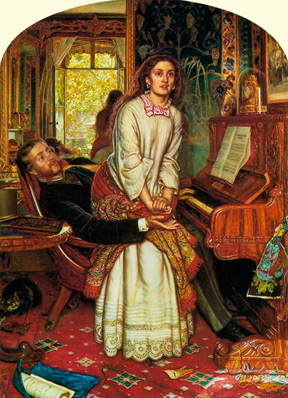
I saw this image in the AGO on Sunday: William Holman Hunt's The Awakening Conscience. It's a very famous painting from the Pre-Raphaelites.
The group challenged the artistic, political, social and religious values of the time. Taking subjects from history, literature and modern life, Hunt addressed gender relations, the crisis of faith and problems in the Middle East – difficult issues which have resonance for us today. The exhibition brings together more than 60 works, including Hunt's most famous paintings, The Awakening Conscience, The Light of the World and Isabella and the Pot of Basil. Also on view are costumes from the artist's studio, works on paper and historical documents. (source)
The story is that this "wayward" woman sitting on this dude's lap suddenly realized the error of her slutty ways while singing a sentimental song about the innocence of childhood. There are various cues to read that from the painting--for instance the clock in the painting is decorated with a depiction of "chastity binding cupid." Also note that she is wearing a ring on every finger except where a wedding ring would be.
Part of the backstory is that Hunt had a relationship with the woman he used as a model, and had hoped to convert her to faith. When the painting was originally exhibited it shocked victorian sensibilities (which is not hard to do) and the first owner convinced Hunt to "soften" the woman's expression--a work the painter was unable to complete before his death. The painting is ripe for analysis on many levels. For instance, while it seems to focus on the woman's sin in this relationship without necessarily giving any responsibility to the man, I think the focus on the woman's agency is important. We are invited to enter into her subjectivity, I think, and that's a good thing.
One writer commented that the picture can be read as a response to the even more famous The Light of the World. In other words, this the human response to Christ knocking on the soul's door. Pretty cool.
-t
Tuesday, February 3, 2009
Memories of New York--Lego Style
A very amusing article appears in the NYT by an artist--Christopher Neimann--living in Berlin but desperately missing New York City. He realized that he could represent lots of aspects of NYC life with his son's toys....


-t
-t
Wednesday, January 21, 2009
Atom Agoyan's "Adoration"
A few days ago Betsy and attended a special screening of Atom Egoyan's new movie Adoration. Egoyan is a Canadian film maker known for some remarkable films like Exotica (1994), The Sweet Hereafter (1997), and (my favorite of his so far) Ararat (2002). The screening was held at Innis College at the University of Toronto, where Egoyan is a Distinguished Visitor. He showed up after the screening to answer questions from the audience for about half an hour.
Like many of Egoyan's films, questions of identity as mediated by both history and the representation of history are front and centre. Egoyan is also very interested in how trauma is ritualized and socially processed.
This has obvious roots in Egoyan's biography--it was when he came to the U of T as an Undergrad that he began learning about his Armenian heritage and the legacy of the genocide. At the time Father Harold Nahabedian (also of Armenian heritage) was the Chaplain at Trinity College. Harold taught Egoyan the Armenian Alphabet and other cultural lessons, and Egoyan remembers that time fondly.
During the Q and A period I asked Egoyan about the relationship between his own experience of coming-of-age and the appearance of that theme in his work. He didn't really answer the question, but Betsy, my wife-the-art-historian, pointed out that artists rarely have good answers as to why they create certain things. It's part of the old "Fallacy of Authorial Intention" problem familiar to anyone who has studied critical theory. The better question is probably "how" they create. My sister Lynne used to interview a lot of artists, I bet she would back me up on that.
Here is the trailor for Adoration:
Good movie. Heavy on character study.
-t
Like many of Egoyan's films, questions of identity as mediated by both history and the representation of history are front and centre. Egoyan is also very interested in how trauma is ritualized and socially processed.
This has obvious roots in Egoyan's biography--it was when he came to the U of T as an Undergrad that he began learning about his Armenian heritage and the legacy of the genocide. At the time Father Harold Nahabedian (also of Armenian heritage) was the Chaplain at Trinity College. Harold taught Egoyan the Armenian Alphabet and other cultural lessons, and Egoyan remembers that time fondly.
During the Q and A period I asked Egoyan about the relationship between his own experience of coming-of-age and the appearance of that theme in his work. He didn't really answer the question, but Betsy, my wife-the-art-historian, pointed out that artists rarely have good answers as to why they create certain things. It's part of the old "Fallacy of Authorial Intention" problem familiar to anyone who has studied critical theory. The better question is probably "how" they create. My sister Lynne used to interview a lot of artists, I bet she would back me up on that.
Here is the trailor for Adoration:
Good movie. Heavy on character study.
-t
Tuesday, December 9, 2008
Children's Mural Article

The Anglican ran a short article about the mural in the Children's Chapel. The text isn't very readable, for some reason, in the image above. So here's the copy:
Mural brightens children’s space
Sunday School at Church of the Messiah in Toronto got more colourful in October, as mural artist Susannah Bleasby finished her transformation of the walls of the children’s chapel into a whimsical vision of God’s kingdoms in heaven and on earth. The painting includes animals, children, people, angels, saints, landscapes and
an expanse of blue sky and puffy clouds, with colours and style
chosen to appeal to young eyes.
“From the moment you walk into the children’s chapel, you can feel the excitement, youthful happiness and the power of Jesus Christ to make a difference in the
lives of children,” says church warden Brendan Caldwell.
The mural is part of the church’s investment in its ministry to children and families, along with the hiring earlier this year of Kerrie Fulton, director of Children’s and Youth Ministry. “Increasingly we find that churches have to invest
the effort to have some extraordinary ministry that defines them,” says the Rev. Tay Moss, incumbent.
“One of the things we believe God is calling us to is extraordinary mission to children and families.” The church will hold a dedication service for the children’s chapel on Dec. 7 at 3 p.m. (source)
Indeed, the dedication service with the bishop went very well and I'm pleased. I think the parish feels good about having accomplished such a thing, as well.
-t
Wednesday, September 24, 2008
Nantenbo Scroll Photos
As promised, here is a picture of that scroll by Nantenbo.

Interestingly, neither the dealer that sold the scroll to me (who is Japanese, btw) nor the dealer he bought it from (a specialist in scroll collecting) can read the script. Nantenbo was never very interested in making particularly legible characters; he was more interested in cultivating a kind of unstudied immediacy in his work. By comparing this work with others by the same artist, I think the characters in the upper left hand corner (next to the signature stamp) say "Daruma." Daruma (Sanskrit: Bodhidharma) is the saint who took Buddism from India to China. He's a popular motif in Zen art. That's him seated at the bottom of the scroll.

Daruma--the Patriarch of Chinese/Japanese Buddhism
The contrast between the quick, almost careless calligraphy at the top and the carefully executed Daruma at the bottom of the scroll is deliberate, obviously. Nantenbo was famous for his sense of humor and playfulness.
One of the stories about Daruma that fascinated Nantenbo goes like this: some time after arriving in China, Daruma was called before the Emperor. The Emperor asked, "What is your teaching?" Daruma replied: "Vast empiness; nothing sacred." Then he went away and spent nine years meditating facing a wall, speaking to no one. Nantenbo and other Zen Masters painted portraits of Daruma facing the wall. In this instance, it seems that we are the wall Daruma is facing. Nor does he seem particularly happy about that!
The composition of this portrait of Daruma also incorporates another important Zen motif: the Enso circle. It symbolizes "...enlightenment, strength, elegance, the universe, and the void"--in other words, everything. But what's most beautiful about the Enso in the moment of creating it. Drawing a circle free-hand is much more difficult than you might imagine, and the very task requires Zen-like presence. If you don't believe me, just try it!

Inside this Enso Nantenbo wrote:
Good stuff. I'm going to enjoy thinking about this scroll more.
-t
Interestingly, neither the dealer that sold the scroll to me (who is Japanese, btw) nor the dealer he bought it from (a specialist in scroll collecting) can read the script. Nantenbo was never very interested in making particularly legible characters; he was more interested in cultivating a kind of unstudied immediacy in his work. By comparing this work with others by the same artist, I think the characters in the upper left hand corner (next to the signature stamp) say "Daruma." Daruma (Sanskrit: Bodhidharma) is the saint who took Buddism from India to China. He's a popular motif in Zen art. That's him seated at the bottom of the scroll.

The contrast between the quick, almost careless calligraphy at the top and the carefully executed Daruma at the bottom of the scroll is deliberate, obviously. Nantenbo was famous for his sense of humor and playfulness.
One of the stories about Daruma that fascinated Nantenbo goes like this: some time after arriving in China, Daruma was called before the Emperor. The Emperor asked, "What is your teaching?" Daruma replied: "Vast empiness; nothing sacred." Then he went away and spent nine years meditating facing a wall, speaking to no one. Nantenbo and other Zen Masters painted portraits of Daruma facing the wall. In this instance, it seems that we are the wall Daruma is facing. Nor does he seem particularly happy about that!
The composition of this portrait of Daruma also incorporates another important Zen motif: the Enso circle. It symbolizes "...enlightenment, strength, elegance, the universe, and the void"--in other words, everything. But what's most beautiful about the Enso in the moment of creating it. Drawing a circle free-hand is much more difficult than you might imagine, and the very task requires Zen-like presence. If you don't believe me, just try it!
Inside this Enso Nantenbo wrote:
Born within the ensō of the world
the human heart must also
become an ensō
Good stuff. I'm going to enjoy thinking about this scroll more.
-t
Tuesday, September 23, 2008
Nantenbo

Yesterday I finally bought that Japanese Zen scroll I've been thinking about. It was written in 1918 or 1919 by a Buddhist priest named Nakahara Nantenbo. He was a colorful figure that served as an important bridge to 20th century Zen. Here's a bit about him:
"If I cannot become a priest of extraordinary accomplishment, I will not walk upon the earth," vowed eighteen-year-old Nantenbō (Tōjū Zenchū) to his Zen Master.' The impassioned spirit of this precocious young man was to burn brightly throughout his eighty-seven years. Not only did he rise through ecclesiastical ranks to an exalted position at one of the most prestigious Rinzai Zen monasteries in Japan, he was "a Zen priest of the people."' In his determination to restore Zen to its former purity and brilliance, he emulated the severe methods of legendary Zen masters from the distant past. The thick staff of nandina he used to "encourage" disciples and frighten "false priests" resulted in a great deal of notoriety, giving him the nickname Nantenbō (nandina staff). He also published ten volumes of Zen commentaries, headed numerous Zen study groups and, by his own estimate, brushed over one hundred thousand calligraphies and paintings, which he freely gave away to anyone brave enough to ask. Certainly his efforts helped maintain Zen during Japan's tumultuous modernization. By wielding the brush with unmitigated vigor, he also may have unwittingly exerted tremendous influence on twentieth-century "action" artists and avant-garde calligraphers."
This son of a Samurai attacked the scroll with unusual speed and energy. "Splash" marks at the beginning of his strokes are common, as are abbreviations and bold, dynamic movements.
I'll post a picture when I get a chance. It's not often that I get to collect a piece of fine art, so I'm very pleased about this acquisition--a real treat.
-t
Thursday, September 11, 2008
PhotoSynth of Hagia Sophia
This is a PhotoSynth created by National Geographic of Hagia Sophia
I love how this technology makes it so intuitive to visualize the thee-dimensional space.
-t
I love how this technology makes it so intuitive to visualize the thee-dimensional space.
-t
Friday, September 5, 2008
Art from Articles
I had trouble getting to sleep last night. It was a little warm in our bedroom, I suppose. But since the weather is only going to get cooler from now on it doesn't make much sense to try to put the A/C in. Interestingly, our new bedroom is much "warmer" feeling than the old one: probably because of the wall-to-wall carpet and the smaller size.
I finished that article for the Anglican. They are going to pay me this time, which is extra cool and definitely may motivate me to do another. I'm saving up to buy a piece of art for the new house. I have my eye on a gorgeous long Japanese Zen Bodhidharma scroll. I really like these type of scroll paintings. Here's a very nice version of the Heart Sutra:

And there are lots of beautiful landscapes and still-lifes, too. So that's something to look forward to.
The Mural is finished! Yipee! Now we just have to plan for the official unveiling.
The sound system at the church broke last Sunday. Luckily I believe I can get it repaired tomorrow. What it is it with church sound systems? So rarely are they done well. This one is in terrible shape and I'm surprised it lasted this long!
-t
I finished that article for the Anglican. They are going to pay me this time, which is extra cool and definitely may motivate me to do another. I'm saving up to buy a piece of art for the new house. I have my eye on a gorgeous long Japanese Zen Bodhidharma scroll. I really like these type of scroll paintings. Here's a very nice version of the Heart Sutra:
And there are lots of beautiful landscapes and still-lifes, too. So that's something to look forward to.
The Mural is finished! Yipee! Now we just have to plan for the official unveiling.
The sound system at the church broke last Sunday. Luckily I believe I can get it repaired tomorrow. What it is it with church sound systems? So rarely are they done well. This one is in terrible shape and I'm surprised it lasted this long!
-t
Wednesday, August 20, 2008
A Sneak Peak at the Mural
Here is a close-up of God the Father in the Mural underway at COTM...

Notice that He's wearing a cross. Susy (the artist) and I are discussing whether this is good or not. She says in "feels right" because she always imagines God and the cross together. Others have suggested that for humans the cross is a symbol of hope but for God is a symbol of suffering. It's a deep question, theologically: what is God's relationship to the cross?
-t

Notice that He's wearing a cross. Susy (the artist) and I are discussing whether this is good or not. She says in "feels right" because she always imagines God and the cross together. Others have suggested that for humans the cross is a symbol of hope but for God is a symbol of suffering. It's a deep question, theologically: what is God's relationship to the cross?
-t
Saturday, August 2, 2008
More Pictures from Istanbul Adventures


Thursday, July 31, 2008
The Chora
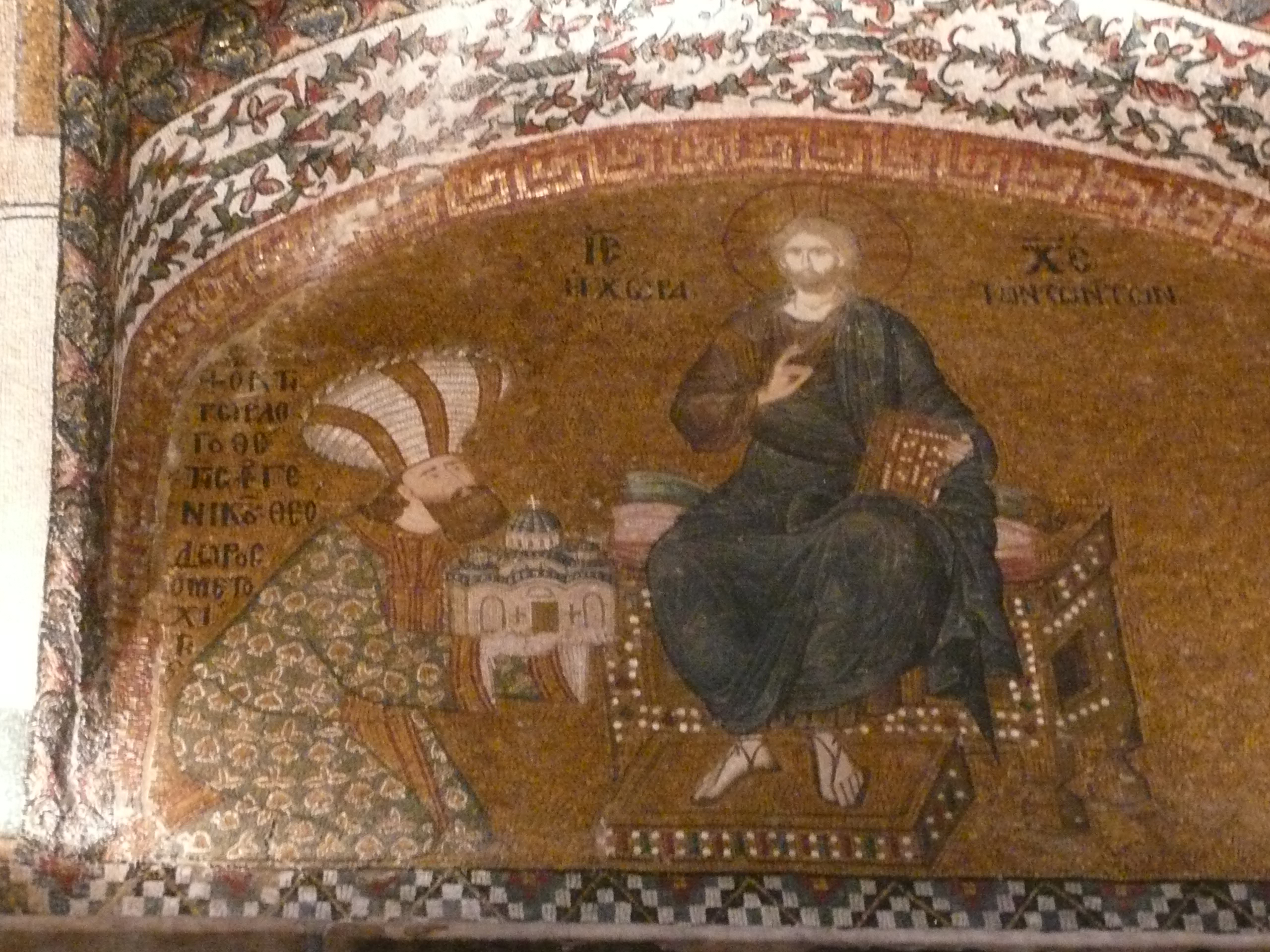
Today we saw Chora Church (pronounced "whore-ah")--also known as Kariye Camii. The name "Chora" is really just the last word of the formal greek title for the church: ἡ Ἐκκλησία του Ἅγιου Σωτῆρος ἐν τῃ Χώρᾳ (i.e.: the Church of the Holy Saviour in the Country). "Chora" means country. This church was located outside the walls built by Constantine (but was later enveloped by the growing city and the Theodosian walls built to protect the enlarged metropolis). The original church was built in the 5th century, but it went through several revisions (some necessitated by earthquakes, etc.). The most impressive parts of the current structure, including the elaborate mosaics and frescoes, were built in the 14th century. The man responsible for them, Theodore Metochites, was a rare man gifted academically and politically. He was the Byzantine equivalent of the Prime Minister at the height of his power, but then a regime change brought about his exile. He was allowed to return to Constantinople having promised to stay out of politics and be a monk at the Chora. This he did. In his last years he wrote that he hoped the Chora Church would secure his legacy until the end of the ages. It just might.
Impressive mosaics, frescos, and marble work fill the place--and yet so much is lost from it's Byzantine glory. We took a ton of pictures, but it's late and I need to get to bed. I'll just wrap up by saying that I'm enjoying this city more and more as I stay here. The place is electric with energy and vibrant in a dozen ways. Just walking down the streets is exhilarating.
-t
Wednesday, July 30, 2008
Turkish Carpet


-t
Friday, May 30, 2008
Lost
The season finale for "Lost" was last night. It was satisfyingly opaque. The show catches part of the modern spiritual zeitgeist: a group of strangers stuck in a bewildering environment that is both physically and spiritually threatening.
But it doesn't collapse into nihilism--on the contrary, actions in the world of "Lost" have moral weight and meaning. In fact, the show's fascination with meaning and consequence is what drives the drama.
There is a theology undergirding "Lost" that deserves some Christian critique. Redemption does happen on the island, but it is usually earned rather than a gift of free grace. Yet this world is highly providential ("fate" comes up a lot) and one gets the sense that the characters are being constantly challenged to grow beyond themselves.
One of these days I should search the Web for sermons about "Lost"--I'm sure there's more than a few out there.
-t
“Lost” is, in some sense, in the dark business of exploring just how futile the modern search for peace, knowledge, recovery or profit really is. The failure of people to combat their most debilitating weaknesses is one of the show’s most compelling themes. In the recent flash-forwards to the survivors’ post-marooned lives, we see Jack drinking; his girlfriend, Kate, living a lie; Hurley lost to bizarre superstition. At the same time, Sayid, a former member of the Iraqi Republican Guard, is avenging his wife’s death as a killer for hire and, so we must assume, failing to find redemption. (source)
But it doesn't collapse into nihilism--on the contrary, actions in the world of "Lost" have moral weight and meaning. In fact, the show's fascination with meaning and consequence is what drives the drama.
There is a theology undergirding "Lost" that deserves some Christian critique. Redemption does happen on the island, but it is usually earned rather than a gift of free grace. Yet this world is highly providential ("fate" comes up a lot) and one gets the sense that the characters are being constantly challenged to grow beyond themselves.
One of these days I should search the Web for sermons about "Lost"--I'm sure there's more than a few out there.
-t
Thursday, November 29, 2007
Random Notes from Today
It's only 3:30 and I'm already feeling exhausted. Lots going on today--but it felt productive and that's good. One needs to feel productive in their work, sometimes.
Highlights include arranging the space into it's Advent configuration. I got most of it done by myself in 35 minutes. The final touches (moving the altar off the raised Chancel area) only took another 10 or 15 minutes with the help of another guy. It looks great. Predictably, it gets faster each time I do it.
Susy Bleasby stopped by with the first sketches of our proposed mural project for the kid's room upstairs. It looks very good, and we had one of those fun conversations about what the kingdom of heaven might look like. I'm looking forward to the next round of drawings.
I noticed this article in the New York Times about a movement among Jews in the 20's and 30's. It sounds a lot like the Emerging Church movement in Christian Faith. I think these movements are really critical to understanding the future of religion and spirituality in North America.
The kitten, BTW, is doing brilliantly. It's amazing to actually watch him learn how to do the most basic cat things. He's still missing some jumps, for example, and falling off of stuff when he gets to carried away. And it was wonderful comfort to have them around after some of the bad days we've been having lately.
I had a very intense prayer experience this morning. Sometimes it is really nice to surrender to the liturgy and let it do what it do. zone of the nice things about belonging to a tradition that likes to take prayers from books (BCP/BAS/etc) is that we can surrender the burden of being o-so-clever with God. Why make it up fresh everytime when others have done in better in the past? So even when I'm being liturgically "creative" (as with this Sunday upcoming) I'm still basing everything on ancient and well-used rites. This Sunday we are doing aspergance, the Great Litany, and then a pretty standard modern language Eucharist after that. I'm thrilled.
-t
Highlights include arranging the space into it's Advent configuration. I got most of it done by myself in 35 minutes. The final touches (moving the altar off the raised Chancel area) only took another 10 or 15 minutes with the help of another guy. It looks great. Predictably, it gets faster each time I do it.
Susy Bleasby stopped by with the first sketches of our proposed mural project for the kid's room upstairs. It looks very good, and we had one of those fun conversations about what the kingdom of heaven might look like. I'm looking forward to the next round of drawings.
I noticed this article in the New York Times about a movement among Jews in the 20's and 30's. It sounds a lot like the Emerging Church movement in Christian Faith. I think these movements are really critical to understanding the future of religion and spirituality in North America.
The kitten, BTW, is doing brilliantly. It's amazing to actually watch him learn how to do the most basic cat things. He's still missing some jumps, for example, and falling off of stuff when he gets to carried away. And it was wonderful comfort to have them around after some of the bad days we've been having lately.
I had a very intense prayer experience this morning. Sometimes it is really nice to surrender to the liturgy and let it do what it do. zone of the nice things about belonging to a tradition that likes to take prayers from books (BCP/BAS/etc) is that we can surrender the burden of being o-so-clever with God. Why make it up fresh everytime when others have done in better in the past? So even when I'm being liturgically "creative" (as with this Sunday upcoming) I'm still basing everything on ancient and well-used rites. This Sunday we are doing aspergance, the Great Litany, and then a pretty standard modern language Eucharist after that. I'm thrilled.
-t
Wednesday, November 28, 2007
Stuart Reid
I came across this artist, Stuart Reid, who worked with St. John's, West Toronto, on their interior repainting. His work is stunning in both the content and the shear breadth of disciplines he has covered.
-t
-t
Subscribe to:
Posts (Atom)