A Shruti Box is a classical Indian musical instrument which sustains a constant drone of a combination of user-set notes. In other words, you select which pitches you want in your drone, then you start pumping the Shruti and it sustains a constant drone at the specified intervals. It's a lot like a Harmonium, except that instead of keys it simply has little covers over each of the reed holes. You open the holes corresponding the pitches you want played.
The Shruti is useful for many different applications. They are useful in performance, especially because they lay down a kind of carpet on which a singer or instrumentalist can lay down something special. They are also useful for practice since you can, for instance, set the Shruti to drone the home-tone of a chant you are playing with. As you improvise and play around you can simultaneously hear how you sound against your musical home base.
I was was first introduced to the Shruti by the St. Gregory of Nyssa folks. They love a good drone! It's easy to get such a sound out of a congregation, but you can also simulate a Shruti with a pipe organ pretty easily (you just need something or someone to hold the right keys down).
Of course, there is also an iPhone app for that. And they sound surprisingly good. You just need to have a sound system to hook up to your iPhone (or iPod Touch) and you've got yourself an instant Shruti box! Here is an example of what the Shruti sounds like. This musician will play over the top of it with a Hang Drum, which is a whole post in its own right!
-t
Showing posts with label St. Greg's. Show all posts
Showing posts with label St. Greg's. Show all posts
Sunday, January 31, 2010


Friday, January 29, 2010
Extemporaneous Eucharistic Prayers
Of course I'm a liturgy nerd. I care a great deal about what we pray and how we pray. Like many Episcopal Priests, I was "raised" to think that great precision is required when praying the Eucharistic Prayer. God help you (literally) if you say it wrong. The magic won't happen! Jesus will flee your feast!
So I find it impressive when people can extemporaneously pray the Eucharistic prayers and hit all the right points. There is an ancient precedent for this: the Mozarabic Rite. It requires a deep understanding, in my humble opinion, of the Eucharistic prayers to do it well, but it is certainly within the capacity of most priests who put their mind to it. The so-called Rite III liturgy in the American Prayerbook (1979 BCP 402ff) gives the presiding priest great discretion in how the Eucharistic Prayer is to be said, but still specifies the words for the Institution Narrative and a few other parts. Of course, the Rite III rubrics insist that it should not be used during the principal Sunday service of the community.
Certainly doing a Eucharistic Prayer off-the-cuff is stretching the bounds of what is "Anglican"--but that's perhaps what interests me about it. I see great potential for relational liturgy in the immediacy of such a prayer. It's the same principle as what happens when one learns to preach without notes or improvise of the organ.
I happen to enjoy broad episcopal permission when it comes the Contemplative Eucharists that I do on Wednesday morning and Saturday afternoon. Further, the Archbishop has told us (priests) that we "have the keys to the family car--just don't wreck it." So in that spirit I've been trying my hand at extemporaneous eucharistic prayers at my Contemplative Eucharists. The group that comes appreciates it. I find that it requires even more concentration and preparation than what I used before, which is even more than what it required to a regular BCP/BAS Mass!
To prepare for it, I think you need a couple of years of saying the Eucharist out of the prayerbooks. To this end, saying the daily masses at St. Mary Magdalene's was great training. It's like the 10,000 hours concept of Malcome Gladwell--you need to spend about 10,000 hours saying the Mass to master it. Maybe I haven't wracked up that much time, perhaps I've got about 3 or 4 thousand hours, though? You should have a few of rites basically memorized from repetition.
Then, you need to have a real command over the different parts of the Eucharistic prayers. You need to know what they are and why they are there.
Next, and perhaps most importantly, you need to be right with your personal sacramental prayer life. I mean that you need to be really confident in your own skin as a priest doing the thing priests do. So... that's my advice about that.
Now, here is an example of Rick Fabian (best known from St. Gregory of Nyssa fame) presiding at the Eucharist that ended our Music That Makes Community Conference in Atlanta a few months ago. Note that both the words and the music were made-up on the spot. We sing a Sanctus at the end in a paperless-style, but it wasn't our first time hearing/singing that particular song.
Now, there is a lot of craft in doing this well. For one thing, notice that Rick has a particular pattern in mind for how is going to chant the text. He is basically going up and a down a scale. Also, he has an idea in his head of the shape of the eucharistic prayers. He knows where is beginning from and where he is ending. He also knows some of the points he wants to hit along the way: thanksgiving for creation, rehearsing salvation history, the institution narrative, the epiclesis, etc.
BTW, I like the way Rick says "whores." It's a nice, sharp moment in the flow of the prayer.
I was never taught how to pray this way. I wasn't ready for it in seminary, anyway. These are advanced teachings. But it's definitely worth sharing because the spiritual results can be breath taking!
-t
So I find it impressive when people can extemporaneously pray the Eucharistic prayers and hit all the right points. There is an ancient precedent for this: the Mozarabic Rite. It requires a deep understanding, in my humble opinion, of the Eucharistic prayers to do it well, but it is certainly within the capacity of most priests who put their mind to it. The so-called Rite III liturgy in the American Prayerbook (1979 BCP 402ff) gives the presiding priest great discretion in how the Eucharistic Prayer is to be said, but still specifies the words for the Institution Narrative and a few other parts. Of course, the Rite III rubrics insist that it should not be used during the principal Sunday service of the community.
Certainly doing a Eucharistic Prayer off-the-cuff is stretching the bounds of what is "Anglican"--but that's perhaps what interests me about it. I see great potential for relational liturgy in the immediacy of such a prayer. It's the same principle as what happens when one learns to preach without notes or improvise of the organ.
I happen to enjoy broad episcopal permission when it comes the Contemplative Eucharists that I do on Wednesday morning and Saturday afternoon. Further, the Archbishop has told us (priests) that we "have the keys to the family car--just don't wreck it." So in that spirit I've been trying my hand at extemporaneous eucharistic prayers at my Contemplative Eucharists. The group that comes appreciates it. I find that it requires even more concentration and preparation than what I used before, which is even more than what it required to a regular BCP/BAS Mass!
To prepare for it, I think you need a couple of years of saying the Eucharist out of the prayerbooks. To this end, saying the daily masses at St. Mary Magdalene's was great training. It's like the 10,000 hours concept of Malcome Gladwell--you need to spend about 10,000 hours saying the Mass to master it. Maybe I haven't wracked up that much time, perhaps I've got about 3 or 4 thousand hours, though? You should have a few of rites basically memorized from repetition.
Then, you need to have a real command over the different parts of the Eucharistic prayers. You need to know what they are and why they are there.
Next, and perhaps most importantly, you need to be right with your personal sacramental prayer life. I mean that you need to be really confident in your own skin as a priest doing the thing priests do. So... that's my advice about that.
Now, here is an example of Rick Fabian (best known from St. Gregory of Nyssa fame) presiding at the Eucharist that ended our Music That Makes Community Conference in Atlanta a few months ago. Note that both the words and the music were made-up on the spot. We sing a Sanctus at the end in a paperless-style, but it wasn't our first time hearing/singing that particular song.
Now, there is a lot of craft in doing this well. For one thing, notice that Rick has a particular pattern in mind for how is going to chant the text. He is basically going up and a down a scale. Also, he has an idea in his head of the shape of the eucharistic prayers. He knows where is beginning from and where he is ending. He also knows some of the points he wants to hit along the way: thanksgiving for creation, rehearsing salvation history, the institution narrative, the epiclesis, etc.
BTW, I like the way Rick says "whores." It's a nice, sharp moment in the flow of the prayer.
I was never taught how to pray this way. I wasn't ready for it in seminary, anyway. These are advanced teachings. But it's definitely worth sharing because the spiritual results can be breath taking!
-t
Sunday, November 8, 2009
Music that Makes Community: Come light of lights
Emily Scott leading "Come Light of Lights" on Friday at the "Music that Makes Community" conference that Eric and I attended. Note how little direction she uses--real economy of communication greatly facilitates leading this kind of music.
-t
-t
Saturday, November 7, 2009
Home
What a week. I was at the College of Preachers Monday, Tuesday, and Wednesday. Then Wednesday night I flew to Atlanta. Thursday, Friday, and Saturday I was at the Music that Makes Community Conference with my Minister of Music. It was an exhilarating, but exhausting. I flew back this evening and have church in the morning. Sunday afternoon and Monday I expect to be nearly useless.
Did I learn much? Of course! Spending three days working of preaching was very worthwhile. Really it was a "Master Class" in preaching. It was also neat to reconnect with Lillian Daniel, whom I met at Yale when I was there. She would come in and give guest lectures on preaching. The topic for the three days was the use of personal narrative in preaching. Of course, I already do a fair amount of this, but it was still worth working on with the group.
It Atlanta we studied "Paperless Music"--which is the recovery and use of methods to get congregations and groups singing without relying on the congregation having music-in-hand. In other words, using techniques like call-and-response, echo (lining hymns), and so forth. There are many advantages to using this kind of music in worship, which you'll hear about later!
So it was three days of working on how to lead (and compose) this kind of music. It was a lot of fun. Great to catch up with some friends from All Saint's Company like Donald, Rick, Marilyn, Emily, and Scott. I knew Emily at Yale, so that's other Yale Divinity School connection this week. We sang and sang and sang. Worthwhile, and I have more to say about it later.
Right now, time to go to bed!
-t
Did I learn much? Of course! Spending three days working of preaching was very worthwhile. Really it was a "Master Class" in preaching. It was also neat to reconnect with Lillian Daniel, whom I met at Yale when I was there. She would come in and give guest lectures on preaching. The topic for the three days was the use of personal narrative in preaching. Of course, I already do a fair amount of this, but it was still worth working on with the group.
It Atlanta we studied "Paperless Music"--which is the recovery and use of methods to get congregations and groups singing without relying on the congregation having music-in-hand. In other words, using techniques like call-and-response, echo (lining hymns), and so forth. There are many advantages to using this kind of music in worship, which you'll hear about later!
So it was three days of working on how to lead (and compose) this kind of music. It was a lot of fun. Great to catch up with some friends from All Saint's Company like Donald, Rick, Marilyn, Emily, and Scott. I knew Emily at Yale, so that's other Yale Divinity School connection this week. We sang and sang and sang. Worthwhile, and I have more to say about it later.
Right now, time to go to bed!
-t
Tuesday, September 15, 2009
Thoughts from a Tuesday
A busy day that started with some e-mails and phone calls and then the Trad Com (BCP Communion) service at Messiah. I regretted not transferring the Feast of Holy Cross to a Sunday, but at least I was able to transfer it to today! Not surprisingly, I had plenty to preach about on the Patronal Feast of OHC! A pleasant lunch with some of my parishioners followed.
In the early afternoon I drove down to Diocesan HQ for a meeting related to the Back to Church Sunday initiative. Bishop Poole was leading the meeting, but Bishop Johnson did stop by briefly to share some thoughts about the project. I couldn't help noticing that he was wearing a really flattering suit. And I admit thinking, "I wonder how many suits he had to buy when he became bishop?" Lol. He also shared that a new grand child was to be born immanently. Good for him.
After the meeting it was back to Messiah for a staff meeting. It went longer than usual, which I should have anticipated given that Eric is new on staff and it's the beginning of the church's programme year. We prayed briefly, then we debriefed last Sunday and planned for the next. Much of our time ended up focusing on the Confirmation Service/Bishop's Visitation/Back-to-Church Sunday marathon that will be September 27th! Now we've added a bouncy castle. Because everybody loves the bouncy castle! We also beginning to talk about the Christmas Pageant (yeah, really!).
In November Eric is going to the "Music that Makes Community Conference" in Atlanta. I've talked about paperless singing on this blog from time-to-time, and these conferences put on by the All Saints Company (the people that gave the world St. Gregory of Nyssa, San Francisco) are the place to go to learn about that. I'm thrilled that Eric is going. In fact, he wanted to go long before he was called to COTM. It's a three day conference/workshop teaching the techniques of so-called "paperless singing." It's a method of congregational worship that recovers much older methods of making music in community. It uses techniques like call-and-response, lining, rounds, etc. to get a congregation singing together. Inevitably it feels much more organic, free, and intimate than head-in-hymnal, everybody-follow-the-organ, style singing.
Needless to say, I'd love to go to this conference. The only problem is that the same week I'm going to this year's Preaching College at St. Clement's. This is an invitation-only intensive four-day workshop for preachers. I'm wondering whether I can miss the last half-day and take the red-eye to Atlanta? The other option is to attend the same conference a few months later in January in San Francisco. I love San Francisco--but at that point I'll have a new baby at home and (probably) no desire to travel! Besides, there is a nice synergy that will happen if Eric and I are BOTH at the same conference. I had such a blast the last time I went to an All Saints Company conference, I'd love to share that with one (or more) of my worship staff.
One of the things I love about Eric that we have a shared language for talking about liturgy. I have yet to come up with anything (a term, a hymn, a resource, anything) that he doesn't know about. I suspect he may have a better liturgical library than I do! Going to a conference like this will only take that shared language to the next level: shared experience!
So I'm trying to figure out how to make that trip work!
Lots of other challenges at work. Many of which I just can't talk about for obvious reasons. Suffice it to say, my plate is full.
Meanwhile, Betsy's belly is getting bigger. She's feeling great except for a little bit of joint soreness in her hips. She's been getting good advice via Facebook about that. We are both reading and studying pregnancy stuff like the nerds we are!
The weather in Ontario is starting to turn cool. It makes me think about the need to schedule a firewood delivery and do more canning. Maybe we'll get the farmer's market again this weekend...
-t
In the early afternoon I drove down to Diocesan HQ for a meeting related to the Back to Church Sunday initiative. Bishop Poole was leading the meeting, but Bishop Johnson did stop by briefly to share some thoughts about the project. I couldn't help noticing that he was wearing a really flattering suit. And I admit thinking, "I wonder how many suits he had to buy when he became bishop?" Lol. He also shared that a new grand child was to be born immanently. Good for him.
After the meeting it was back to Messiah for a staff meeting. It went longer than usual, which I should have anticipated given that Eric is new on staff and it's the beginning of the church's programme year. We prayed briefly, then we debriefed last Sunday and planned for the next. Much of our time ended up focusing on the Confirmation Service/Bishop's Visitation/Back-to-Church Sunday marathon that will be September 27th! Now we've added a bouncy castle. Because everybody loves the bouncy castle! We also beginning to talk about the Christmas Pageant (yeah, really!).
In November Eric is going to the "Music that Makes Community Conference" in Atlanta. I've talked about paperless singing on this blog from time-to-time, and these conferences put on by the All Saints Company (the people that gave the world St. Gregory of Nyssa, San Francisco) are the place to go to learn about that. I'm thrilled that Eric is going. In fact, he wanted to go long before he was called to COTM. It's a three day conference/workshop teaching the techniques of so-called "paperless singing." It's a method of congregational worship that recovers much older methods of making music in community. It uses techniques like call-and-response, lining, rounds, etc. to get a congregation singing together. Inevitably it feels much more organic, free, and intimate than head-in-hymnal, everybody-follow-the-organ, style singing.
Needless to say, I'd love to go to this conference. The only problem is that the same week I'm going to this year's Preaching College at St. Clement's. This is an invitation-only intensive four-day workshop for preachers. I'm wondering whether I can miss the last half-day and take the red-eye to Atlanta? The other option is to attend the same conference a few months later in January in San Francisco. I love San Francisco--but at that point I'll have a new baby at home and (probably) no desire to travel! Besides, there is a nice synergy that will happen if Eric and I are BOTH at the same conference. I had such a blast the last time I went to an All Saints Company conference, I'd love to share that with one (or more) of my worship staff.
One of the things I love about Eric that we have a shared language for talking about liturgy. I have yet to come up with anything (a term, a hymn, a resource, anything) that he doesn't know about. I suspect he may have a better liturgical library than I do! Going to a conference like this will only take that shared language to the next level: shared experience!
So I'm trying to figure out how to make that trip work!
Lots of other challenges at work. Many of which I just can't talk about for obvious reasons. Suffice it to say, my plate is full.
Meanwhile, Betsy's belly is getting bigger. She's feeling great except for a little bit of joint soreness in her hips. She's been getting good advice via Facebook about that. We are both reading and studying pregnancy stuff like the nerds we are!
The weather in Ontario is starting to turn cool. It makes me think about the need to schedule a firewood delivery and do more canning. Maybe we'll get the farmer's market again this weekend...
-t
Tuesday, March 17, 2009
The Braided Leather Cord: Pleasure, Desire, and Gratitude
Donald Schell has a meditation worth reading on the Episcopal Cafe blog: "The Braided Leather Cord." He relates his experience of climbing a rope while on pilgrimage in Ethopia to need for soulful people to integrate pleasure, desire, and gratitude. A few choice passages:
Rope is a powerful image. It connects and binds and somehow manages to be both strong and flexible. In some circles wedding ceremonies now include a "binding" ceremony in which an intricate knot temporarily binds the couple to each other. This resonates with me more than the "unity candles" that you sometimes see.
I've always enjoyed playing with rope, even though my mother was afraid I would hang myself! I consider knot-tying to be one of those essential skills everyone should learn, like cooking, sewing, or changing a tire. It's a practical skill that comes in surprisingly handy in the parking lot of Ikea or when hanging a vinyl sign on the side of your church!
 It's a symbol we probably don't use enough in Christianity; consider that Jesus, that carpenter and friend of fisherman, probably knew more knots than most people, even in his culture. Ropes connect and give structure and allow us to move things and hold things. One of the things I find fascinating about St. Gregory of Nyssa's Church in San Francisco (the parish Donald co-founded) is the ropes that hold the oil lamps over the altar. They are thick, black, sturdy ropes that look like they could probably hold a person's weight. They go from the lamps to pulleys in the ceiling to cleats in the wall high enough to discourage kids from doing damage.
Anyway, that's what comes to mind when I think of ropes....
-t
Just as the three strands of interwoven flesh - animals’ skins - made a lifeline and a way of ascent, the sixth century Syrian monks who built Debra Damo, despite their fierce asceticism, confidently wove Pleasure, Desire, and Gratitude into a line sturdy enough to carry us up into God’s embrace. Most Christians of that time braided this same line.
....
But who is trying? For a single sermon commending pleasure or desire, we’ve probably heard twenty urging us to give or share because we ‘should be grateful.’ We’re in the grip of fearful Christian thinking from those bitter centuries that came to mistrust pleasure and desire.
...
Our pleasure delights God. Both giving us our daily bread and giving us Christ the bread eternal please God because both ordinary bread and Christ our living bread delight and pleasure us. We’re all of us the prodigal welcomed home to a Great Feast in OUR honor and for our pleasure. Receiving God’s vast blessings with pleasure moves us (makes us want or desire) to offer God our thanks. We’re in bolder and more paradoxical territory than ‘It is right to give God thanks and praise.’
....
The joy at bending knee and hip for prayer was so exhilarating that I refused to hold myself back, so went forward to kneel at the rail to receive communion, even though I wasn’t confirmed and knew I was breaking the rules to receive. This was an altar call I welcomed joyfully.
Finally had desire unlocked what was frozen. Desire hadn’t let me rest, and in the end it moved me to a path I’m still pursuing. Gregory of Nyssa in his Commentary on the Song of Songs says that we are most like God in our infinite desire.
....
[That] Sunday [my wife and I] started ballroom dancing lessons. For three years we hardly missed a week. Week by week for three years, we danced our way to deeper understanding and love. Learning to dance together was as deep as any conversation we’d ever had.
There’s the three braid strand - pleasure, desire, and gratitude. I started this reflection with pleasure. Braiding, each is equally essential. I might have told other stories if I’d begun with desire or gratitude, but once braiding has begun, each is line is important in turn, and as Christians of the first centuries knew, together they carry us to Life. (source)
Rope is a powerful image. It connects and binds and somehow manages to be both strong and flexible. In some circles wedding ceremonies now include a "binding" ceremony in which an intricate knot temporarily binds the couple to each other. This resonates with me more than the "unity candles" that you sometimes see.
I've always enjoyed playing with rope, even though my mother was afraid I would hang myself! I consider knot-tying to be one of those essential skills everyone should learn, like cooking, sewing, or changing a tire. It's a practical skill that comes in surprisingly handy in the parking lot of Ikea or when hanging a vinyl sign on the side of your church!
 It's a symbol we probably don't use enough in Christianity; consider that Jesus, that carpenter and friend of fisherman, probably knew more knots than most people, even in his culture. Ropes connect and give structure and allow us to move things and hold things. One of the things I find fascinating about St. Gregory of Nyssa's Church in San Francisco (the parish Donald co-founded) is the ropes that hold the oil lamps over the altar. They are thick, black, sturdy ropes that look like they could probably hold a person's weight. They go from the lamps to pulleys in the ceiling to cleats in the wall high enough to discourage kids from doing damage.
Anyway, that's what comes to mind when I think of ropes....
-t
Thursday, December 4, 2008
Donald Schell on Death
I would commend to you the recent article by Rev'd Donald Schell published on the Daily Episcopalian Blog. Donald is reflecting on the death of his father and how a good grief leads us to experience a certain finality in death:
Amen, brother. We must consume it and taste its bitterness. I'm so deeply grateful for all the patients whom I helped die when I was a chaplain. I learned so much from them. There is so much wisdom in death--it's sad so few of us are willing to "go there."
I'm reminded of words from the Hagakure: "Meditation on inevitable death should be performed daily." I've heard the Dalai Lama say pretty much the same thing, as does much of the Western spiritual canon. God knows the world gives us plenty of fodder for such meditations!
-t
One morning after my dad’s death, Ellen said that she was grateful that psalms said so plainly that death was death. It matched her experience of seeing my dad laid out on the floor after the paramedics had stopped CPR. He was gone. There was his body, but the life we’d known in that body, the man we’d loved was gone. ...
It’s not some irreducible, barely glimpsed idealized essence of my dad that escaped and flew free from the fires of the crematorium. He’s gone, what remains is ash, is dead as a doornail. And the whole of him, the hands I marveled at as a kid when he played Rachmaninoff’s B minor prelude, the face that looked so much like mine and which, in the pictures I’ve got still teaches me to smile, the courageous heart that managed to squeeze almost eighty-seven years of living from a terrifying beginning as a preemie in 1921 and scarlet fever a few years later, the whole of that good man was, is, and will be held in God’s love. I don’t know what it means or looks like but I trust it - God’s initiative, God’s creative embrace that won’t let one vibration of one atom that was him out of the old/new whole of God’s making. ...
The darkness, the abandonment, the devastation and decay and knowledge that we’re all just in remission and each of us alone faces a ‘moment of terror’ and ‘eternal dark’ must sink in, take hold, and be bitterly true. We’re none of us going to make out of this alive. None of us and nothing in us is any match for death. Nothing except the love of God. (source)
Amen, brother. We must consume it and taste its bitterness. I'm so deeply grateful for all the patients whom I helped die when I was a chaplain. I learned so much from them. There is so much wisdom in death--it's sad so few of us are willing to "go there."
I'm reminded of words from the Hagakure: "Meditation on inevitable death should be performed daily." I've heard the Dalai Lama say pretty much the same thing, as does much of the Western spiritual canon. God knows the world gives us plenty of fodder for such meditations!
-t
Thursday, June 5, 2008
Advice on Improv From Donald Schell
Donald Schell, former Co-Rector of St. Gregory of Nyssa and now Consultant and Creative Director of the All Saints Company, posted the following advice about improvising Gospel stories on a liturgy E-mail list-serve. I'm thinking that anything posted on a forum is fair game, so here's a repost:
Having participated in this kind of thing on several occasions even as a child, I can relate that it is very powerful and transformative work. I mean that it's not just pedagogically useful for conveying the content of the stories, but that it changes you as a person to participate.
If this kind of thing interests you, check out Systemic Constellations, which is a therapy methodology that takes advantage of the mysterious dynamics of drama to affect positive psychological change. I attended one such therapy session back when I was seminary and it was a real eye-opener. Sometime I'll do a long post to tell the remarkable story of that day. Suffice it to say that is not just psycho-bable: drama resonates with something deep in the human condition.
-t
I'm writing from Malawi, Africa where I'm spending three weeks assisting my wife's annual visit (she's international programs director for Global AIDS Interfaith Alliance). Through the wonders of wi-fi, I'm here reading this conversation. Responding to Margaret Lukens' reference to what we developed at Family Camp and Pamela's concern that it takes an auteur, I offer this description of a process for converting a Bible story into an improvised, participatory theater event where reflection on what people have done takes scripture into body memory.
I'm in the process of developing this as a replicable method, so am glad to answer questions, clarify, or pursue this in whatever detail would be helpful to anyone (and doing so will help my work as well). My only caveat is that I'm slower, at the moment, at email due to to travel -
The method doesn't work well with every Bible story. It takes a narrative that's more than just a conversation because the improvising structure is based on finding and communicating physical cues (blocking and gesture) in the text. Stories that work very, very well, so examples to hold in mind as you read through this would include the Prodigal Son, Zacchaeus, Jesus healing the blind man in John's Gospel (pretty substantial and a little long, but reach in physical detail), Mary Magadalene at the Tomb (John) and the double resurrection appearance in the upper room (John again). I've discovered John's Gospel stories (unlike the discourses) are remarkably rich in physical description of action, as though the writer had a dramatist's imagination, but any Gospel or other story with physical gesture and conflict and resolution can work.
Here's the description of the method as I've practiced it and begun teaching it - - -
1. read the story over several times (stories with a small to medium sized cast of characters work best and stories with real conflict work best).
2. find ANY physical (posture, touch, movement) cues embedded in the story (e.g. 'Mary Magdalene turned...' or 'Jesus reached out to touch...,' or 'Jesus knelt down to write in the sand...') The physical cues are the essential framework for the improv. (this is a powerful means for the 'preacher-director' to make discoveries including questions of possibly different interpretations in the text - for example, in the appearance to Thomas, does Thomas take Jesus's invitation to place his hands in the nail holes and in the wound in his side? Does he begin to make that gesture and then fall at Jesus' feet? And does Jesus leave him there or raise him up. These can be director's decisions or the director can frame them and leave them to the improvising actors, but I'm getting a little ahead of myself.
3. where the text offers choices about how to enact (does Jesus appear to Thomas in his sight or behind his back other disciples see him and he has to turn?) make a choice for directing the improvising actors. For this passage in John, I think it's interested to have Thomas first SEE the wonder on the face of the other disciples and then turn to face Jesus. If I'm making a choice that's not determined by the text, I tell people that as we're making the improvisation.
4. study the lines characters speak. Will the words work paraphrased or are there specific words or lines people need to get quite accurately for the story/enactment to make sense? in the later case, plan either to give people an index card (only when they need the line) or feed it to them a phrase at a time and have them repeat it.
that's the planning stage as I do it.
5. In the moment, read or narrate the story and then recruit volunteers from the congregation or group, usually starting with the least challenging roles ('I need three disciples of Jesus who will represent all twelve for us,' or 'we'll need four people to be a crowd of townspeople'), then moving on to more individual and challenging roles ('We'll need a Zacchaeus), to the roles that people might be initially reluctant to volunteer for - 'we'll need someone to be Jesus.') I nearly always find it works to trust who volunteers. I also do gender-blind and age-blind casting. Having a girl or woman play Jesus would be the most obvious example. Sometimes it's revealing and in parables, it's possible to adapt the story to the actors, e.g. the parable of the prodigal daughter or the prodigal son and the dutiful big sister.
6. talk them through the scene using the preparation work you've done ahead. This is something like a rehearsal. It may feel a little stiff, but discovery begins to happen (you'll see and feel it). When you've gone through the story beginning to end as an enactment ask the actors (and then the group) what they felt or saw (not 'thought'). Then invite group and then actors to provide other directorial choices and say, 'shall we try it that way?' and we do it again, concluding with a second conversation about what they felt or saw. Nearly always the second enactment takes on an sincerity, intensity and economy that is full of grace and discovery.
My goal is to get the text embodied and envisioned rather than interpreted. It's more wild and alive that way and stays with people (learning continues past the liturgical or teaching event).
I'm glad to offer clarification or addition to any of this.
love,
donald
Having participated in this kind of thing on several occasions even as a child, I can relate that it is very powerful and transformative work. I mean that it's not just pedagogically useful for conveying the content of the stories, but that it changes you as a person to participate.
If this kind of thing interests you, check out Systemic Constellations, which is a therapy methodology that takes advantage of the mysterious dynamics of drama to affect positive psychological change. I attended one such therapy session back when I was seminary and it was a real eye-opener. Sometime I'll do a long post to tell the remarkable story of that day. Suffice it to say that is not just psycho-bable: drama resonates with something deep in the human condition.
-t
Tuesday, January 29, 2008
Aaron
I really love what they did with the classic vestry mirror. This is where us clergy love to look at our pretty selves all dressed up for the party. At St. Gregory's they etched the poem below into the mirror to use as the "Vesting Prayer" they say before every service...
Nice, heh? Beats the heck out of the traditional vesting prayers. I used the old ones for a few years (even before serving at the Anglo-Catholic St. Mary Mag's), but find the theology to be somewhat out of synch with where I am now (a bit too donatist). So lately I just make something up as I vest, but I really like the idea of etching the mirror with something like this....
-t
AARON.
HOLINESS on the head,
Light and perfection on the breast,
Harmonious bells below raising the dead
To lead them unto life and rest.
Thus are true Aarons drest.*
Profaneness in my head,
Defects and darkness in my breast,
A noise of passions ringing me for dead
Unto a place where is no rest :
Poor priest ! thus am I drest.
Only another head
I have another heart and breast,
Another music, making live, not dead,
Without whom I could have no rest :
In Him I am well drest.
Christ is my only head,
My alone only heart and breast,
My only music, striking me e'en dead ;
That to the old man I may rest,
And be in Him new drest.
So holy in my Head,
Perfect and light in my dear Breast,
My doctrine tuned by Christ (who is not dead,
But lives in me while I do rest),
Come, people ; Aaron's drest.
-George Herbert
Nice, heh? Beats the heck out of the traditional vesting prayers. I used the old ones for a few years (even before serving at the Anglo-Catholic St. Mary Mag's), but find the theology to be somewhat out of synch with where I am now (a bit too donatist). So lately I just make something up as I vest, but I really like the idea of etching the mirror with something like this....
-t
A Few Pictures
Here are a few of the hundred-some pictures I took during my time in San Francisco...
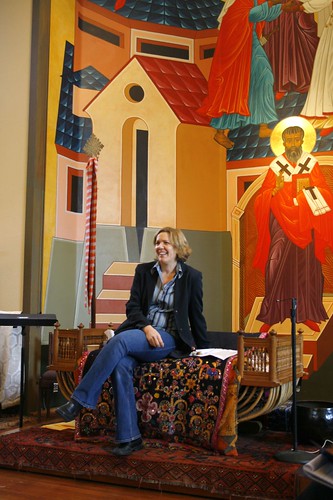
That's Sara Miles, who founded the St. Gregory's Food Bank, talking to us about the healing power of touch

Here's the Lectern at St. Greg's--
note the similarity to a Jewish Bimah
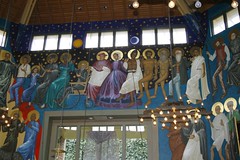
A few of the dancing saints...
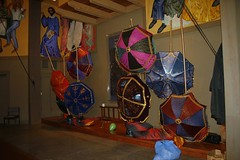
A display of some of their liturgical umbrellas
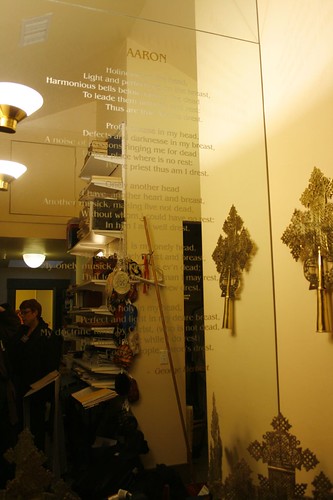
This the Vestry Mirror--
Note the poem "Aaron" by George Herbert etched in
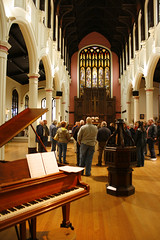
On a field trip to St. John's, Mission District--
note the lack of pews
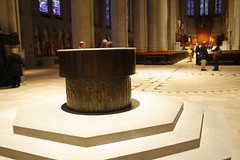
Field trip to Grace Cathedral
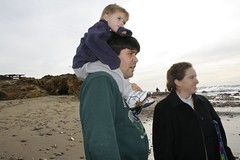
At the beach with some friends
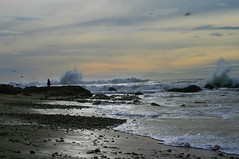
The ocean
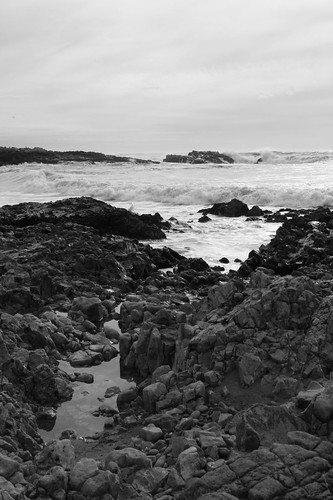
More ocean
That's Sara Miles, who founded the St. Gregory's Food Bank, talking to us about the healing power of touch
Here's the Lectern at St. Greg's--
note the similarity to a Jewish Bimah
A few of the dancing saints...
A display of some of their liturgical umbrellas
This the Vestry Mirror--
Note the poem "Aaron" by George Herbert etched in
On a field trip to St. John's, Mission District--
note the lack of pews
Field trip to Grace Cathedral
At the beach with some friends
The ocean
More ocean
Saturday, January 26, 2008
The Last Day
The conference wrapped up today. In the morning we met at Grace Cathedral to look at some of their worship spaces and talk about how they work and don't work. Side note, Grace has famously bad acoustics for speaking (huge reverb) and recently invested in a new sound system based on the same technology that I advocated for SMM--linear array speakers. They are so thin (about 3 inches) as to be virtually invisible against the columns, but thanks to sophisticated digital sound processing they create an incredibly articulate perception of the spoken word. I hear that SMM did get a new sound system, but I havedn't heard it.
Anway, after spending some time at Grace we went back to St. Greg's and experienced their famous food pantry first hand. They typtically distribute food to about 500 people, and what's really interesting is that this ministry supports itself entirely thanks to a few key gifts and low overhead. It's only costs about $1 per person, and they can raise that easily enough. so at this point they have used the extra money they raise to found 14 other food pantries throughout the city. It's an amazing story worth more desciprtion, but suffice it to say that they are clearly doing God's word and it's a beautiful to behold. The stories of how this ministry has changed people's lives can easily move you to tears to hear.
Afer that we spent time listening to each other talk about change how it can transform communtities in amazing ways. After that there was time to reflect as a group about what we had been through, and then it was over. Now I have another few days to enjoy SF and then it's back to Toronto. So much to share when I get there. These last few days have been amazing!
-t
Anway, after spending some time at Grace we went back to St. Greg's and experienced their famous food pantry first hand. They typtically distribute food to about 500 people, and what's really interesting is that this ministry supports itself entirely thanks to a few key gifts and low overhead. It's only costs about $1 per person, and they can raise that easily enough. so at this point they have used the extra money they raise to found 14 other food pantries throughout the city. It's an amazing story worth more desciprtion, but suffice it to say that they are clearly doing God's word and it's a beautiful to behold. The stories of how this ministry has changed people's lives can easily move you to tears to hear.
Afer that we spent time listening to each other talk about change how it can transform communtities in amazing ways. After that there was time to reflect as a group about what we had been through, and then it was over. Now I have another few days to enjoy SF and then it's back to Toronto. So much to share when I get there. These last few days have been amazing!
-t
Thursday, January 24, 2008
Improv
My friends are going through the rituals necessary to put their 3-year-old to bed, so I'll make some comments about the day.
Equipment I brought with me....
I know--I'm a nerd. But I'm a nerd who is coming back to Toronto with lots of material to share. For example, I recorded a fascinating talk about how to lead "paperless" congregational singing. This stuff is amazing to experience, and recording it will make it much easier to share with others!
Morning Prayer this morning was neat. I found singing the Gospel improvisationally be as amazing as I hoped. I was able to find an emotional center in some sections, and that is very cool to convey with voice.
We spent some time in our conference sessions working on improv. At one point we were put into small groups with the task of acting out short snippets of assigned Gospel stories--and we couldn't use words at all, not even as we planned what to do. The idea was to convey the emontional content of these stories without relying on traditional narrative. The results were stunning. I ended up playing the Good Samaritan, and as I collapsed to the ground having been struck, I had moment of really inhabiting that role.
From there we ended up doing some work around how to "land" your communications. That is, there is a subtle way in which an actor or preacher can "land" his words on the people in the congregation. This is the opposite of the kind of preaching where eye contact is considered a good embelishment of a act which is still really about conveyance of the written word. This is advanced teaching, and yet totally intuitive. I think it's something people respond to in my preaching even when the "understandings" I convey are not particularly profound or remarkable.
there is much more to say--I'll be reflecting on this trip for a long time, I think. Good thing I brought plenty of equipment to capture some of it.
-t
Equipment I brought with me....
- Video Camera
- Digital Camera
- Digital Audio Recorder
- GPS
- Cell Phone
I know--I'm a nerd. But I'm a nerd who is coming back to Toronto with lots of material to share. For example, I recorded a fascinating talk about how to lead "paperless" congregational singing. This stuff is amazing to experience, and recording it will make it much easier to share with others!
Morning Prayer this morning was neat. I found singing the Gospel improvisationally be as amazing as I hoped. I was able to find an emotional center in some sections, and that is very cool to convey with voice.
We spent some time in our conference sessions working on improv. At one point we were put into small groups with the task of acting out short snippets of assigned Gospel stories--and we couldn't use words at all, not even as we planned what to do. The idea was to convey the emontional content of these stories without relying on traditional narrative. The results were stunning. I ended up playing the Good Samaritan, and as I collapsed to the ground having been struck, I had moment of really inhabiting that role.
From there we ended up doing some work around how to "land" your communications. That is, there is a subtle way in which an actor or preacher can "land" his words on the people in the congregation. This is the opposite of the kind of preaching where eye contact is considered a good embelishment of a act which is still really about conveyance of the written word. This is advanced teaching, and yet totally intuitive. I think it's something people respond to in my preaching even when the "understandings" I convey are not particularly profound or remarkable.
there is much more to say--I'll be reflecting on this trip for a long time, I think. Good thing I brought plenty of equipment to capture some of it.
-t
Live From SF
I'm exhausted, so this will have to be a short post...
The conference is blowing my mind. It's about 40 energetic, creative, and bold folks from all over North America (Oklahoma, Vancouver, Indiana, New York, etc.). The content of the talks and the exercises are interesting enough, but then there is the Spirit in which we do them. It's incredibly inspiring and prayerful and playful and supportive. I have many stories to tell. It's revolutionizing my approach to some key aspects of the liturgy--but it will have to wait as I'm increibly tired and have to get up by 6 A.M. to make to Morning Prayer at St. Greg's. BTW, Morning Prayer is compeletely a lay initiative at St. Greg's. They have four to about fourteen people show up every morning to pray--how many parishes can claim that kind of corporate prayerfulness? And tomorrow I'm on to chant the Gospel lesson as the morning reading IMPROVISATIONALLY! We're not talking doing the stardard chant tones from the back of the Altar Book--we're talking about doing sometime much more free-flowing and expressive. And you know what, it feels really, really good. It's incredbily liberating to sing what you feel as you read the words and not be thinking at all about what you are "supposed" to be singing. This is something my voice teacher has been talking about for ages--chant as elevated speech.
Time for bed. It's all blessings. God is good, etc.!
-t
The conference is blowing my mind. It's about 40 energetic, creative, and bold folks from all over North America (Oklahoma, Vancouver, Indiana, New York, etc.). The content of the talks and the exercises are interesting enough, but then there is the Spirit in which we do them. It's incredibly inspiring and prayerful and playful and supportive. I have many stories to tell. It's revolutionizing my approach to some key aspects of the liturgy--but it will have to wait as I'm increibly tired and have to get up by 6 A.M. to make to Morning Prayer at St. Greg's. BTW, Morning Prayer is compeletely a lay initiative at St. Greg's. They have four to about fourteen people show up every morning to pray--how many parishes can claim that kind of corporate prayerfulness? And tomorrow I'm on to chant the Gospel lesson as the morning reading IMPROVISATIONALLY! We're not talking doing the stardard chant tones from the back of the Altar Book--we're talking about doing sometime much more free-flowing and expressive. And you know what, it feels really, really good. It's incredbily liberating to sing what you feel as you read the words and not be thinking at all about what you are "supposed" to be singing. This is something my voice teacher has been talking about for ages--chant as elevated speech.
Time for bed. It's all blessings. God is good, etc.!
-t
Tuesday, January 15, 2008
St. Paul's Chapel
Preparing for the conference next week, I came across this essay by Donald Schell (co-founder of St. Greg's, SF) about the recent "Music that Makes Community" conference at St. Paul's Chapel, Manhattan. St. Paul's has become a 9/11 shrine site that attracts many pilgrims, and the response of the place to this ministry is remarkable. Here's a quote from Donald's essay...
This notion of church as holy place of calm in the midst of swirling and sometimes confused pilgrims is a compelling manifestation of a usually invisible dynamic. I think it's an image for our age's version of urban ministry. Part of what really impresses me about what St. Paul's Chapel is doing right now is this thing about developing unique liturgical expressions that are relevant to their exact circumstances. I'm anxious to learn more about this musical style that is emerging there.
Wow, next week is going to be mind blowing. I can't wait to spend four days talking liturgy and leadership with some people that have real wisdom and experience. It's going to be fantastic!
-t
Last week that’s where twenty of us, clergy and church music leaders from around the country were making music, specifically developing a practice of the most traditional and modern kind of church music – singing we learn by ear and by heart, singing without books. All day our workshop sessions, our worship and even our mid-day meal was at the center of a swirling sea of people, all of America, the world. When we were singing we could feel the music touch them (and sometimes we forgot they were there and lost ourselves in music-making and praise). Sometimes we saw curiosity, joy or even healing on people’s faces. It came in swells, both for us and in their response. Sometimes they walked with their backs to us, continuing their quiet murmur of background conversation as they surveyed the 9/11 displays and the story of workers and a city who turned the terrorist attack into a sign of mutual support and courage. Then a piece of sacred song, something hearty or haunting, maybe some improvised bluesy jazz on a text from the Bible, or even our laughter at a shared discovery, something drew their attention and they were with us in church – both the community of people and the place of worship. So it went all day, hundreds of people an hour and flashes of grace and glory as our little group joined our Public Work to Trinity’s. (source)
This notion of church as holy place of calm in the midst of swirling and sometimes confused pilgrims is a compelling manifestation of a usually invisible dynamic. I think it's an image for our age's version of urban ministry. Part of what really impresses me about what St. Paul's Chapel is doing right now is this thing about developing unique liturgical expressions that are relevant to their exact circumstances. I'm anxious to learn more about this musical style that is emerging there.
Wow, next week is going to be mind blowing. I can't wait to spend four days talking liturgy and leadership with some people that have real wisdom and experience. It's going to be fantastic!
-t
Friday, January 4, 2008
I'm Going to San Francisco!
The Diocese mandates that I have to put aside (and eventually spend) a certain amount every year for Continuing Education. So this year I've decided to spend that money going to a conference in San Francisco. It's called "Leadership In Community: helping the people find their voice in the liturgy" and is being hosted/sponsored by St. Gregory of Nyssa Episcopal Church, which I've talked about a lot on this blog. I feel that I have a lot to learn from these people, so I think it will be a worthwhile investment of my time. Plus, SF is a kick-ass town and I can see some friends while I'm there. The conference runs from the 22nd to the 25th, but I'll probably take that Sunday off as my post-Christmas vacation (clergy get 1 week off after Christmas and then a month off in the summer).
This is one of those moments where I am just delighted that my life and ministry are turning out so well. Blessings, blessings, blessings.
But there is work to be done, too. This morning I had a meeting with some folks to look at some of the financial administration issues that need to be addressed. Some of it is compliance stuff, like making sure we get our books properly audited. Others have more to do with getting data flowing from A to B in a helpful way and planning how we are going to make up the 2008 budget. Most of the tasks to be done are straightforward, but it's just a matter of planning a course of action and implementing it.
-t
This is one of those moments where I am just delighted that my life and ministry are turning out so well. Blessings, blessings, blessings.
But there is work to be done, too. This morning I had a meeting with some folks to look at some of the financial administration issues that need to be addressed. Some of it is compliance stuff, like making sure we get our books properly audited. Others have more to do with getting data flowing from A to B in a helpful way and planning how we are going to make up the 2008 budget. Most of the tasks to be done are straightforward, but it's just a matter of planning a course of action and implementing it.
-t
Friday, December 21, 2007
St. Bart's in the NYT
St. Bart's, NYC, is one of these parishes that people talk about a lot as an example of how to renew/rebuild an urban church. Today the Rector, Bill Tully, was profiled in the NY Times. From the article:
Now that he has grown the numbers and has a good corp of people, he has started to raise the money to repair the facilities--that will take about $100 Million. His first phase is only $30 Million, but still inconceivable by the standards of most Canadian Anglican churches. And yet he's already well on his way.
One of the comments that my Canadian colleagues always make when discussing St. Bart's is something like, "Americans aren't afraid to ask for money." And I think they may be pointing to one difference between American and Canadian Church culture, but at the heart of it I think a more profound difference is evident: American churches are more entrepreneurial in character. "Radical" initiatives of the type that made St. Bart's successful are simply more common and better accepted in the ECUSA than the ACC.
This pattern is shifting. There is a lot of talk in ministry circles about being being more entrepreneurial. That means taking risks and being creative and spending resources without a guaranteed return. I know of only a few churches in this diocese that seem to be doing that (I'd rather not name them here). And it also requires a very new kind of pastoral leader:
This is not your grandfather's parish priest--nor am I. Pastoral leadership that is capable of this kind of transformation requires a certain amount of edgy gumption. I'm sure that means that people like Billy Tully are weak in other areas. And I'm sure there are lots of faithful disciples out there who won't gain much from his leadership--but he sure has done a remarkable thing at St. Bart's.
I think it's a mistake when looking at examples of good clerical leadership to focus too much on what was done or even how it was done. The more fruitful question to ask is about the character of someone like Billy Tully. What sort of person is he? How does he live? What does he care about. Where does he spend his time? And so forth. Alas, a short profile in the New York Times won't help me much in this regard.
Another church that gets talked about a lot is St. Gregory of Nyssa in San Francisco. I see that they are hosting a conference on leadership in late January. I'm tempted to go--it seems right where I am. As usual, though, much will depend on the timing of things.
-t
His very first Sunday sermon at St. Bart’s was, in a word, lonely. In a space designed to accommodate 1,300 worshipers, there were perhaps 200. Extinction not only seemed a real possibility; in a sad way it seemed to make sense, even to him. “I didn’t want to be known for being the rector of a fancy landmark and nothing more.” Mr. Tully came to the instant revelation that if reinvention was in the cards, putting new people in the pews was paramount. “A theology of radical welcome was what we needed,” he says. “Because there is no parish here in the traditional sense of a residential neighborhood, we had to become a destination church. We are loose around the edges, but solid at the core. This is a thinking person’s church.”
Now that he has grown the numbers and has a good corp of people, he has started to raise the money to repair the facilities--that will take about $100 Million. His first phase is only $30 Million, but still inconceivable by the standards of most Canadian Anglican churches. And yet he's already well on his way.
One of the comments that my Canadian colleagues always make when discussing St. Bart's is something like, "Americans aren't afraid to ask for money." And I think they may be pointing to one difference between American and Canadian Church culture, but at the heart of it I think a more profound difference is evident: American churches are more entrepreneurial in character. "Radical" initiatives of the type that made St. Bart's successful are simply more common and better accepted in the ECUSA than the ACC.
This pattern is shifting. There is a lot of talk in ministry circles about being being more entrepreneurial. That means taking risks and being creative and spending resources without a guaranteed return. I know of only a few churches in this diocese that seem to be doing that (I'd rather not name them here). And it also requires a very new kind of pastoral leader:
Only an outside-the-steeple thinker whose idea of a religious experience is donning cycling Spandex for a full-throttle 12-mile bike ride through Central Park at daybreak could be unfazed about raising $30 million — in phase one — in the current fiscal climate. So far, his parish has come up with $15 million; corporate donations, led by a $1 million gift from the Conrad N. Hilton Foundation, have yielded just over $2 million. Progress.
This is not your grandfather's parish priest--nor am I. Pastoral leadership that is capable of this kind of transformation requires a certain amount of edgy gumption. I'm sure that means that people like Billy Tully are weak in other areas. And I'm sure there are lots of faithful disciples out there who won't gain much from his leadership--but he sure has done a remarkable thing at St. Bart's.
I think it's a mistake when looking at examples of good clerical leadership to focus too much on what was done or even how it was done. The more fruitful question to ask is about the character of someone like Billy Tully. What sort of person is he? How does he live? What does he care about. Where does he spend his time? And so forth. Alas, a short profile in the New York Times won't help me much in this regard.
Another church that gets talked about a lot is St. Gregory of Nyssa in San Francisco. I see that they are hosting a conference on leadership in late January. I'm tempted to go--it seems right where I am. As usual, though, much will depend on the timing of things.
-t
Saturday, October 27, 2007
"Take this Bread"
Here's a profile shown on PBS's Religion and Ethics Newsweekly. You can click on the video to watch the 8 minute segment about Sara Miles. She is the person behind St. Gregory's foodbank. They give away about 9 TONS of food every week. She herself has an interesting story of conversion to tell--about being an atheist and coming to God once she discovered that being a person of faith means to be a person who is simply hungry for God.
Tuesday, October 23, 2007
St. Gregory of Nyssa Movie
I'm very interested in the style of worship developed at St. Gregory of Nyssa in San Francisco. For those of you completely unfamiliar with it, here's a 4 minute video of their Easter Vigil service:
Of course, I've got some criticisms of this model of doing church, but identifying those points of disagreement can be just as fruitful as adapting some of the very cool stuff that they do. What I love most about St. Greg's is the shear enthusiasm and vibrancy of their worship. They love color and drama and aren't afraid to use a bold palette.
But then, how far can we push the liturgy before it becomes un-Anglican? The funny thing is that St. Gregory's Liturgy strikes me as very "Episcopalian" for reasons I can't identify. I'm confident that I could pick it out of a lineup of liturgies as the Episcopal one. Hmmm.
-t
Of course, I've got some criticisms of this model of doing church, but identifying those points of disagreement can be just as fruitful as adapting some of the very cool stuff that they do. What I love most about St. Greg's is the shear enthusiasm and vibrancy of their worship. They love color and drama and aren't afraid to use a bold palette.
But then, how far can we push the liturgy before it becomes un-Anglican? The funny thing is that St. Gregory's Liturgy strikes me as very "Episcopalian" for reasons I can't identify. I'm confident that I could pick it out of a lineup of liturgies as the Episcopal one. Hmmm.
-t
Sunday, September 30, 2007
Random Post-Worship Thoughts
Last night I dreamt that I was about to preside at a funeral service for my grandmother (who died when I was in College several years ago). It was in unfamiliar but large church with a full congregation. I was supposed to preach, but hadn't prepared much and couldn't even recall what the lessons would be. Anyway, I survived the dream.
I also survived today's services. Each Sunday seems to be smoother and smoother as I fit into the grooves of the place. Megan and I have worked out a good system for doing announcements at the beginning of the service. We've also come to a nice place with regards to our "altar craft" (there is still some room for improvement here). Today I tried using the brass desk rather than the pillow to support the Altar Missal. It was a good idea, the "desk" works much better, though I appreciate what the pillow is trying to accomplish. The Chancel Guild is now putting the corporal in the burse--which is what I prefer.
One of the decisions you have make in liturgical planning is whether you imagine that you are doing a rite in a place that is already pre-sanctified, or whether you are coming into the place as for the first time. The difference is that in the latter model you spend a lot more energy marking off holy space and defining it as such. So the procession follows the cross and you deliberately put down the corporal as a beat of the liturgy, etc. If you imagine the space to be already sacred, you don't have to do as much sanctifying. Both modes are good and suitable to Sunday worship, it just tends to bias things in one direction or another depending on what affect you are trying to achieve. The only problem comes when you confuse the two approaches. Anyway, we are working on it.
As we recessing down the aisle after the service, a woman from Egypt reached out and touched the processional cross and kissed her hand. I recognized the gesture immediately, and I'd love to implement a similar devotional practice around the gospel book or the processional cross more regularly. They do this at St. Gregory of Nyssa Episcopal Church in San Francisco. This Sunday's devotional kiss was not a deliberate reference to St. Greg's but there are number of other practices at COTM that were, indeed, inspired by the liturgically innovative parish in San Fran. I understand that St. Greg's does liturgical workshops regularly--it's tempting to put that on my list of continuing ed events. But I think the conferences at St. Bart's in NY in June and the Leadership Summit at Willow Creek in August of next year are higher priorities at the moment. Hopefully I can get a COTM contingent together for one or both.
Speaking of ministry, we have a gift of $10,000 to spend towards a new piano. That's about a 1/3 of what we ultimately may need, but it is enough that we may be able to get a fantastic "concert grade" instrument if we can find a dealer willing to give us a deep discount. Or we might simply have to raise a bit more money--but having the seed of $10k makes a HUGE difference to the likelihood that we'll get what we're looking for. I'm very excited.
Megan did a good job with today's sermon. A couple visiting from SMM told me that it was the best sermon they had heard on the subject of money. It is a hard thing to preach about and she did an excellent job of teasing out the implications of the Scripture's sayings on the topic.
That reminds me, I need to fix the sound system. Not sure how premium I should go with that. I think I would probably do well with about $3k worth of equipment. It will be much easier to repair and upgrade than the SMM system. Besides swapping out the ancient amplifier and wireless mics and adding an EQ and a mini-mixer, I'm also thinking about getting a TASCAM HD P2. These are really designed for field recording, but the flexibility it offers would be nice for recording any kind of concerts that might happen here. I could simply put it where I need it, attach to microphones and we are good to go!
But even before I get to that point I need to make more progress on reading the parish histories, develop the website, rebuild my computer, edit and post sermon videos, get the Rectory rented, meet with Merv, pray, pray, and pray. sigh.
Right now I'm going to go watch some football.
-t
I also survived today's services. Each Sunday seems to be smoother and smoother as I fit into the grooves of the place. Megan and I have worked out a good system for doing announcements at the beginning of the service. We've also come to a nice place with regards to our "altar craft" (there is still some room for improvement here). Today I tried using the brass desk rather than the pillow to support the Altar Missal. It was a good idea, the "desk" works much better, though I appreciate what the pillow is trying to accomplish. The Chancel Guild is now putting the corporal in the burse--which is what I prefer.
One of the decisions you have make in liturgical planning is whether you imagine that you are doing a rite in a place that is already pre-sanctified, or whether you are coming into the place as for the first time. The difference is that in the latter model you spend a lot more energy marking off holy space and defining it as such. So the procession follows the cross and you deliberately put down the corporal as a beat of the liturgy, etc. If you imagine the space to be already sacred, you don't have to do as much sanctifying. Both modes are good and suitable to Sunday worship, it just tends to bias things in one direction or another depending on what affect you are trying to achieve. The only problem comes when you confuse the two approaches. Anyway, we are working on it.
As we recessing down the aisle after the service, a woman from Egypt reached out and touched the processional cross and kissed her hand. I recognized the gesture immediately, and I'd love to implement a similar devotional practice around the gospel book or the processional cross more regularly. They do this at St. Gregory of Nyssa Episcopal Church in San Francisco. This Sunday's devotional kiss was not a deliberate reference to St. Greg's but there are number of other practices at COTM that were, indeed, inspired by the liturgically innovative parish in San Fran. I understand that St. Greg's does liturgical workshops regularly--it's tempting to put that on my list of continuing ed events. But I think the conferences at St. Bart's in NY in June and the Leadership Summit at Willow Creek in August of next year are higher priorities at the moment. Hopefully I can get a COTM contingent together for one or both.
Speaking of ministry, we have a gift of $10,000 to spend towards a new piano. That's about a 1/3 of what we ultimately may need, but it is enough that we may be able to get a fantastic "concert grade" instrument if we can find a dealer willing to give us a deep discount. Or we might simply have to raise a bit more money--but having the seed of $10k makes a HUGE difference to the likelihood that we'll get what we're looking for. I'm very excited.
Megan did a good job with today's sermon. A couple visiting from SMM told me that it was the best sermon they had heard on the subject of money. It is a hard thing to preach about and she did an excellent job of teasing out the implications of the Scripture's sayings on the topic.
That reminds me, I need to fix the sound system. Not sure how premium I should go with that. I think I would probably do well with about $3k worth of equipment. It will be much easier to repair and upgrade than the SMM system. Besides swapping out the ancient amplifier and wireless mics and adding an EQ and a mini-mixer, I'm also thinking about getting a TASCAM HD P2. These are really designed for field recording, but the flexibility it offers would be nice for recording any kind of concerts that might happen here. I could simply put it where I need it, attach to microphones and we are good to go!
But even before I get to that point I need to make more progress on reading the parish histories, develop the website, rebuild my computer, edit and post sermon videos, get the Rectory rented, meet with Merv, pray, pray, and pray. sigh.
Right now I'm going to go watch some football.
-t
Subscribe to:
Posts (Atom)