The retreat was great. It wrapped up in fine style this morning after Mattins. Both the Cathedral Clergy and the Guest Lodge Staff went out of their way to give us fond farewells. I have a lot of memories and stories, and I look forward to a moment when I am relaxed enough to tell them. As it was, I spent much of the day traveling from Canterbury up to London and then down to a town on the outskirts of London called Orpington. I'm staying with a ministry friend and his wife until Friday.
Tomorrow I'm meeting with Rachel Jordon from Church House and some of her colleagues to talk about church-y stuff--Fresh Expressions and Pioneer Ministry and Missional Church, etc. Then I might do a little sight-seeing. The short list of places to visit Wednesday and Thursday includes the Tate Modern, Lambeth Palace, the National Portrait Gallery, Covent Garden, and the British Museum. Of course, I won't be able to hit all of those in two days without a severe brain-sprain, so I'll pick two or three and see how it goes.
On Monday I was wandering around the cloister with Bede when we noticed a door that said, "Private - Archdeacon's Garden." Bede stooped down and peered through the key hole. Like many of the doors around the Cathedral, it still has one of those old fashioned locks with the big key-holes. As he was gazing in, one of the workman came up behind us, "No need for that! Here, have a proper look 'round." With that he unlocked the door with an impressive set of keys and swung it open. He invited us to step just across the threshold and explained the different ruins and houses we could see. He was genial and warm and obviously enjoyed our interest.
Now, he didn't know we were part of a retreat group, we were just curious visitors so far as he knew. And he wasn't a steward, verger, or cleric. He was simply one of the maintenance staff who went out of his way to show two visitors a little something special. As I said to Bede as we walked away, "At Canterbury, curiosity is rewarded." There is a spirit of generous hospitality that has totally imbued the place at all levels.
When we told this story to one of the Canons, she explained that most of the staff were actually non-Christian, yet they are also fiercely loyal to the Cathedral and believe in its mission. They are enormously proud and want to share what they have with others. Time and again this was referred to as the influence of the Benedictine virtue of hospitality. The Rule of Benedict says that all visitors are to be treated as Christ.
The Verger who took us up to the Organ Loft above the Quire Screen on Sunday told us about what Canterbury means to him. He finds meeting people from all over the world incredibly rewarding, but he also is honored to be part of an institution that has done this ministry of welcome for hundreds and hundreds and hundreds of years. He explained that he had been initiated into the Cathedral Foundation as a special ceremony in which is name was inscribed in a special book. He beamed as he talked about his work.
When I get back to Toronto I want to write a long-ish letter to the Dean to compliment various people who were particularly friendly and helpful. I hope it's the sort of letter that ends up in personnel files.
I'm already missing the place. I'm thinking of the Canons waiting by the exit from the Quire to say goodbye to us as we left Mattins to go to breakfast. Some places just feel like home, yeah know?
-t
Showing posts with label prayer. Show all posts
Showing posts with label prayer. Show all posts
Tuesday, July 13, 2010


Wednesday, April 14, 2010
"Send a Prayer" iPhone App
Ann W. point this out to me from the Huffington Post:
I dunno, seems to take the whole point out of the Wailing Wall tradition. Call me crazy! Here's a link to the app's website.
And a video review of the app, which includes zero irony!
-t
A new iPhone application called "Send a Prayer" allows users to enter personal prayers into their mobile phones, then send them to a rabbi in Jerusalem who will print the prayers out, and put them on the Western Wall (or Wailing Wall) in time for Yom Kippur, a major Jewish holiday.
On its homepage, "Send a Prayer" says the application is, "the only iPhone app that puts you directly in touch with God." (source)
I dunno, seems to take the whole point out of the Wailing Wall tradition. Call me crazy! Here's a link to the app's website.
And a video review of the app, which includes zero irony!
-t
Wednesday, March 10, 2010
It Never Gets Old
Those that read this blog regularly know about the Contemplative Eucharists that I do on Wednesday mornings (and now, also on Saturday afternoons). It's basically just a Communion service done in a contemplative style. Lots of silence and meditation. Over time it has evolved. Now I have a regular group of four people who come almost every week. I've also moved away from a set text and now do all the prayers (including the Eucharistic prayers) extemporaneously.
I could write a whole essay (or even a book) about the "how" and "why" of praying the Eucharistic off-the-cuff. Certainly it's not something I would recommend to just anybody, it takes a lot of preparation and discipline to do with the integrity. But there is an ancient precedent for this sort of prayer in the Mozarabic Rite. Also keep in mind that this is not something I do on Sunday mornings and I have the permission of the Bishop. The final ingredient is a community of worshippers who are sophisticated enough in their theology and well formed enough in their spirituality to make this work.
And when it works... it's gorgeous. This morning was one of those mornings when I think we all felt blessed by the presence of the Holy Spirit. After doing the liturgy we spent some time talking, as is our custom. The topic was the Gospel text for the day--Jesus talking about how he has come to fulfil, not abolish, the law. From that we started talking about the freedom we have in Christ and the discipline of living a holy life. It was beautiful.
It occurred to me, afterwards, that building up this little service for four people has required a lot of discipline from me. I've had to show up every Wednesday for years to make this happen. And the spiritual rewards for that work are beyond value, as far as I am concerned.
It's a classic pattern of ministry, and has taught me an important lesson about priest-craft. Gathering and building up a community of disciples of Jesus takes time and the wilingness to show up, week after week, even when the ground seems dry and unyielding. Forget about quick fixes and rejoice in small blessings.
I'm going to Canterbury Cathedral this summer for a retreat. I'm thinking that I should add a few days to the trip to see if I can find some little groups of Christ-followers that have stories of faithfulness I can bring back to Toronto.
-t
Saturday, February 6, 2010
A Good Day for Prayer
Today was a good day for prayer. It started off with the usual Saturday morning brunch date with Betsy. We went to a new place for us--Ezra's Pound. It's a coffee shop in our neighbourhood (on Dupont, next to the LCBO). Betsy strapped the BabyBjörn onto me--and then put Henry into it. I must admit, I've been slightly suspicious of the BabyBjörn, preferring the simplicity and closeness of the sling. But the nice thing about the BabyBjörn is that Henry can face outwards at the world. And these days he likes to see what's going on when he's awake. As we walked down the street I found that the BabyBjörn worked well. Comfortable for both father and son.
At Ezra's Pound I realized that I really like coffee shops and should spend more time at places like this. The coffee was excellent--far better than Starbucks. And I appreciated that all the food items were homemade. The strawberry jam was excellent, and so was the bread that came with it. The people that run that place choose to do a few things with excellence rather than fill the menu board with resold Aramark crap. I would recommend this place to any foodies out there! Looking around, I couldn't help thinking about what kind of ministry partnerships it might be possible to create.
After walking Henry and Betsy home, I went to the church for the usual Saturday block of services. I admit that I set up the Contemplative Eucharist feeling a little discouraged about it. I was thinking that I may need to cancel it if I don't start getting more people. I resolved to keep it going until Easter and then shut it down if I haven't attracted a regular congregation. Then I said some prayers that God might send me some new people to that service.
Wouldn't you know... two new people showed up! That made for four of us. I was pleased as punch. I know, some of my colleagues might scoff at a mere 2 new people. But for churches like mine that is precious fruit! We had a wonderful Eucharist and some interesting conversation afterwards. Sweet. The two new folks decided to stay for the Healing Prayer service, as well.
After that I did a session of pastoral counselling. We both decided we needed a little break from the depth work we've been doing, so we spent most of the session reading Psalm 119 together. I noticed as I was reading the odd number verses that each verse seemed to carry a lot of meaning for me. Sometimes the Psalms just resonate, you know? I found myself wishing that I was chanting them rather than just reading them. I thought about times that I've read through the entire psalter in one sitting as a devotional exercise. The last time was probably the all-night vigil I kept before my ordination. I should do that again, sometime.
After the Psalm we prayed together, and I found that it was easy today to be very present to the spirit of prayer. I'm often called on to pray for people and the degree to which I am "into it" can vary depending on many things. But today I was right into it. Saying the psalm and having the Contemplative Eucharist earlier in the day probably helped.
Prayer is mysterious like that. Sometimes it can come so easily and with such power and beauty. Other times it can seem dry. Today someone told me about how Thomas Keating said that scripture sometimes tastes "like straw." I knew what he meant immediately. It's like when a monk says he goes to the Offices "because the bell rings." There is an emptiness there in the discipline of spiritual practice which one encounters in the spiritually-engaged life. It's a good thing. It's the novice that prays or reads scripture because it is rewarding or edifying. It takes a real friend of God to show up when it ain't so fun!
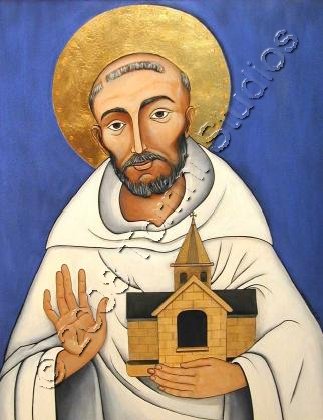 Me, I'm happy to survive on occasional "consolations of the spirit" like today. I can survive just fine on the "memory of Divine Favour" (as St. Bernard puts it). Other people have a different spiritual temperament, naturally, I'm just speaking for myself.
This reminds me of my absolute favourite story from the Desert Fathers and Mothers:
Thinking on these things makes me miss Mary Gates. She was my therapist back in Connecticut. She was also a priest and had been a student of Thomas Keating once upon a time. Mary would sit on her rocking chair. I would lie down on the couch and stare out into her big garden through the plate glass window. Mary is a wise woman.
I think Mary would shrug if I told her about this. "What did you expect prayer to be like?" she might quip. Just so.
-t
At Ezra's Pound I realized that I really like coffee shops and should spend more time at places like this. The coffee was excellent--far better than Starbucks. And I appreciated that all the food items were homemade. The strawberry jam was excellent, and so was the bread that came with it. The people that run that place choose to do a few things with excellence rather than fill the menu board with resold Aramark crap. I would recommend this place to any foodies out there! Looking around, I couldn't help thinking about what kind of ministry partnerships it might be possible to create.
After walking Henry and Betsy home, I went to the church for the usual Saturday block of services. I admit that I set up the Contemplative Eucharist feeling a little discouraged about it. I was thinking that I may need to cancel it if I don't start getting more people. I resolved to keep it going until Easter and then shut it down if I haven't attracted a regular congregation. Then I said some prayers that God might send me some new people to that service.
Wouldn't you know... two new people showed up! That made for four of us. I was pleased as punch. I know, some of my colleagues might scoff at a mere 2 new people. But for churches like mine that is precious fruit! We had a wonderful Eucharist and some interesting conversation afterwards. Sweet. The two new folks decided to stay for the Healing Prayer service, as well.
After that I did a session of pastoral counselling. We both decided we needed a little break from the depth work we've been doing, so we spent most of the session reading Psalm 119 together. I noticed as I was reading the odd number verses that each verse seemed to carry a lot of meaning for me. Sometimes the Psalms just resonate, you know? I found myself wishing that I was chanting them rather than just reading them. I thought about times that I've read through the entire psalter in one sitting as a devotional exercise. The last time was probably the all-night vigil I kept before my ordination. I should do that again, sometime.
After the Psalm we prayed together, and I found that it was easy today to be very present to the spirit of prayer. I'm often called on to pray for people and the degree to which I am "into it" can vary depending on many things. But today I was right into it. Saying the psalm and having the Contemplative Eucharist earlier in the day probably helped.
Prayer is mysterious like that. Sometimes it can come so easily and with such power and beauty. Other times it can seem dry. Today someone told me about how Thomas Keating said that scripture sometimes tastes "like straw." I knew what he meant immediately. It's like when a monk says he goes to the Offices "because the bell rings." There is an emptiness there in the discipline of spiritual practice which one encounters in the spiritually-engaged life. It's a good thing. It's the novice that prays or reads scripture because it is rewarding or edifying. It takes a real friend of God to show up when it ain't so fun!
Me, I'm happy to survive on occasional "consolations of the spirit" like today. I can survive just fine on the "memory of Divine Favour" (as St. Bernard puts it). Other people have a different spiritual temperament, naturally, I'm just speaking for myself.This reminds me of my absolute favourite story from the Desert Fathers and Mothers:
Abba Lot went to see Abba Joseph and he said to him, "Abba, as far as I can, I say my little office, I fast a little, I pray and meditate, I live in peace and as far as I can I purify my thoughts. What else can I do?" Then the old man stood up and stretched his hands toward heaven; his fingers became like ten lamps of fire and he said to him, "If you will, you can become all flame."
Thinking on these things makes me miss Mary Gates. She was my therapist back in Connecticut. She was also a priest and had been a student of Thomas Keating once upon a time. Mary would sit on her rocking chair. I would lie down on the couch and stare out into her big garden through the plate glass window. Mary is a wise woman.
I think Mary would shrug if I told her about this. "What did you expect prayer to be like?" she might quip. Just so.
-t
Friday, January 29, 2010
Extemporaneous Eucharistic Prayers
Of course I'm a liturgy nerd. I care a great deal about what we pray and how we pray. Like many Episcopal Priests, I was "raised" to think that great precision is required when praying the Eucharistic Prayer. God help you (literally) if you say it wrong. The magic won't happen! Jesus will flee your feast!
So I find it impressive when people can extemporaneously pray the Eucharistic prayers and hit all the right points. There is an ancient precedent for this: the Mozarabic Rite. It requires a deep understanding, in my humble opinion, of the Eucharistic prayers to do it well, but it is certainly within the capacity of most priests who put their mind to it. The so-called Rite III liturgy in the American Prayerbook (1979 BCP 402ff) gives the presiding priest great discretion in how the Eucharistic Prayer is to be said, but still specifies the words for the Institution Narrative and a few other parts. Of course, the Rite III rubrics insist that it should not be used during the principal Sunday service of the community.
Certainly doing a Eucharistic Prayer off-the-cuff is stretching the bounds of what is "Anglican"--but that's perhaps what interests me about it. I see great potential for relational liturgy in the immediacy of such a prayer. It's the same principle as what happens when one learns to preach without notes or improvise of the organ.
I happen to enjoy broad episcopal permission when it comes the Contemplative Eucharists that I do on Wednesday morning and Saturday afternoon. Further, the Archbishop has told us (priests) that we "have the keys to the family car--just don't wreck it." So in that spirit I've been trying my hand at extemporaneous eucharistic prayers at my Contemplative Eucharists. The group that comes appreciates it. I find that it requires even more concentration and preparation than what I used before, which is even more than what it required to a regular BCP/BAS Mass!
To prepare for it, I think you need a couple of years of saying the Eucharist out of the prayerbooks. To this end, saying the daily masses at St. Mary Magdalene's was great training. It's like the 10,000 hours concept of Malcome Gladwell--you need to spend about 10,000 hours saying the Mass to master it. Maybe I haven't wracked up that much time, perhaps I've got about 3 or 4 thousand hours, though? You should have a few of rites basically memorized from repetition.
Then, you need to have a real command over the different parts of the Eucharistic prayers. You need to know what they are and why they are there.
Next, and perhaps most importantly, you need to be right with your personal sacramental prayer life. I mean that you need to be really confident in your own skin as a priest doing the thing priests do. So... that's my advice about that.
Now, here is an example of Rick Fabian (best known from St. Gregory of Nyssa fame) presiding at the Eucharist that ended our Music That Makes Community Conference in Atlanta a few months ago. Note that both the words and the music were made-up on the spot. We sing a Sanctus at the end in a paperless-style, but it wasn't our first time hearing/singing that particular song.
Now, there is a lot of craft in doing this well. For one thing, notice that Rick has a particular pattern in mind for how is going to chant the text. He is basically going up and a down a scale. Also, he has an idea in his head of the shape of the eucharistic prayers. He knows where is beginning from and where he is ending. He also knows some of the points he wants to hit along the way: thanksgiving for creation, rehearsing salvation history, the institution narrative, the epiclesis, etc.
BTW, I like the way Rick says "whores." It's a nice, sharp moment in the flow of the prayer.
I was never taught how to pray this way. I wasn't ready for it in seminary, anyway. These are advanced teachings. But it's definitely worth sharing because the spiritual results can be breath taking!
-t
Thursday, November 19, 2009
The Holy Spirit in Worship...
Emily Scott, one of my liturgist friends, wrote an interesting piece for Episcopal Cafe Blog back in December:
This rings true for me. So much of the liturgy we do in the Church seems designed to leave as little room for the Holy Spirit as possible. When the Holy Spirit does show up, everyone seems surprised (no one more so, perhaps, than the priest). How remarkable that the best worship services I see happening outside of my own parish are often on the fringes of other communities: house eucharists sponsored by one congregation, the "early service" on a Sunday morning at another, the sort of worship we do at Synods and camp. The edge is where it's at.
That's why I think it's important to push the envelope a bit at regular Sunday services. I don't think you want to push people over the edge, but you got to make a gesture worthy of the boldness of the Gospel, ya know?
Sure, it's possible to find that edge in even the most ritual-notes-following, high-church, incense-burning, BCP-loving homage to Victorian Spirituality. I remember finding that edge at SMM a few times at the 11 AM Solemn Mass. But I think that we as clergy (and laity) need to do a better job of pushing ourselves to the fullest expression of prayer we are able to offer.
To do the opposite is to fall into a kind of apathetic, too-comfortable repetition that I see disturbingly often.
It's nice to be in a parish that appreciates us looking for that edge of faithful prayer together. I'm really excited about our plans for Advent!
-t
Holy Chaos, or: What Episcopalians can learn from Baptists
....
Urban Holmes wrote that good liturgy leads regularly to the edge of chaos, a regular flirt with doom (Theology and Religious Renewal). These past weeks in worship, I’ve felt myself clearly standing dangerously on the edge of a precipice – nothing below me but God.
How often do we trick ourselves into believing that if we do everything right – if we use the right words and process the right way and bow at the right moments, God will be present in our worship? How often do we deceive ourselves into, as Aidan Kavanaugh so incisively wrote, “tam[ing] the Lion of Judah and [putting] him into a suburban zoo to entertain children (On Liturgical Theology)?
And how often to we believe, as we stand in the Narthex among the acolytes and choir members, that the cataclysmic Spirit of God just might thunder into our sanctuary, cracking open our familiar and comforting practices, and change the very lives of the people to whom we minister? How often do we trust that someone might be healed, that someone might be saved? How often do we trust our own ability to be the lighting rod to God’s presence and touch? .... (source)
This rings true for me. So much of the liturgy we do in the Church seems designed to leave as little room for the Holy Spirit as possible. When the Holy Spirit does show up, everyone seems surprised (no one more so, perhaps, than the priest). How remarkable that the best worship services I see happening outside of my own parish are often on the fringes of other communities: house eucharists sponsored by one congregation, the "early service" on a Sunday morning at another, the sort of worship we do at Synods and camp. The edge is where it's at.
That's why I think it's important to push the envelope a bit at regular Sunday services. I don't think you want to push people over the edge, but you got to make a gesture worthy of the boldness of the Gospel, ya know?
Sure, it's possible to find that edge in even the most ritual-notes-following, high-church, incense-burning, BCP-loving homage to Victorian Spirituality. I remember finding that edge at SMM a few times at the 11 AM Solemn Mass. But I think that we as clergy (and laity) need to do a better job of pushing ourselves to the fullest expression of prayer we are able to offer.
To do the opposite is to fall into a kind of apathetic, too-comfortable repetition that I see disturbingly often.
It's nice to be in a parish that appreciates us looking for that edge of faithful prayer together. I'm really excited about our plans for Advent!
-t
Sunday, November 8, 2009
Tell It Like It Is
 One of the books we had to read in advance for the Preacher's College last week was Tell It Like It Is: Reclaiming the Practice of Testimony by Lillian Daniel (our guest presenter at the College). This book is based on her D.Min. dissertation and focuses on reclaiming the tradition of Testimony for "mainline" churches (think Congregationalist, Methodist, Episcopal, Lutheran, even Catholic). She developed a practice at her church in New Haven (and brought it with her to Chicago) of inviting lay members of the congregation to give testimony from the heart (usually only for about 7-8 minutes) about their life with God. The only real rule (besides the time limit and the fact that these folk were specifically invited by the pastor) was that Testimonies could not be "godless." What she didn't want to hear was, "What I learned about myself in psychotherapy," nor, "What civic minded people can accomplish when they work together." The point is to talk about how God is active in your life.
The practice was very successful and brought people closer together in the congregation. It also helped to spread out leadership and foster both discipleship and (yes) stewardship.
 So she wanted to talk to us about how this practice can be helpful to congregations as well as how the use of personal testimony in preaching can be a powerful tool. To this end she had us read a book she co-wrote with Martin Copenhaven, This Odd and Wondrous Calling: The Public and Private Lives of Two Ministers. This book reads as a series of essays reflecting on different aspects of the pastoral vocation. Many of them are amusing, thoughtful, and certainly familiar to those of us "in the cloth." It would be a great book for anyone considering ordained ministry, and was written to be a counterpoint to such books as Leaving Church by Barbara Brown Taylor (which focused on the problems of life in pastoral leadership) and the You-Can-Make-Your-Mega-Church-Grow-with-Jesus'-Help kind of books. It provides some good examples of how personal narrative can be used to make theological arguments in a far more compelling way than the products of "illustration factories." You know, those cutesy generic sermon illustrations you can find on various sermon-writing websites.
The "College of Preachers" is run by St. Clement's Church here in Toronto but is really meant to be a National programme. They have a sermon number of slots for Toronto priests and then the other half are taken by priests from around the Anglican Church of Canada. You have to be nominated by your bishop to attend. The College happens every two-years.
About a week before the event I was told I would be preaching at Morning Prayer on the first day of the conference. I had no idea what the readings would be, so I prepared a sermon that made good use of personal narrative and was pleased that it did, in fact, go with the readings. Mine was the first sermon heard this year, so I was naturally more nervous than usual. But it went well.
As our days together went one we heard talks by Lillian and then broke up into groups hear each other preach and critique. We also had times of prayer and recreation.
It was wonderful to be with other clergy and talk about preaching, though not without some interesting disagreements on things like the usefulness of the lectionary. There was also a fruitful discussion about one should preach at wedding and funerals (seems like a great evangelism opportunity to me, but some pastors disagree). Lots of discussion of clergy role, boundaries, etc.
 David Montgomery (one of the priest's at St. Clement's) did an excellent job with the Offices. He even did some "Paperless Music" using the Music by Heart Hymnal. He's the first person I've seen use it (besides Eric and I) in Toronto, so I was very excited to see how easily he was able to do it. Naturally I told him that I would meeting with the All Saint's Company folks that wrote that hymnal in a few days!
There is an interesting quality to praying together at these sorts of retreats. Something about having a roomful of clergy praying together makes for a very special atmosphere. Something about the shared ministry and collegiality makes for really rich prayer time together. Nor is it necessarily limited to ordained clergy, I experienced the same thing with the mostly lay-group in Atlanta.
I had to leave the College after the last full-day. I missed the banquet dinner and the last Plenary talk and Lillian's sermon, alas. But I had to catch my flight to Atlanta, which I will blog about soon....
-t
Sunday, August 9, 2009
An Unusual Vespers
Long Retreat is over, we are all talking now. I'm glad for it, myself! Matins and Eucharist in the morning, of course, and then the monks and I went out to a diner for brunch. People were in a good mood. Now that Long Retreat is over about half the monks of the house are taking vacation time. Some have already left (but not without giving me hour long video taped interviews, first!), but for lunch it was decided to go out to a diner. In the afternoon I took a nap before Vespers.
Vespers was remarkable for several reasons. First, a storm come on. Between having the windows open and the rain hitting the roof, it was quite loud. Just before the Angelus bells rang, Bede told us that the incense he would be burning was a slightly different variation of the scent oils--he wanted feedback about how we liked it. As the bell rang and we started the Office a family came into the chapel. Out of the corner of my eye I could see a woman with a kid in arm crossing herself with holy water as she entered.
As the family settled in, I could sense that the community was a curious, by they seemed so natural and self confident that I thought that they were probably related to one of the monks, and were planning to go out for dinner or something (Sunday night are often a convienient time for that kind of thing). It was a husband and wife and two boys, perhaps as young as 5 and 8. As it turns out, they have NEVER been to Holy Cross before. The husband is a professor at Vassar and his wife is from France. They have been aware of Holy Cross for sometime, and have been checking out the website. Something inspired them to come on this particular day, for some reason, and we received them graciously. The boys did extremely well for such a quiet service, and I think we were all delighted to have them. Of all the Offices that happen in the course of a week, I think this is the one I would pick to take young kids. Sunday Vespers is always pretty relaxed--the mark of the end of the week and the beginning of sabbath rest. The next Office isn't until Tuesday. Almost every guest has left by Sunday Vespers, so it is usually just the monks and residents at Vespers.
So between those three things--new incense, the rain storm, and the family--it was a very energized Vespers!
BTW, I've interviewed about half the monks, now. Lots of really excellent material!
-t
Wednesday, July 22, 2009
Quick Update from the Monastery
I've been taking a break from blogging, for the most part, during my my vacation/retreat/work at Holy Cross, but I thought I would do a quick note to check-in.
Already this time at Holy Cross has been very special to me. Something about the silences and the overall deliberativeness of life here has been remarkably good for my soul. I feel totally at home and have been resting into the reality of this place. Lots of prayer and eating and meditating. The evening I went with Bede to an "Insight Meditation" group that meets nearby.
I've also been productive. The new version of the Holy Cross website is almost ready to go live--just a few pieces left to finish on the basic website. Then I'm going to really push myself to add some sophisticated CMS (Content Management System) tools to make editing the site easy for non-specialists. I'm also going to add some kind of on-line catalog/shopping cart kind of thing for the book store and possibly a way to see Guest House availability and even request reservations. What could possibly be next after that? How about a social networking site like Facebook, only for Holy Cross Associates and Monks? And did I mention the videos? I've already gotten some great content "in the can"--with the bulk of the interviews still left to do.
I know it sounds like a lot, but actually I've been making rapid progress. Feels good to have creative work balanced with prayer and mediation just about right.
-t
Saturday, March 21, 2009
Encouragement
Remarkably, eight people showed up for the Healing Prayer Service (plus me makes nine). Even cooler, three, yes three, were simply people from the neighborhood who felt the need for some healing prayer after seeing our posters. How cool is that! It actually worked. I had my doubts--but there are people who actually saw my little poster and came because of it. Amazing. I know three might not sound like a lot, but for us that's a big deal. I'm pleased as punch.
-t
Saturday, March 14, 2009
Healing Prayer Service Progress
Today was the third Healing Prayer service here at the church. Thought I would offer a few quick reflections.
Liturgy... We follow this outline:
Attendance... The first Saturday it was just two of us. The second there were six. And today we had six as well. Until today it was entirely parishioners--but then today we had a visitor who came because she saw our banner out front. Sweet! Now this person is a life-long Anglican who has known of our church, but not been inside before. That's just great. It's exactly the kind of encouragement I needed!
Spirituality... It has been quite moving to share prayer together in this way. I think doing the open intercessions followed by the anointing flows really nicely. I think that as we continue to meet the feeling of intimacy and connection will grow and the prayers will feel even more powerful.
So I'm feeling pretty good about this. I think we need to post even more flyers and advertising and we'll see how this goes...
-t
Liturgy... We follow this outline:
- We sit in a circle in front of the chancel. Three candles burn on a table near the presider.
- Greeting and opening collect from BAS pg. 554.
- A reading from scripture (related to healing)
- Silence for contemplation
- Sharing about the scripture
- Extemporaneous, open prayer time
- Laying on of Hands and Anointing (those who wish to receive it take turns sitting in a chair in the middle of the circle. Everyone gathers around and puts a hand on the person's shoulder or arm. Presider lays hands on the person's head. Silent prayer for three or four breaths, then anointing using the BAS formula pg. 555)
Attendance... The first Saturday it was just two of us. The second there were six. And today we had six as well. Until today it was entirely parishioners--but then today we had a visitor who came because she saw our banner out front. Sweet! Now this person is a life-long Anglican who has known of our church, but not been inside before. That's just great. It's exactly the kind of encouragement I needed!
Spirituality... It has been quite moving to share prayer together in this way. I think doing the open intercessions followed by the anointing flows really nicely. I think that as we continue to meet the feeling of intimacy and connection will grow and the prayers will feel even more powerful.
So I'm feeling pretty good about this. I think we need to post even more flyers and advertising and we'll see how this goes...
-t
Wednesday, March 4, 2009
The Holy Pretzel

Bob, my bro-in-law, points out this fascinating article about using the humble pretzel as a traditional symbol of Lent:
The pretzel has a deep spiritual meaning for Lent. In fact, it was the ancient Christian Lenten bread as far back as the fourth century. In the old Roman Empire, the faithful kept a very strict fast all through Lent: no milk, no butter, no cheese, no eggs, no cream and no meat. They made small breads of water, flour and salt, to remind themselves that Lent was a time of prayer. They shaped these breads in the form of crossed arms for in those days they crossed their arms over the breast while praying. Therefore they called the breads "little arms" (bracellae). From this Latin word, the Germanic people later coined the term "pretzel."
Thus the pretzel is the most appropriate food symbol in Lent. It still shows the form of arms crossed in prayer, reminding us that Lent is a time of prayer. It consists only of water and flour, thus proclaiming Lent as a time of fasting. The earliest picture and description of a pretzel (from the fifth century) may be found in the manuscript-codex No. 3867, Vatican Library. (source)
The article even includes a "Ceremony of the Pretzel" to use in Lent:
The Ceremony of the Pretzel
1. On Ash Wednesday, father or mother may explain the origin of the holy pretzel, so that the children will understand its significance.
2. The pretzel might be served on each plate for each evening meal until Easter.
3. Added to the grace before meals, is the "pretzel prayer."
PRAYER
We beg you, O Lord, to bless these breads which are to remind us that Lent is a sacred season of penance and prayer. For this very reason, the early Christian started the custom of making these breads in the form of arms crossed in prayer. Thus they kept the holy purpose of Lent alive in their hearts from day to day, and increased in their souls the love of Christ, even unto death, if necessary.
Grant us, we pray, that we too, may be reminded by the daily sight of these pretzels to observe the holy season of Lent with true devotion and great spiritual fruit. We ask this through Christ our Lord. Amen.
(source)
I'm touch by this--but I also think it would be excellent fodder for a Monty Python skit.
-t
Monday, March 2, 2009
A Calm and Prayerful Night
Betsy went to the Bach Vespers at Redeemer this evening. She enjoyed it, and when she came home we talked and sipped tea. Later, as she and the cats slept, I read more of Kathleen Norris' recent book, Acedia and Me. It's a very grown up book that traces many decades worth of accumulated spiritual wisdom. It's the sort of book that goes to some pretty dark places, including her husband's history with depression and suicide attempts.
Reading her talk about the necessity of prayer inspired me to dust off my old pocket-sized (American) Book of Common Prayer. It was given to me by my parents when I was confirmed. I have prayed with it often throughout my life, but less since I moved to Canada and started saying the Office from the BAS or the Holy Cross Breviary. When I was a kid I would say Compline every night. So this prayer book is well-worn. But in recent years I've been doing most of my prayers "at the office" so to speak. That is, I've been praying at church. I know this is probably a mistake, one should allow prayer to infuse all life, but besides grace at meals and extemporaneous prayers in the shower or when the thought of someone in need of prayers strikes me, I haven't been indulging in something as well developed or rich as the little Compline Office in the '79 BCP. Picking up tonight just felt right, somehow, as a response to both Kathleen Norris and everything else.
Perhaps this is the way Lent is going to come at me this year--quiet moments sipping tea with my wife or reading a poet talk about her spiritual journey through life, marriage, and vocation. And then the prayers and now the blogging. I'm sipping warm milk and trying not to let my mind race ahead to all the things I want to get done on my day off!
It seems lately I've been having the the same conversation over and over with different people--a talk about surface versus depth. If I let my attention rest on the surface of the pond--worrying about who is in church and who isn't or how the roof is going to get fixed and why didn't more people come to Ash Wednesday--I'm going to be jostled by every little ripple and possible overwhelmed by every wave. But underneath that is something still and deep and dark and full of all the rich, squirmy life that we need. You catch fishes by letting down nets, I suppose.
Those crafty desert fathers knew this lesson well. I'm so young as a Christian I find the challenges of this life daunting to say the least. I can't imagine what I would do if I didn't have people like Bede and Kathleen Norris and the Desert Fathers and Eugene Peterson and the rest of the struggling saints!
Sigh. A night for prayer.
-t
Wednesday, January 21, 2009
And Winner of the Prayer Contest is....
The Rev'd Dr. Joseph Lowery!
I don't think anyone else could have pulled this off, but he sure did!
-t
Tuesday, January 20, 2009
Bishop Robinson's Prayer Controversy
The plot thickens... HBO said that they didn't broadcast Bishop Robinson's prayer because the Inaugural Planning Committee had decided to put it in the "pre-show." The Obama people have apologized and said that this was a mistake. So today the whole Lincoln Memorial Concert will be re-broadcast, with the Bishop's prayer.
Here is a summary of events around this from Rachel Maddow:
As for the prayer itself, here the video currently circulating on the web:
I imagine that this was a challenging prayer to write! But I'm proud that the Episcopal Church had such a central role in everything. I have some friends on staff at Washington National Cathedral and I'm curious what kind of stuff they have going on around the Inauguration.
-t
Wednesday, January 7, 2009
Epiphany at Trinity
Yesterday evening I said Mass at Trinity College. It was the Feast of the Epiphany, so I was very pleased to have a chance to Celebrate Mass that day. The school has a new Chaplain, Andrea Budgey, whom I've know for a few years. Before the service, the Sacristan, Andrea, the organist (Christopher Ku) and I went over the service and decided what liturgical options to exercise. Since it was a Principal Feast we did most stuff, including the Gloria and the Creed. I also elected to sing the Preface.
Saying Mass in a seminary chapel like this is a lot of fun for a priest like me that still has some high-church tendencies that don't get exercised much in my own parish. There is a glee that comes from being able to discuss which manual gestures with people that care about such things. I'm not complaining about my own parish--I don't want them to care about how many times I make the sign of the cross during the Canon of the Mass (so many other things are more important), but sometimes it's a nice change. It's like being married to someone who is allergic to peanuts and going out and eating a nice Thai dish with a peanut sauce--you don't feel deprived at home, but the change of pace can be refreshing now and again.
Anyway, the Mass went extremely well. The student giving the sermon did a good job and the servers were excellent and everything went perfect from a liturgical purist point of view. Even more delightful, however, was perceiving the presence of the Holy Spirit as I said the prayers and distributed communion. Sometimes I really love my life! I know, I know, I'm a church nerd. So be it!
-t
Sunday, December 28, 2008
Rick Bobby Praying to the Baby Jesus
One of the funniest and most interesting prayer scenes in a movie in recent years was from the movie Talladega Nights: The Ballad of Ricky Bobby. The theology of this satire is worth more than a few sermons. Naturally, I used it today on one of the most baby-Jesus days of the whole lectionary cycle.
-t
Thursday, December 11, 2008
Prayer of the Week - Advent III
Beloved Parishioners,
A lot of eating happens around Christmas, and I know I am very much looking forward to another dose of Turkey! The holidays are a time to celebrate the birth of Christ with gift-giving and much love expressed in time together and lots and lots of food!
Usually we don't think very much about where our food comes from. We simply go to the grocery store or sit down at a table and there it is! Gone are the days when we had to actually see our food when it was still growing in the ground or walking around in a pasture. Not many of us have the experience of picking lead shot, like fish bones, from the pheasant we are enjoying. Yet part of our call as Christians is to be good stewards of the earth God has given into our hands. We are supposed to use it wisely and in a way that treats those who work it on our behalf fairly.
I want to encourage us in this season of eating to think about the choices we make with regards to food. It is possible, with little effort, to be part of the solution when it comes to improving our health, our environment, and even our economy. Buy locally grown food. Eat fresh food. And don't overdo it!
Today I saw a picture of a local farmer who lives just north of Port Stanley. She was kneeling in the snow harvesting carrots! What really struck me was her smile--she was enjoying her work! I thought of how she is clearly getting something that most of us are just learning: that when we ground ourselves in what is real (real food, real love, real God) we find joy and contentment.
I pray that all of us might be similarly grounded this season heading into Christmas.
-t
A lot of eating happens around Christmas, and I know I am very much looking forward to another dose of Turkey! The holidays are a time to celebrate the birth of Christ with gift-giving and much love expressed in time together and lots and lots of food!
Usually we don't think very much about where our food comes from. We simply go to the grocery store or sit down at a table and there it is! Gone are the days when we had to actually see our food when it was still growing in the ground or walking around in a pasture. Not many of us have the experience of picking lead shot, like fish bones, from the pheasant we are enjoying. Yet part of our call as Christians is to be good stewards of the earth God has given into our hands. We are supposed to use it wisely and in a way that treats those who work it on our behalf fairly.
I want to encourage us in this season of eating to think about the choices we make with regards to food. It is possible, with little effort, to be part of the solution when it comes to improving our health, our environment, and even our economy. Buy locally grown food. Eat fresh food. And don't overdo it!
Today I saw a picture of a local farmer who lives just north of Port Stanley. She was kneeling in the snow harvesting carrots! What really struck me was her smile--she was enjoying her work! I thought of how she is clearly getting something that most of us are just learning: that when we ground ourselves in what is real (real food, real love, real God) we find joy and contentment.
I pray that all of us might be similarly grounded this season heading into Christmas.
God of all abundance, we thank you for preparing the earth to receive your glorious Son. We ask you to bless all those whose labor feeds us and whose work sustains the earth. Give us our daily bread that sustained in body and mind we may bring your new kingdom to earth. Help us, who eagerly long for your kingdom, to prepare Your Way. We ask this in the name of Jesus Christ, your Son our Lord, Amen.
-t
Thursday, December 4, 2008
Prayer of the Week - Advent II
Beloved Parishioners,
I'm very sad to report that Kerrie Fulton's mom, Carole Fulton, passed away last night after a long illness. Kerrie and Nick appreciate all the prayers that have been and will offered for them in this time of grief.
Death is a familiar visitor in most homes, including God's home, the church. Paradoxically, the more alive we are--that is, the more connected to other people and engaged with our world--the more we will experience death. None of us are getting out of this alive, it seems, and so as the years pass and friends and family go ahead of us into their eternal reward, we become more aware of our own impending mortality.
Spiritually wise people throughout all the traditions (not just Christian) have commended thinking about one's one death. It's a profound thing to think about how we, too, will pass away like the grass in the field. What's unique about the Christian meditation on this subject, however, is the special promise that God makes to us through the life, death, and resurrection of Jesus. By linking ourselves too Christ in Baptism we hope to share not only death in common with him, but resurrection as well.
The exact nature of this resurrection is still a mystery to us, but the Bible does make it clear that our resurrected selves will have a kind of fullness of life not possible now. Further, that in our resurrected bodies we will continue to know and love each other. And yet our new existence is perfected, in some sense that God knows, and made whole. The best image of this is the resurrected Body of Christ when he appeared to his disciples: his wounds were still there, only they had been made glorious.
A friend on mine, Donald Schell, recently wrote an article reflecting on the death of his father. He noted how much of what our society has to say about death misses the point. He found that the most spiritually satisfying truth evident in the death of his father was the simple finality of it. "One morning after my dad’s death, Ellen said that she was grateful that psalms said so plainly that death was death. It matched her experience of seeing my dad laid out on the floor after the paramedics had stopped CPR. He was gone. There was his body, but the life we’d known in that body, the man we’d loved was gone."
Gone. Dead and gone. That is our experience and it doesn't need to be coddled or denied. The hope we have in the resurrection is not to be found in the mortician's expertise in making the dead appear to be "sleeping." Our hope is something much grander and more difficult to imagine. It is a hope that we receive in the Gospels and know by revelation, not euphemism.
It's when we face up the reality of the certainty and finality of death in this life that we can begin to open our hearts to the promises of Christ. I know that for many people it is difficult to look at a realistically rendered crucifix. The sight of Jesus dying on the cross ought to be disturbing to us--it's purpose is to show us that suffering is real and death is real and that God can go there, too, to be with us. God died. Jesus was burried. And after three days he rose again.
So even at the grave me make our song: Alleluia, Alleluia, Alleluia.
I'll close with one of my favorite old prayers from the Prayerbook. I used it often in the hospital and still find it can move me to tears when I think of it:
-t
I'm very sad to report that Kerrie Fulton's mom, Carole Fulton, passed away last night after a long illness. Kerrie and Nick appreciate all the prayers that have been and will offered for them in this time of grief.
Death is a familiar visitor in most homes, including God's home, the church. Paradoxically, the more alive we are--that is, the more connected to other people and engaged with our world--the more we will experience death. None of us are getting out of this alive, it seems, and so as the years pass and friends and family go ahead of us into their eternal reward, we become more aware of our own impending mortality.
Spiritually wise people throughout all the traditions (not just Christian) have commended thinking about one's one death. It's a profound thing to think about how we, too, will pass away like the grass in the field. What's unique about the Christian meditation on this subject, however, is the special promise that God makes to us through the life, death, and resurrection of Jesus. By linking ourselves too Christ in Baptism we hope to share not only death in common with him, but resurrection as well.
The exact nature of this resurrection is still a mystery to us, but the Bible does make it clear that our resurrected selves will have a kind of fullness of life not possible now. Further, that in our resurrected bodies we will continue to know and love each other. And yet our new existence is perfected, in some sense that God knows, and made whole. The best image of this is the resurrected Body of Christ when he appeared to his disciples: his wounds were still there, only they had been made glorious.
A friend on mine, Donald Schell, recently wrote an article reflecting on the death of his father. He noted how much of what our society has to say about death misses the point. He found that the most spiritually satisfying truth evident in the death of his father was the simple finality of it. "One morning after my dad’s death, Ellen said that she was grateful that psalms said so plainly that death was death. It matched her experience of seeing my dad laid out on the floor after the paramedics had stopped CPR. He was gone. There was his body, but the life we’d known in that body, the man we’d loved was gone."
Gone. Dead and gone. That is our experience and it doesn't need to be coddled or denied. The hope we have in the resurrection is not to be found in the mortician's expertise in making the dead appear to be "sleeping." Our hope is something much grander and more difficult to imagine. It is a hope that we receive in the Gospels and know by revelation, not euphemism.
It's when we face up the reality of the certainty and finality of death in this life that we can begin to open our hearts to the promises of Christ. I know that for many people it is difficult to look at a realistically rendered crucifix. The sight of Jesus dying on the cross ought to be disturbing to us--it's purpose is to show us that suffering is real and death is real and that God can go there, too, to be with us. God died. Jesus was burried. And after three days he rose again.
So even at the grave me make our song: Alleluia, Alleluia, Alleluia.
I'll close with one of my favorite old prayers from the Prayerbook. I used it often in the hospital and still find it can move me to tears when I think of it:
Depart, O Christian soul, out of this world; in the name of God teh Father almighty who created you; in the name of Jesus Christ who redeemed you; in the name of the Holy Spirit who sanctifies you. May your rest be this day in peace, and your dwelling place in the paradise of God. Amen.
-t
Thursday, November 13, 2008
Prayer of the Week - Pentecost 26
Beloved Parishioners,
Today I came to work resolved to write the Prayer of the Week. So I sat down in front of my computer woke it up, and checked my e-mail first thing. Satisfied that everything important was taken care of, I started drafting the Prayer of the Week. I opened up a window and got ready to type and then... nothing.
Not to worry, I reasoned, I'll expose myself to what other God-groupies are writing and then I'll try again. So I opened up my internet browser and read some inspirational stuff written on blogs I follow. Satisfied that I was up to date on what my colleagues on-line had to say, I tried again. Again... nothing.
So, last resort, I went into the sanctuary with one of my favorite devotional manuals and started praying. I prayed a litany to the Holy Spirit and then prayed for the people I know who have specific needs. Then I opened up psalms to a random page and started chanting them. Chanting the psalms is a very soothing sort of prayer. The Book of Psalms is the original Prayerbook.
I sat down again front on my computer and... nothing. I have no idea what to write about for prayer of the week. I have some sense of what I'm going to preach about on Sunday. I even managed to start an essay to be published in the Anglican newspaper in January. But as for a Prayer of the Week... nothing.
But, alas, all is not lost. I can hear the voice of my teachers in my head: attend to process. Notice what's happening. So that's why today I'm praying about praying:
-t
Today I came to work resolved to write the Prayer of the Week. So I sat down in front of my computer woke it up, and checked my e-mail first thing. Satisfied that everything important was taken care of, I started drafting the Prayer of the Week. I opened up a window and got ready to type and then... nothing.
Not to worry, I reasoned, I'll expose myself to what other God-groupies are writing and then I'll try again. So I opened up my internet browser and read some inspirational stuff written on blogs I follow. Satisfied that I was up to date on what my colleagues on-line had to say, I tried again. Again... nothing.
So, last resort, I went into the sanctuary with one of my favorite devotional manuals and started praying. I prayed a litany to the Holy Spirit and then prayed for the people I know who have specific needs. Then I opened up psalms to a random page and started chanting them. Chanting the psalms is a very soothing sort of prayer. The Book of Psalms is the original Prayerbook.
I sat down again front on my computer and... nothing. I have no idea what to write about for prayer of the week. I have some sense of what I'm going to preach about on Sunday. I even managed to start an essay to be published in the Anglican newspaper in January. But as for a Prayer of the Week... nothing.
But, alas, all is not lost. I can hear the voice of my teachers in my head: attend to process. Notice what's happening. So that's why today I'm praying about praying:
Holy God, you make all our lives one prayer of thanksgiving and love to you, Creator of All. Send your Holy Spirit to your people to teach us to pray. Light our hearts on fire with your flame of love to brightly illuminate the dim pathways of grief and doubt. Inspire us with an awareness of your presence so that all that we do may be a gesture of affection to you, lover of all. We ask this in the Name of the One who died and rose again, Jesus Christ, Our Lord. Amen.
-t
Subscribe to:
Posts (Atom)