One of the many things the Environics report is giving me to think about is that in our part of the city the second highest social value is "Importance of Aesthetics" (second only to "Consumptivity." (A word I've never heard before, which will have to wait for its own post). This ties to a nagging issue that has bothered me for many years--the interior of our church.
Our building was gutted by a fire which also destroyed the parish hall next door. I understand that the architects were trying to solve a complex problem--fitting the the functions of two buildings into one. I think they did an admirable job, but one of the trade-offs was a space with a lot of "noise." For example, the square north-south lines of the floor tiles clash with the radial arches of the ceiling lights. The space between the magnificent stained glass window and the chancel area is visually "messy," and yet resides at one of the most natural resting places for the eye. The columns in the room are two completely different styles (some are ornate clement and the others are plain columns). As one architect put it to me, "The place lacks a central conviction about worship." Precisely so, in solving the practical problems the architects abandoned the effort to say anything about worship, God, or church. Or, more accurately, they a few things, but in a confused and unorganized way.
Most visitors don't mind, but a few do. I've certainly seen people walk into our church, see that it doesn't "look like a church," and walk out again. And the parishioners like the quirky but straightforward character of it, but like some of my predecessors I dream of "fixing" it. Interestingly, a blogger who reviewed our church said the interior was one of the "low lights" of his visit. Sigh.
In my years here I have collected a variety of opinions about how to do that. Some have been brilliant, others seem to try to recreate a past that was destroyed by the fire in 1976. Cost is obviously a factor in any plan, but some of the ideas have involved nothing more expensive than paint, which certainly seems do-able.
So now that we know that the people around us care about Aesthetics, how to respond? What sort of architectural expression will mediate the Gospel to such folks? Hmmm.
Showing posts with label architecture. Show all posts
Showing posts with label architecture. Show all posts
Friday, April 26, 2013


Saturday, February 13, 2010
The Trump Tower!
Hey, I know that guy! That's Chris, one of my closest friends here in Toronto. He's the Superintendent for Construction on the Trump Tower at the corner of Bay and Adelaide in downtown Toronto. This video has him talking some about the project.
The video doesn't say this, but Chris and his wife are from Seattle. He was brought to Toronto for this project because he has experience with a particular construction technique called pre-stressed concrete. If understand it correctly, if you put concrete under load laterally via cables running through the material, it can bear more weight for a given thickness than more traditional floor designs. I can safely say that Chris knows more about concrete than anybody I know (including my architect friends)!
-t
The video doesn't say this, but Chris and his wife are from Seattle. He was brought to Toronto for this project because he has experience with a particular construction technique called pre-stressed concrete. If understand it correctly, if you put concrete under load laterally via cables running through the material, it can bear more weight for a given thickness than more traditional floor designs. I can safely say that Chris knows more about concrete than anybody I know (including my architect friends)!
-t
Thursday, October 29, 2009
RIP Stephen Bélanger–Taylor

Stephen Bélanger–Taylor, the artist who created Messiah's famous East Window, passed away this summer. One of the Staff at the Diocesan Centre was sharp enough to notice and to pass this obituary on to me. It came just in time to help inspire my Dedication Day sermon:
Stephen Bélanger –Taylor died unexpectedly at this home outside Geraldine, New Zealand in mid July. He had been diagnosed with cancer last Fall, but after chemo and radiation treatments, was declared disease –free about 2 weeks before he died. His death was a result of a seizure he had in the night. The irony…..
As many of you may know, Stephen’s wife Denise is a glass blower. They built a beautiful hot and cold glass studio on their country property on the south island of New Zealand. Their two sons, Michael and Kevin live on the north island. Michael and his wife Donnelle have a son and they have just had twins, so Denise has some very concrete and life affirming diversions for the moment.
Born and raised in Britain, Stephen’s art education began at 15 when he won a scholarship to Wimbledon School of Art where he was introduced to stained glass and learned the skill of restoration. He then won a place at the Royal College of Art in London where he continued his study and apprenticeship of stained glass and glass painting.
He immigrated to Canada in 1968 after receiving a stained glass commission at St. James Cathedral in Toronto through Yvonne Williams’ Toronto stained glass studio. As we know, he went on to develop a significant career in Canada doing numerous liturgical and residential stained glass commissions throughout Ontario.
He took the tradition skill of glass painting to a new and contemporary level with the use of double and triple matt layers. His line work was definitive, simple, and elegant. His bold colour sense and organically abstracted landscape shapes blended to create windows with very strong presence.
A strong presence was also a trait of his personality. My first meeting with Stephen was in a studio he was using in downtown Toronto. He was working on a large painted liturgical commission. I was meeting with him to talk about the possibility of apprenticing with him. At this point I had been doing stained glass as a hobby, with no formal art training at all. I walked into a darkened room. The only light was what was coming through the painted glass on an incredibly large easel. Stephen was in front of the panel with a brush and mull stick in hand. It was a rather medieval scene. In lieu of a regular introduction, his first words were “So you want to do stained glass do you?” “Are you a masochist?’ That cackle laugh of his followed the question. He proceeded to give me a reading list 2 pages long, most of which were published in England and dealt with the esoteric, philosophical, artistic and technical aspects of the art of stained glass. I knew then that this was the teacher for me.
The depth of training he had had was of a level that hardly existed in Canada. His standards of professionalism around his work were very high. He was openly very critical of what he considered mediocre work presented as something more. He was often seen as arrogant and intimidating. In fact he was a shy man, with bold opinions, based on a standard of excellence that he had been trained for, an accomplished stained glass designer, an amazing builder and innovator in the technical construction of glass furnaces, a generous, gifted teacher, and a dedicated artist in the way he lived his life, a committed father and partner.
Some of his most notable works can be seen in Toronto at Church of the Holy Trinity (4 south windows), Church of the Messiah (East window), St. Luke’s Thornhill (South altar window), St. Michael’s All Angels (Etobicoke), and Picton Town Hall.
Along with his commission work, Stephen also taught and influenced many students at Humber and Georgian Colleges, lecturing at U of T and conducting private apprenticeship courses.
After spending time in New Zealand in the 1980’s and 90’s, Stephen established what would be a long creative working relationship with New Zealand artist Beverly Shore Bennett. He collaborated with her on many commission throughout New Zealand. This eventually led to the Belanger-Taylor family moving to New Zealand in 1995 where Stephen continued his glass career with much success.
The Window he created is probably my favourite piece of art in the whole church. It was created from the broken pieces of glass collected after the fire here in 1976. When I first saw it I thought of the Burning Bush motif, and I still that is one possible reading of the window, but actually he intended to express something about how God's Holy Spirit encounters humanity and we respond to that grace with praise.
-t
Friday, August 21, 2009
St. Peter's Lutheran, NYC
Take a look at this font:

It's in an architecturally interesting church--St. Peter's Lutheran (ELCA), Manhattan--that you may recognize from the TV series "Kings" on NBC. Alas, "Kings" was cancelled. Too bad, another example of why the traditional networks can't imitate the success of HBO's high quality productions. They just don't have the patience to develop a show like this. Anyway, they shot a bunch of scenes on location in this church, and I was pleased to be able to track it down.
One of the interesting features of this font/baptismal pool is that you can walk into from above easily with the steps that go right into the pool. Or, it's an a convenient height relative to the nave floor for doing baptism via sprinkling.
The set-dressers for the show "Kings" added some really cool tree-shaped free-standing candelabras. I hope the chancel guild of the church was paying attention!
Here are some more photos of St. Peter's Lutheran...


And, yes, that organ is a "Tracker."
-t
It's in an architecturally interesting church--St. Peter's Lutheran (ELCA), Manhattan--that you may recognize from the TV series "Kings" on NBC. Alas, "Kings" was cancelled. Too bad, another example of why the traditional networks can't imitate the success of HBO's high quality productions. They just don't have the patience to develop a show like this. Anyway, they shot a bunch of scenes on location in this church, and I was pleased to be able to track it down.
One of the interesting features of this font/baptismal pool is that you can walk into from above easily with the steps that go right into the pool. Or, it's an a convenient height relative to the nave floor for doing baptism via sprinkling.
The set-dressers for the show "Kings" added some really cool tree-shaped free-standing candelabras. I hope the chancel guild of the church was paying attention!
Here are some more photos of St. Peter's Lutheran...
And, yes, that organ is a "Tracker."
-t
Tuesday, September 16, 2008
Church of the Resurrection in Newfoundland
 Does this look familiar? Doug C. calls my attention to the Church of the Resurrection in Newfoundland. Collegiate-style (aka Choir-style) seating across a central axis that begins with font and pascal candle, continues through the ambo, and ends in the altar.
 On the left we see that a warm, welcoming, and essentially domestic greeting space opens generously onto the principle worship axis beginning with the font and leading the ambo.
  A nice looking Ambo that illustrates the concept well--note the teaching Christ icon and the Bema-style solidity of it. This is no mere lectern!
 A large square altar with President's chair behind. The square shape helps reinforce the equality of participation while the chair preserves apostolic presidency.
 Another view showing how the altar relates to the rest of the space. Although it's not elevated as it is in some places, the path between the two poles of Word and Table is a powerful negative space that draws out attention.
 From the church's website:
Because we recognize that the “Church” is the people, we want to avoid calling our building or any part of it the “church.” The place where we gather for prayer is called the “Oratory”, which is Latin for “place of prayer.”
The Oratory is designed with the principles of equality of celebration, participation verses spectation, and flexibility of liturgical space.
The altar table and the ambo (table of the Word) are placed at opposite ends of the oratory to enable liturgical action to take place in the whole of the oratory. Sitting in the “round,” with the use of chairs, also enables the gathered community not only to be drawn into the liturgy, but to face one another and to acknowledge Christ’s presence in the other. The use of chairs, instead of pews, also allows us to be more flexible in the liturgical use of our space. (source)
I'm looking forward to returning to a configuration like this for Advent this year. We learned a few things from previous experiments that will help in the next iteration.
-t
Thursday, September 11, 2008
PhotoSynth of Hagia Sophia
This is a PhotoSynth created by National Geographic of Hagia Sophia
I love how this technology makes it so intuitive to visualize the thee-dimensional space.
-t
I love how this technology makes it so intuitive to visualize the thee-dimensional space.
-t
Saturday, August 2, 2008
More Pictures from Istanbul Adventures


Thursday, July 31, 2008
The Chora
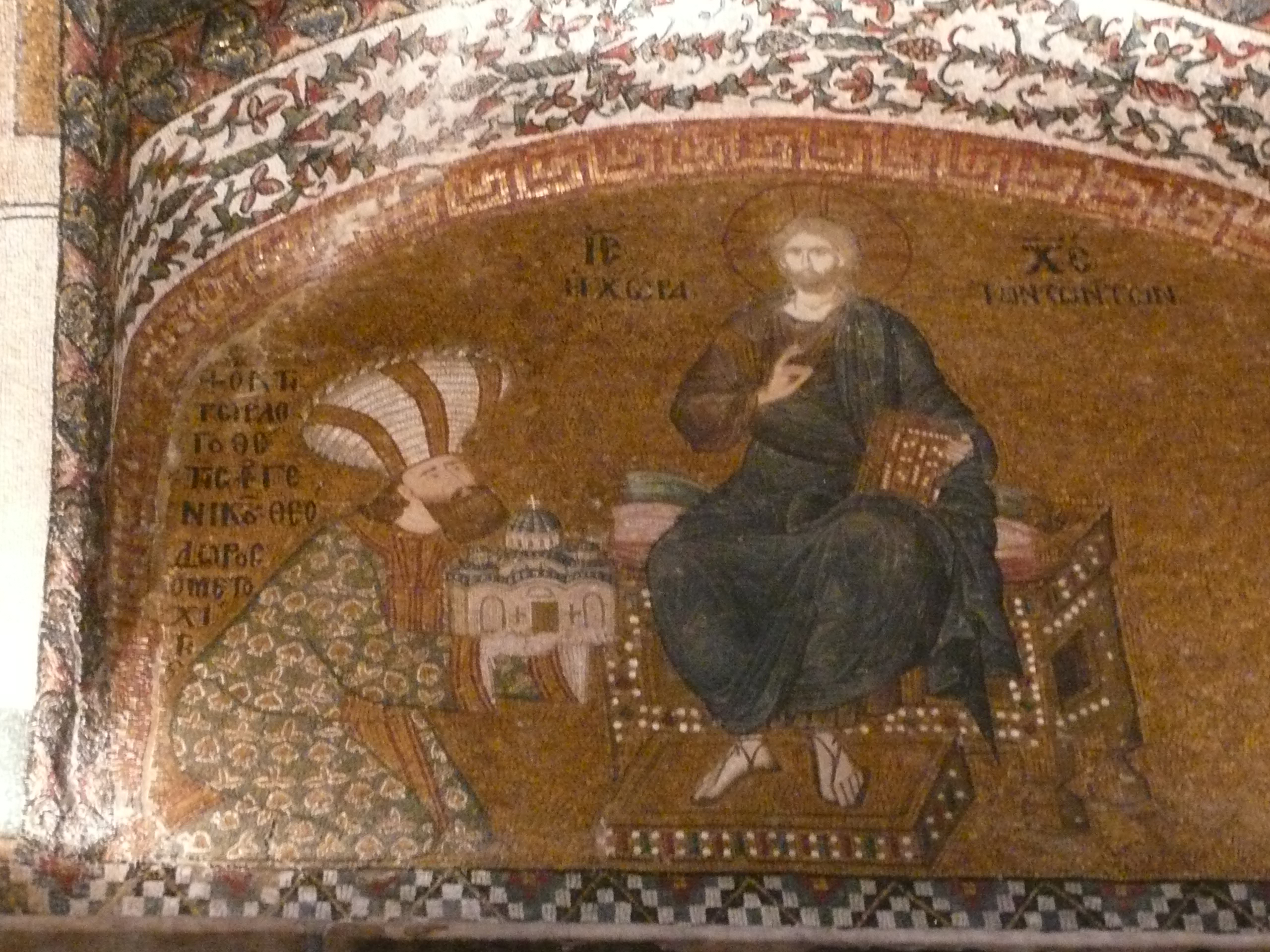
Today we saw Chora Church (pronounced "whore-ah")--also known as Kariye Camii. The name "Chora" is really just the last word of the formal greek title for the church: ἡ Ἐκκλησία του Ἅγιου Σωτῆρος ἐν τῃ Χώρᾳ (i.e.: the Church of the Holy Saviour in the Country). "Chora" means country. This church was located outside the walls built by Constantine (but was later enveloped by the growing city and the Theodosian walls built to protect the enlarged metropolis). The original church was built in the 5th century, but it went through several revisions (some necessitated by earthquakes, etc.). The most impressive parts of the current structure, including the elaborate mosaics and frescoes, were built in the 14th century. The man responsible for them, Theodore Metochites, was a rare man gifted academically and politically. He was the Byzantine equivalent of the Prime Minister at the height of his power, but then a regime change brought about his exile. He was allowed to return to Constantinople having promised to stay out of politics and be a monk at the Chora. This he did. In his last years he wrote that he hoped the Chora Church would secure his legacy until the end of the ages. It just might.
Impressive mosaics, frescos, and marble work fill the place--and yet so much is lost from it's Byzantine glory. We took a ton of pictures, but it's late and I need to get to bed. I'll just wrap up by saying that I'm enjoying this city more and more as I stay here. The place is electric with energy and vibrant in a dozen ways. Just walking down the streets is exhilarating.
-t
Tuesday, April 22, 2008
Blue Sky Plans for COTM
Quite a while ago I wrote on this blog about the "Blue Sky" project. Since even before I came there has been talk about some renewal of the physical church plant. Some of the ideas proposed are relatively minor cosmetic improvements (replacing the chairs and repainting the sanctuary, for example). But I was encouraged to look a bit beyond that to see if there are other architectural things we might to do to make our place more inviting, missional, and theologically expressive of the Gospel.
So down the road we went. Now we have a bunch of different related projects that form a kind of wish list. I doubt we'll do all of them, but it is worthwhile talking about things that seem out of reach, too. So... Here's what we've come up with so far...
As I said, we know it's unlikely that we'll suddenly come upon the cash to do all of these projects, but it's worth exploring what is possible in a clear blue sky of potentials!
New Chairs
Melana has sourced several possible chairs to replace the 1977 Steelcase chairs we currently have. One option is the relatively conventional church chairs now is use at places like SSJD, St. Augustine of Canterbury, etc. They look kind of like this...

Currently, the most important features that people identify are that the chairs should be stackable, have some place to put hymnals, have some way of hooking together, and should be tough enough to take many years' abuse. Sauder has lot of possibilities for this kind of chair.
Melana showed us some other possibilities as well, such as another chair from Steelcase that is a bit updated from what we have now. She is also fond of the Moller Church Chair.

Repainting the Sanctuary
A fairly obvious face-lift thing to do: repainting the interior. Right now it's gray with a whitish accent color. Melana suggests a simplified pallet in which white would dominate. Not just any white, but a specific white that would work just right.
Replace the Carpets in the Chancel, Lounge, and Sunday School Rooms
Melana showed us some samples from Interface, which is a Canadian firm that has led the way in both Green Manufacturing and in using carpet squares laid down much like tile. One of the several advantages of the carpet squares is that if one gets badly stained you can simply pull it up and replace the the one tile. She has ideas about a more fun design for the Sunday School Room and then something more subdued for the lounge and worship spaces.
Update Exterior Signage and Landscaping
Here's where things start to get really interesting. Everybody agrees that we need better signage. The reason that people notice the Hare Krishna Temple across the street and not us is that they have better signage! So check this conceptual drawing out:


A nice big banner to take advantage of the already-existing horizontal pole sticking out from the bell tower. At one time, a giant rainbow flag hung from there--but as we all know the meaning of symbols change over time!

In this one you can see Melana's concept of having some kind of horizontal sign to complement the vertical banner. It would have some kind of permanent element (our name, perhaps) and then some kind of LED element that would replace the function of our current acrylic letters. The cross would remain, and the three elements would be designed to work together like this...

In terms of landscaping, here is a version of the site-plan with Melana's idea drawn over it. The original design is "ghosted" underneath.

In this drawing, Avenue Road runs along the left edge and Dupont is along the bottom edge. The original plans from the 1976 Renovation indicate that much of the steps on the left side of this drawing (the east end of the church) were supposed to be removed, but that was never done. Melana proposes taking out some of those steps and basically cleaning up the lines of the planter beds. This plan would also replace the rotting railroad ties with more attractive stone (probably matching or complimenting the church). Plants going into the bed would be low-maintenance varieties.
Paint the Murals in the Sunday School Room
I've been wanting to spruce up the "Godly Play Room" since I came. Susan Bleasby has developed a marvelous concept for two huge murals on either end of the room. Here they are again...


It's the Kingdom of Heaven on one end and God's Kingdom on Earth on the other end. We would also, of course, replace the florescent tubes in the ceiling with more attractive hanging lights of some kind and replace the carpet.
Renovate the Chancel
Chancel renovation is a bit trickier. From this drawing you can see where Melana and I have gotten so far in our discussions...

So here the the current raised portion of the chancel has been removed and replaced with an oval-shaped platform on which the altar sits. This platform would have a rail for people to kneel for communion. It would be movable (perhaps on locking casters of some kind). So it could be brought out of the corner and into the center of the church, for instance, or simply centered under the stained glass window.
In the drawing Melana also proposed a second platform for the ministers to sit and to hold the Ambo. This is still a work in progress, but it shows how we are trying to make the space more flexible and resolve some of the issues of the current chancel (which is too far into the corner and too angular--the priest ends up facing an unpopulated corner of the room rather than the congregation).
Another important element Melana is thinking about has to do with the two curving walls in the corner behind the altar. She thinks we should creat a subtle light effect by painting the back side of one of the pannels. Light coming in from an existing window would then bounce off the paint and create a color wash on the front side of the other curved wall. (Those who know our church well will understand what I mean). It's a great idea.
Removing the two curved walls would mean abandoning the radial orientation of the church to that corner entirely, which would require redoing the ceiling and a host of other problems. But this chancel idea is definitely worth working on some more...
Enhance the Entrance to the Church

In this plan you see the main entry to the church as it is now, with Melana's proposal superimposed. People enter through the bottom doors, dog leg to the left, then swing around a 90 degree corner to the left and then again to the right (where it gets really narrow). Chief among the problems in that the proper entrance to the church is not clear from the outside of the building. Melana thinks that a nice canopy of some kind would make the entrance unambiguous. (Cf. Rosedale United Church's new glass canopy designed--I believe--by Ian McGillivray). The pink block shows where the canopy could go.
Melana also aligned the two doors and enlarged the area where you make the left into the church. On this drawing the green shows the amount of space currently there for making the turn left, while the aquamarine color shows how her proposed changes would enlarge the space and make for a more proper vestibule.
Add A Baptismal and Memorial Garden on the South Side of the Church
As Melana dreamed about possibilities, she noted an unused portion of land on the south side of the church. She then remembered how I felt a strong need to do something to architecturally emphasize baptism more than the current font allows. What she came up with was a garden in that space with a baptismal pool large and deep enough for adult full-immersion baptism and also a memorial wall with niches for the interment of ashes. Thus baptism and burial are linked (as they properly ought to be) and also baptism is located at the intersection of the church and the world (as it ought to be). The Garden would be screened off from the street, but large enough to have a serene outdoor kind of feeling.
The challenge was then connecting that garden to the church interior. There needs to be sufficient continuity to link the baptismal pool outside with the font inside. There also needs to be a sense that the sanctuary space continues into the outdoor space. So she proposes a set of three door under the already existing three windows on the south side of the church. They would be glass--acoustically and thermally opaque yet visually transparent. She imagines them pivoting on a point a few inches from the inside edge.

This is brilliant. I don't know if we can do it, but my God would it be beautiful! Imagine the feeling of sitting in this little urban oasis with the pool and the burial niches and the gorgeous stone of the church. Imagine doing baptisms out there! I love it.
So...
Now for the practical stuff. We need to introduce these ideas to the congregation. We need to hear people's ideas and develop the the plans further in response. We need to think about costs and scope. Not to mention what kind of permits are required for what kind of change. It's daunting, but exhilarating. Apparently mine is a kind of "go big or go home" kind of ministry moment. I suppose this is what "entrepreneurial ministry" looks like in established Anglican churches. Cool. I can do that.
What I have to be careful about is that this doesn't replace the other kinds of evangelism and mission we are about. I'm very keen to develop some other initiatives. This may cover the "Attractional Evangelism" piece, but I also want to develop program that will help people grow in Discipleship ("Process Evangelism") and found new groups that incarnate God's love in this neighborhood ("Relational Evangelism"). So much to do. I'm praying god will send me more people to help. It's really amazing. Praise be to God. Time for supper...
-t
So down the road we went. Now we have a bunch of different related projects that form a kind of wish list. I doubt we'll do all of them, but it is worthwhile talking about things that seem out of reach, too. So... Here's what we've come up with so far...
- New Chairs
- Repaint the Sanctuary
- Replace the Carpets in the Chancel, Lounge, and Sunday School Rooms
- Update Exterior Signage and Landscaping
- Paint the Murals in the Sunday School Room
- Renovate the Chancel
- Enhance the Entrance to the Church
- Add A Baptismal and Memorial Garden on the South Side of the Church
As I said, we know it's unlikely that we'll suddenly come upon the cash to do all of these projects, but it's worth exploring what is possible in a clear blue sky of potentials!
New Chairs
Melana has sourced several possible chairs to replace the 1977 Steelcase chairs we currently have. One option is the relatively conventional church chairs now is use at places like SSJD, St. Augustine of Canterbury, etc. They look kind of like this...

Currently, the most important features that people identify are that the chairs should be stackable, have some place to put hymnals, have some way of hooking together, and should be tough enough to take many years' abuse. Sauder has lot of possibilities for this kind of chair.
Melana showed us some other possibilities as well, such as another chair from Steelcase that is a bit updated from what we have now. She is also fond of the Moller Church Chair.
Repainting the Sanctuary
A fairly obvious face-lift thing to do: repainting the interior. Right now it's gray with a whitish accent color. Melana suggests a simplified pallet in which white would dominate. Not just any white, but a specific white that would work just right.
Replace the Carpets in the Chancel, Lounge, and Sunday School Rooms
Melana showed us some samples from Interface, which is a Canadian firm that has led the way in both Green Manufacturing and in using carpet squares laid down much like tile. One of the several advantages of the carpet squares is that if one gets badly stained you can simply pull it up and replace the the one tile. She has ideas about a more fun design for the Sunday School Room and then something more subdued for the lounge and worship spaces.
Update Exterior Signage and Landscaping
Here's where things start to get really interesting. Everybody agrees that we need better signage. The reason that people notice the Hare Krishna Temple across the street and not us is that they have better signage! So check this conceptual drawing out:


A nice big banner to take advantage of the already-existing horizontal pole sticking out from the bell tower. At one time, a giant rainbow flag hung from there--but as we all know the meaning of symbols change over time!

In this one you can see Melana's concept of having some kind of horizontal sign to complement the vertical banner. It would have some kind of permanent element (our name, perhaps) and then some kind of LED element that would replace the function of our current acrylic letters. The cross would remain, and the three elements would be designed to work together like this...

In terms of landscaping, here is a version of the site-plan with Melana's idea drawn over it. The original design is "ghosted" underneath.

In this drawing, Avenue Road runs along the left edge and Dupont is along the bottom edge. The original plans from the 1976 Renovation indicate that much of the steps on the left side of this drawing (the east end of the church) were supposed to be removed, but that was never done. Melana proposes taking out some of those steps and basically cleaning up the lines of the planter beds. This plan would also replace the rotting railroad ties with more attractive stone (probably matching or complimenting the church). Plants going into the bed would be low-maintenance varieties.
Paint the Murals in the Sunday School Room
I've been wanting to spruce up the "Godly Play Room" since I came. Susan Bleasby has developed a marvelous concept for two huge murals on either end of the room. Here they are again...


It's the Kingdom of Heaven on one end and God's Kingdom on Earth on the other end. We would also, of course, replace the florescent tubes in the ceiling with more attractive hanging lights of some kind and replace the carpet.
Renovate the Chancel
Chancel renovation is a bit trickier. From this drawing you can see where Melana and I have gotten so far in our discussions...

So here the the current raised portion of the chancel has been removed and replaced with an oval-shaped platform on which the altar sits. This platform would have a rail for people to kneel for communion. It would be movable (perhaps on locking casters of some kind). So it could be brought out of the corner and into the center of the church, for instance, or simply centered under the stained glass window.
In the drawing Melana also proposed a second platform for the ministers to sit and to hold the Ambo. This is still a work in progress, but it shows how we are trying to make the space more flexible and resolve some of the issues of the current chancel (which is too far into the corner and too angular--the priest ends up facing an unpopulated corner of the room rather than the congregation).
Another important element Melana is thinking about has to do with the two curving walls in the corner behind the altar. She thinks we should creat a subtle light effect by painting the back side of one of the pannels. Light coming in from an existing window would then bounce off the paint and create a color wash on the front side of the other curved wall. (Those who know our church well will understand what I mean). It's a great idea.
Removing the two curved walls would mean abandoning the radial orientation of the church to that corner entirely, which would require redoing the ceiling and a host of other problems. But this chancel idea is definitely worth working on some more...
Enhance the Entrance to the Church

In this plan you see the main entry to the church as it is now, with Melana's proposal superimposed. People enter through the bottom doors, dog leg to the left, then swing around a 90 degree corner to the left and then again to the right (where it gets really narrow). Chief among the problems in that the proper entrance to the church is not clear from the outside of the building. Melana thinks that a nice canopy of some kind would make the entrance unambiguous. (Cf. Rosedale United Church's new glass canopy designed--I believe--by Ian McGillivray). The pink block shows where the canopy could go.
Melana also aligned the two doors and enlarged the area where you make the left into the church. On this drawing the green shows the amount of space currently there for making the turn left, while the aquamarine color shows how her proposed changes would enlarge the space and make for a more proper vestibule.
Add A Baptismal and Memorial Garden on the South Side of the Church
As Melana dreamed about possibilities, she noted an unused portion of land on the south side of the church. She then remembered how I felt a strong need to do something to architecturally emphasize baptism more than the current font allows. What she came up with was a garden in that space with a baptismal pool large and deep enough for adult full-immersion baptism and also a memorial wall with niches for the interment of ashes. Thus baptism and burial are linked (as they properly ought to be) and also baptism is located at the intersection of the church and the world (as it ought to be). The Garden would be screened off from the street, but large enough to have a serene outdoor kind of feeling.
The challenge was then connecting that garden to the church interior. There needs to be sufficient continuity to link the baptismal pool outside with the font inside. There also needs to be a sense that the sanctuary space continues into the outdoor space. So she proposes a set of three door under the already existing three windows on the south side of the church. They would be glass--acoustically and thermally opaque yet visually transparent. She imagines them pivoting on a point a few inches from the inside edge.

This is brilliant. I don't know if we can do it, but my God would it be beautiful! Imagine the feeling of sitting in this little urban oasis with the pool and the burial niches and the gorgeous stone of the church. Imagine doing baptisms out there! I love it.
So...
Now for the practical stuff. We need to introduce these ideas to the congregation. We need to hear people's ideas and develop the the plans further in response. We need to think about costs and scope. Not to mention what kind of permits are required for what kind of change. It's daunting, but exhilarating. Apparently mine is a kind of "go big or go home" kind of ministry moment. I suppose this is what "entrepreneurial ministry" looks like in established Anglican churches. Cool. I can do that.
What I have to be careful about is that this doesn't replace the other kinds of evangelism and mission we are about. I'm very keen to develop some other initiatives. This may cover the "Attractional Evangelism" piece, but I also want to develop program that will help people grow in Discipleship ("Process Evangelism") and found new groups that incarnate God's love in this neighborhood ("Relational Evangelism"). So much to do. I'm praying god will send me more people to help. It's really amazing. Praise be to God. Time for supper...
-t
Monday, April 21, 2008
Enthusiasm
I just got back from a fantastic Parish Council meeting. What made it so great? Since it was the first Parish Council meeting of the the year we had to elect a Chair and do a few other housekeeping items, but the biggest thing was meeting the Parish Architect--Melana Janzen--and hearing her presentation about some of the ideas we've been developing. I'll do another post to lay them all out, but they are fantastic. It's a wish list that includes things like better signage, a cleaned up entryway, and then some really fun projects like creating a baptismal/memorial garden and redoing the chancel. As I said, I'll post some of the sketches when I have a chance tomorrow.
It's really neat to be engaging in a process that creates so much energy and sense of renewal. I'm very happy to see how people get so engaged with these ideas. I'm pleased.
So... More tomorrow....
(Also today--Betsy and I filled 21 large lawn waste bags with stuff we raked up. The lawn looks much better, but it was a lot of work.)
-t
It's really neat to be engaging in a process that creates so much energy and sense of renewal. I'm very happy to see how people get so engaged with these ideas. I'm pleased.
So... More tomorrow....
(Also today--Betsy and I filled 21 large lawn waste bags with stuff we raked up. The lawn looks much better, but it was a lot of work.)
-t
Wednesday, April 16, 2008
Liturgy and Architecture
I had lunch today with a person very involved at the national level of Anglican Church of Canada liturgy. It was great fun to talk about what's being done in various places and what projects are currently in development and so forth. I'm always up for talking about liturgy! She was particularly interested to hear about the Contemplative Eucharist I've been developing here. But we had our two-hour lunch on the patio at the Pour House and I ended up with a sunburn! Ah, well.
Another highlight of the day was meeting with our architect to talk about what we are going to present to the Parish Council on Monday. The ideas are stellar and all very exciting. It will be interesting to see what others respond to. After that meeting I'll be able to be a bit more open in this blog about what some of these ideas actually are. At the moment it's a bit of a laundry list, but the common theme is renewal and rejuvenation.
Tomorrow morning I'm off to Holy Cross for a check-in with my Spiritual Director. It's a brief trip (I'll be back Saturday), but I find that I can settle into the rhythms of the place almost instantly. So that will be good!
I've been here since 8 AM and won't be finished with my work day until about 9.30pm. I've got a meeting tonight of a local interfaith group.
-t
Another highlight of the day was meeting with our architect to talk about what we are going to present to the Parish Council on Monday. The ideas are stellar and all very exciting. It will be interesting to see what others respond to. After that meeting I'll be able to be a bit more open in this blog about what some of these ideas actually are. At the moment it's a bit of a laundry list, but the common theme is renewal and rejuvenation.
Tomorrow morning I'm off to Holy Cross for a check-in with my Spiritual Director. It's a brief trip (I'll be back Saturday), but I find that I can settle into the rhythms of the place almost instantly. So that will be good!
I've been here since 8 AM and won't be finished with my work day until about 9.30pm. I've got a meeting tonight of a local interfaith group.
-t
Sunday, February 3, 2008
Architecture
Last week I had a friend of mine who is also an architect come by to give me an informal consult about the church. The further along I go with developing plans for replacing the chairs and repainting the interior, etc., the more aware I become that I'm a bit out of my depth when it comes to things like choosing chairs or picking color schemes.
Looking at the space, she said that she could see what the architects who did the 1976 reconstruction (after the fire) were trying to accomplish and also how their plans didn't always work. She said that the challenge was to go with less, not more. Looking around, it's hard to easily identify the elements that could be removed. For example, the vertical columns near the storage closets don't "work" from an aesthetic point of view, but were obviously necessary to support the weight of the daycare above.
So she's going away to think about it some more and come back to me the outline of a proposal. Once I have that in hand I can begin to bundle the pieces together to make a physical plant renewal plan and start raising money.
Speaking of church architecture, I've decided to go back to the collegiate-style (aka choir style) seating arrangement for Lent. It simply does the work of liturgy (worship and transformation) better than the common layout usually used here.
-t
Looking at the space, she said that she could see what the architects who did the 1976 reconstruction (after the fire) were trying to accomplish and also how their plans didn't always work. She said that the challenge was to go with less, not more. Looking around, it's hard to easily identify the elements that could be removed. For example, the vertical columns near the storage closets don't "work" from an aesthetic point of view, but were obviously necessary to support the weight of the daycare above.
So she's going away to think about it some more and come back to me the outline of a proposal. Once I have that in hand I can begin to bundle the pieces together to make a physical plant renewal plan and start raising money.
Speaking of church architecture, I've decided to go back to the collegiate-style (aka choir style) seating arrangement for Lent. It simply does the work of liturgy (worship and transformation) better than the common layout usually used here.
-t
Saturday, November 17, 2007
A Rolling Moss Gathers No Stone
Back when I was studying Karate with great intensity (High School) one of my teachers would say "A Rolling Moss Gathers No Stone." He was encouraging me to move decisively and with speed--I think he would appreciate my current application of that principle. Even if I wanted to linger on the theft I wouldn't have time.
Much of my day today will be consumed by a Synod meeting to take care of some Diocesan business--including the election of a new bishop. Since I've been in this Diocese for a little more than 2 years, I've participated in two of these elections already! Lucky for me, this Synod is taking place at a church within walking distance of COTM. Unlucky for me, my attendance is nearly compulsory and once we enter we are virtually sequestered. That's too bad, as otherwise I would be preparing for tomorrow.
My Uncle Cliff is coming tonight. He'll come to church in the morning and then leaves to continue his trip west to see his kids on Monday. It's a short trip, but a meaningful one.
His coming on a big church day. I'm giving a powerpoint sermon on church architecture and liturgy to introduce the Advent seating arrangement. I spent a few hours on Friday arranging the space and taking some pictures to show the congregation. Here are two of them...


Now this is just going to be an experimental arrangement for Advent and possibly the Christmas season--and for the next two Sundays we will continue with the "normal" arrangement. But I have to say that it is going to break my heart to put things back the way they were this afternoon. I've got lots of good liturgical and historical and theological and even pastoral arguments for the choir-style seating arrangement, however what I find even more compelling the gut feeling this place has when arranged like that. I'm sorely tempted to leave the chairs like this for Sunday, but I realize that I'll be pushing the envelope of how much change I can get away with.
You see, there is a fundamental difference between change that is experienced as continuous vs. discontinuous is huge. In other words, gradual change where one thing flows into another is much easier for a community to handle than radical and surprising shifts. As a leader you often can't determine where a change will fall on that spectrum, but I can in this case, so I should choose to make it a change that has high-continuity with the flow of events. That means introducing it gradually and giving plenty of notice. That's why we are doing three sermons on liturgy and assuring everyone that this will be a temporary and seasonal thing.
Nonetheless, I'm hopeful that people will like it so much they will want to retain it. Several of my predecessors have done similar things with the space here, or wanted to, so I'm in good company. I'm deeply thankful that I have a congregation unafraid to experiment in this way.
Another thing happening on Sunday is a meeting of the Advent Liturgy Committee. This has continuity with the group that used to gather to decorate for Christmas--only this time they are dressing the space for Advent as a separate beat from the Christmas decorating. And that "dressing" of the space will be done with an eye towards liturgy. I expect that many of the traditional elements will be maintained (garlands here, wreaths there) but others will be completely new. My hope is that when we meet after church on Sunday there will be a lot of enthusiasm and energy generating that will propel our efforts forward and even get some new people involved in the project.
Oh, and the Christmas Pageant group is getting together to do more planning. I promised to make more progress on the script! Ahhggg!
So as I get ready to walk down to St. Paul's, Bloor St., for the Synod, I'll be thinking about the feasibility of pulling an all-nighter tonight to get all done. Caffeine is my friend.
-t
Much of my day today will be consumed by a Synod meeting to take care of some Diocesan business--including the election of a new bishop. Since I've been in this Diocese for a little more than 2 years, I've participated in two of these elections already! Lucky for me, this Synod is taking place at a church within walking distance of COTM. Unlucky for me, my attendance is nearly compulsory and once we enter we are virtually sequestered. That's too bad, as otherwise I would be preparing for tomorrow.
My Uncle Cliff is coming tonight. He'll come to church in the morning and then leaves to continue his trip west to see his kids on Monday. It's a short trip, but a meaningful one.
His coming on a big church day. I'm giving a powerpoint sermon on church architecture and liturgy to introduce the Advent seating arrangement. I spent a few hours on Friday arranging the space and taking some pictures to show the congregation. Here are two of them...


Now this is just going to be an experimental arrangement for Advent and possibly the Christmas season--and for the next two Sundays we will continue with the "normal" arrangement. But I have to say that it is going to break my heart to put things back the way they were this afternoon. I've got lots of good liturgical and historical and theological and even pastoral arguments for the choir-style seating arrangement, however what I find even more compelling the gut feeling this place has when arranged like that. I'm sorely tempted to leave the chairs like this for Sunday, but I realize that I'll be pushing the envelope of how much change I can get away with.
You see, there is a fundamental difference between change that is experienced as continuous vs. discontinuous is huge. In other words, gradual change where one thing flows into another is much easier for a community to handle than radical and surprising shifts. As a leader you often can't determine where a change will fall on that spectrum, but I can in this case, so I should choose to make it a change that has high-continuity with the flow of events. That means introducing it gradually and giving plenty of notice. That's why we are doing three sermons on liturgy and assuring everyone that this will be a temporary and seasonal thing.
Nonetheless, I'm hopeful that people will like it so much they will want to retain it. Several of my predecessors have done similar things with the space here, or wanted to, so I'm in good company. I'm deeply thankful that I have a congregation unafraid to experiment in this way.
Another thing happening on Sunday is a meeting of the Advent Liturgy Committee. This has continuity with the group that used to gather to decorate for Christmas--only this time they are dressing the space for Advent as a separate beat from the Christmas decorating. And that "dressing" of the space will be done with an eye towards liturgy. I expect that many of the traditional elements will be maintained (garlands here, wreaths there) but others will be completely new. My hope is that when we meet after church on Sunday there will be a lot of enthusiasm and energy generating that will propel our efforts forward and even get some new people involved in the project.
Oh, and the Christmas Pageant group is getting together to do more planning. I promised to make more progress on the script! Ahhggg!
So as I get ready to walk down to St. Paul's, Bloor St., for the Synod, I'll be thinking about the feasibility of pulling an all-nighter tonight to get all done. Caffeine is my friend.
-t
Wednesday, November 14, 2007
A Visit to SMM
One of the things that is really good about the Contemplative Eucharist is that it is worship that speaks strongly to the point that we never worship alone, but are always joined "by so great a cloud of witnesses." I remember friends from seminary for whom liturgy was reduced to a moment of lateral communion--the community gathered--and ignored the notion that liturgy is also about participating in something larger than our particular community or gathering. I think another baby sometimes thrown out with the bath water is the notion of the church as iconic of God's continuing presence. I suppose if my first point speaks to the notion of Church-as-temple, my second goes to Church-as-tabernacle--we need both.
An implication of this is that moving to chairs to be collegiate-style is all well and good, but I need to also create a sense of connection to something more transcendant. One of the parishes where I grew up, St. Alban's, Wichita, KS, created a very interesting installation that accomplishes this. I'll have to bring this up at Sunday's Advent decorations planning committee.
After celebrating the Contemplative Eucharist, I went to SMM for Edith Long's Requiem Mass. People were glad to see me and I them, but being there stirred up strong feelings. Some of those feelings are enjoyable and pleasant, but there is some sadness and pain there for me, too. I never managed to accomplish as much as I had hoped, and still feel like I let people down. I'm sure that if I told the SMM congregation that they would counter with the stuff I did which was of value, but I still can't help but think of the many different initiatives and changes that I was unable to get off the ground. Fundamentally, I thought my job was to create the change necessary for growth, but in reality my job was to maintain the status quo. I always felt caught between my call to build the kingdom and my obedience to doing what I was told. In that sense the Story of Fr. Tay at SMM probably says a great deal about this moment in that parish's history: the tension between two worlds.
Interestingly, I think this is why much of the preaching at SMM (mine and Fr. Harold's) often addressed the relationship between the Church/Christians and the world. Today Harold's sermon was tight, economic, and fat-free--six minutes that said exactly what needed to be said. And although the bulk of it was spent talking about Edith and her place in the SMM community, he did not neglect to mention how our view of death and the afterlife conflicts with that of our contemporary society. "Heaven," Harold preached, "is not sitting on a cloud eating Philadelphia Cream Cheese."

He's got a point, but I think the fact that we always seemed to be preaching about our place in post-Christian North American society shows that we never really resolved the fundamental problem that SMM faces--i.e. what do we have to say to downtown Toronto?
There is more I could say on the subject of what Anglo-Catholic evangelism could look like, but I'm afraid those ideas are echoes of a ministry fading into a mere two years of parish history. As much as I would like to offer my insight and help, it's time for me to move on. COTM is such fertile ground that, as ideas go, I could plant a pencil and it would grow. There are incredible resources here for transformative ministry--I just have to keep reminding myself that I've only been here for 2 1/2 months!
Stopped by John Hill's Church (St. Augustine of Canterbury) and dropped off the chairs we borrowed to show the congregation. I also picked up a few books from his (personal) library on church architecture. John is a local expert on liturgy and architecture, and I can foresee having many conversations about these matters soon. I knew a fair amount about this stuff before coming to COTM, but God knows I'm learning a lot more in a hurry! For instance, is the Great Litany a good choice to cover the action of asperging the congregation during the gathering rite? Answer: yes. In fact, the Lutherans suggest doing something quite similar to that in their new prayer book.
BTW, check out this cool font from The Cathedral of Our Saviour (Episcopal) in Philadelphia:

And of course they seat the people collegial style for the Liturgy of the Word.
-t
An implication of this is that moving to chairs to be collegiate-style is all well and good, but I need to also create a sense of connection to something more transcendant. One of the parishes where I grew up, St. Alban's, Wichita, KS, created a very interesting installation that accomplishes this. I'll have to bring this up at Sunday's Advent decorations planning committee.
After celebrating the Contemplative Eucharist, I went to SMM for Edith Long's Requiem Mass. People were glad to see me and I them, but being there stirred up strong feelings. Some of those feelings are enjoyable and pleasant, but there is some sadness and pain there for me, too. I never managed to accomplish as much as I had hoped, and still feel like I let people down. I'm sure that if I told the SMM congregation that they would counter with the stuff I did which was of value, but I still can't help but think of the many different initiatives and changes that I was unable to get off the ground. Fundamentally, I thought my job was to create the change necessary for growth, but in reality my job was to maintain the status quo. I always felt caught between my call to build the kingdom and my obedience to doing what I was told. In that sense the Story of Fr. Tay at SMM probably says a great deal about this moment in that parish's history: the tension between two worlds.
Interestingly, I think this is why much of the preaching at SMM (mine and Fr. Harold's) often addressed the relationship between the Church/Christians and the world. Today Harold's sermon was tight, economic, and fat-free--six minutes that said exactly what needed to be said. And although the bulk of it was spent talking about Edith and her place in the SMM community, he did not neglect to mention how our view of death and the afterlife conflicts with that of our contemporary society. "Heaven," Harold preached, "is not sitting on a cloud eating Philadelphia Cream Cheese."
He's got a point, but I think the fact that we always seemed to be preaching about our place in post-Christian North American society shows that we never really resolved the fundamental problem that SMM faces--i.e. what do we have to say to downtown Toronto?
There is more I could say on the subject of what Anglo-Catholic evangelism could look like, but I'm afraid those ideas are echoes of a ministry fading into a mere two years of parish history. As much as I would like to offer my insight and help, it's time for me to move on. COTM is such fertile ground that, as ideas go, I could plant a pencil and it would grow. There are incredible resources here for transformative ministry--I just have to keep reminding myself that I've only been here for 2 1/2 months!
Stopped by John Hill's Church (St. Augustine of Canterbury) and dropped off the chairs we borrowed to show the congregation. I also picked up a few books from his (personal) library on church architecture. John is a local expert on liturgy and architecture, and I can foresee having many conversations about these matters soon. I knew a fair amount about this stuff before coming to COTM, but God knows I'm learning a lot more in a hurry! For instance, is the Great Litany a good choice to cover the action of asperging the congregation during the gathering rite? Answer: yes. In fact, the Lutherans suggest doing something quite similar to that in their new prayer book.
BTW, check out this cool font from The Cathedral of Our Saviour (Episcopal) in Philadelphia:
And of course they seat the people collegial style for the Liturgy of the Word.
-t
Sunday, July 15, 2007
Sunday Recap
Bede just wrote a great blog entry about beauty. Creation of beauty (or perhaps it's co-creation?) has been an important task of religious folks all over the world for a very long time. Creation is a spiritual activity. We are quite used to certain kinds of creativity in church. Traditional church music, for example. But it's too bad that most churches aren't brave enough to journey with the artists that are stretching the creative envelope. I'm not totally sure why that is, but I suspect it has to do with the insider-outsider problem: we want insider art inside our churches. There are exceptions, of course. Note The Episcopal Church and Visual Arts project.
Part of my vision for a 21st century pastorate is the cultivation of my own creative abilities. Not just learning to sing "priest-chant" or collaborating in conventional church art forms like vesture and architecture--I want to push the envelope a bit. That's why my video project is important--we need to proclaim the Gospel in new tongues. Watch Father Matthew Presents to get an idea of where I'm heading...
Speaking of singing, I got some nice compliments on my singing at the 11 o'clock Mass today. Yeah!
Betsy returns in one week. I can hardly wait...
-t
Part of my vision for a 21st century pastorate is the cultivation of my own creative abilities. Not just learning to sing "priest-chant" or collaborating in conventional church art forms like vesture and architecture--I want to push the envelope a bit. That's why my video project is important--we need to proclaim the Gospel in new tongues. Watch Father Matthew Presents to get an idea of where I'm heading...
Speaking of singing, I got some nice compliments on my singing at the 11 o'clock Mass today. Yeah!
Betsy returns in one week. I can hardly wait...
-t
Subscribe to:
Posts (Atom)