My Dad and Mary Lou's farm was one of the stops on this tour of the Big Island in a $350,000 Ferrari FF. You can fast-forward to about 6 minutes in to see his farm. My dad said the hosts and crew for the show were nice and very professional. Later in this video they summit Mauna Kea, which brought back some memories for sure!
As awesome as this car is and fun it would be on the Big Island, I think I would still prefer something like the Jeep we rented the last time we were there. So much of Hawai'i is still a bit rough and having a real 4WD vehicle simply means that you can visit more places, which is surely the point of a vacation in paradise! (Click on either of the links in this last paragraph to see some of our Jeep adventures.)
Showing posts with label car. Show all posts
Showing posts with label car. Show all posts
Wednesday, March 27, 2013


Tuesday, June 16, 2009
Zen and the Art of Motorcycle Mainenance

Zen and The Art of Motorcycle Maintenance: An Inquiry Into Values is a well known book by Robert Pirsig which is part travel journal, part philosophy book, part novel. It's really a meditation on lessons learned both in academia and on the back of a motorcycle. Well worth the read.
It comes up in my mind today because Stanley Fish referenced it in his latest blog entry. In it, Fish summarizes Pirsig's phenomenological approach:
Pirsig’s example is describing the parts of a motorcycle, an exercise that has no natural stopping point. But, he insists, no matter how much data the exercise heaped up, true comprehension would still not have been achieved, for the motorcycle “so described is almost impossible to understand unless you know how it works.” Rather than building up from particulars to generals (the empiricist method), you must begin with generals — with an in-place, intuitive awareness of what motorcycles are for, of what can go wrong with them, of what can go right with them — and within that tacit knowledge you will know where to direct your analytic attention. You can’t just begin with analytic attention, with “mere” or “pure” observation, and expect to get anywhere; you must already, in a sense, be there.
The problem is that once the parts or facts are made to appear, they seem to possess an independence, and it is (literally) tempting to rest in them and to believe that they are the foundation of things. (In theology this mistake is called idolatry.) “The division of the world into parts,” says Pirsig, “is something everyone does,” but in doing it, “something is always killed” — and what is killed is an awareness of and contact with the world before analytic thought has done its (necessarily) reductive work. (source)
The paradox is that a phenomenological approach, where we begin with what can be grasped will necessarily limit us to what we are able to pay attention to. Inevitably, we will focus on the wrong things. In maintenance terms, when you have a problem you tend to want to make it into a problem you have experience with in the past, even though it may be an entirely new malfunction. Trying to solve this paradox drove Prisig nearly insane.
In Matthew Crawford's recent book Shop Class as Soulcraft: An Inquiry into the Value of Work also uses mechanical labour as a way to explore grand themes of both philosophy and father-son dynamics.
In time, this realization leads him to a position like Pirsig’s, but he holds it polemically and without anxiety: “To regard universal knowledge as the whole of knowledge is to take no account of embodiment and purposiveness.” We should not, he says, “separate knowing from doing,” and it makes sense that his model of the true “knowledge worker” is not his father the theoretician, but the mechanic or craftsman whose knowledge resides in his hands and in his hands-on experience.
It follows then that the modern tendency to move further and further from the site of physical labor (by, for example, designing automobiles on a computer or teaching people to fly in a simulated cockpit) is disastrously wrong. As computer diagnosis takes the place of fiddling around with the machinery, “we have too few occasions to do anything because of a certain predetermination of things from afar.” (source)
Again, a worthwhile read--especially as regards the nature of work and craftsmanship. Though he can be a bit polemical at times.
 But we shouldn't loose sight of one of the other main points of these books: relationships between father and son mediated through metal. It's a trope so common as to almost slip into cliché. (Here is a picture of Prisig with his son, Chris, on the trip that became the basis for the book.) Yet I know a lot of men who bonded with their fathers in precisely this way. Indeed, the time spent with my father working on his old TR-3 are a very special memory to me. Other examples abound: a writer helps his son assemble a Shelby Cobra kit as a reward for good grades. A university professor learns to find joy in work again when he reconnects with his motorcycle mechanic father.
 It's a form of benign triangulation--introducing a third party into a relationship between two tends to stabilize the emotional system and lower the anxiety in the system. (Cf. Friedman) Other father-son relationships might use sports in the same way. Really, any hobby can function to facilitate the father-son bond.
I don't know how this plays out in mother-daughter relationships. I suspect it is similar, but I've obviously never observed it from the inside. Maybe someone will comment about that.
This is on my mind for obvious reasons. Father's day approaches. And I've been thinking of what kind of father I will be by the time it comes again next year. Obviously, I hope to be a good one, but how does one go about becoming "good" at a thing like parenting without trial-and-error experience? Perhaps for this reason we should just start saving up for therapy now (advice someone gave me on Sunday), and focus instead on the second or third child. By then we may have learned something about the craft of parenting!
-t
Friday, April 24, 2009
Stewardship
Just recently the Stewardship Committee of the church had it's first meeting. It went extremely well and the ideas flowed fast and furious. Lots of creativity and energy! I'm looking forward to sharing more of what we came up with once it's formed. We looked at the programme recommended by the Diocese, but then took it a few steps further that take it into new ground. More specifically, we've cup with a way of making it more missional. I'll write more about what we have in mind later...
This week has been busy, I'm definitely looking forward to sleeping in tomorrow morning and then having a relatively light day at work. Perhaps I'll finally finish editing the video from Sunday's sermon!
Lately I've been intrigued by the possibility of building my own sports car--specifically a variation of the Shelby Cobra. I'm not talking about building a replica of the 60's era car, but rather marrying the classic styling with the best of modern technologies. For instance, you can build a cobra-like roadster with anti-lock breaks and an advanced dual-overhead cam, fuel injected engine. Many people do this by buying a used Mustang to use as a "donor." The engine, transmission, breaks, power steering etc. are then used in conjunction with a kit that provides the frame, suspension, body, etc., etc. The other option is to build car completely from new parts, also with a kit. Either way, one the most popular such kits, made by Factory Five, is designed to keep project costs to about $24,000 (including the donor car) and 200 hours of labour. That's an extremely reasonable price (both in terms of time and money) when you consider that the typical Cobra kit-built car can outperform almost any production exotic sports car. Even with a 350HP V-8 it can accelerate faster than a Porsche 911 and is only beaten in 0-60 by the $650,000 Enzo Ferrari! If that's not good enough, you can get even more powerful engines until you reach the car's design limit of 1,000HP. Yes, people have put a 1,000HP engine in a 2,000 lbs convertible!
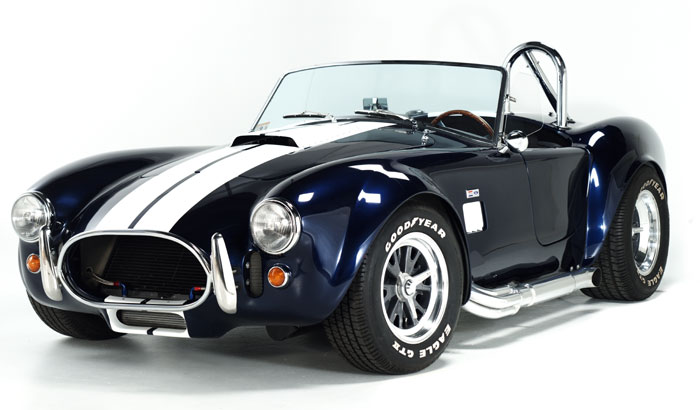
A Factory Five Mark 3 Roadster
These kits are available from a number of different companies, and there is a very large community of helpful enthusiasts to lend advice during the project. Reading about it on-line, I'm extremely impressed by what "average joes" have been able to build in their home garages without a lot of special equipment or even experience at car-building.
So my fantasy is to spend two months some summer building my own car by hand. Alas, this will probably have to wait a few years until whatever kids we might have are off to University and I've got both the time and the money to do such a project. I'm reminded of the New York Times reporter that built a Cobra as a father-son project. Maybe when Betsy and I have kids I'll take on a project like that with my son or daughter. We'll see, I'm getting ahead of myself!
Why do I find this so compelling? I think I just enjoy the craft of building something as complex and sexy as a really hot car. I get great satisfaction from using a computer that I built myself, and this is really just an extension of that. What can I say, I like building stuff!
Speaking of ORAC (my computer)... That project went extremely well. I've had no troubles at all with that set-up. At least, not from a hardware point of view--Windows Vista can be temperamental sometimes. But I find the processing horsepower of that beast very helpful with all the video and audio editing I've been doing lately.
Anyway, time for bed. I'm tired.
-t
This week has been busy, I'm definitely looking forward to sleeping in tomorrow morning and then having a relatively light day at work. Perhaps I'll finally finish editing the video from Sunday's sermon!
Lately I've been intrigued by the possibility of building my own sports car--specifically a variation of the Shelby Cobra. I'm not talking about building a replica of the 60's era car, but rather marrying the classic styling with the best of modern technologies. For instance, you can build a cobra-like roadster with anti-lock breaks and an advanced dual-overhead cam, fuel injected engine. Many people do this by buying a used Mustang to use as a "donor." The engine, transmission, breaks, power steering etc. are then used in conjunction with a kit that provides the frame, suspension, body, etc., etc. The other option is to build car completely from new parts, also with a kit. Either way, one the most popular such kits, made by Factory Five, is designed to keep project costs to about $24,000 (including the donor car) and 200 hours of labour. That's an extremely reasonable price (both in terms of time and money) when you consider that the typical Cobra kit-built car can outperform almost any production exotic sports car. Even with a 350HP V-8 it can accelerate faster than a Porsche 911 and is only beaten in 0-60 by the $650,000 Enzo Ferrari! If that's not good enough, you can get even more powerful engines until you reach the car's design limit of 1,000HP. Yes, people have put a 1,000HP engine in a 2,000 lbs convertible!
These kits are available from a number of different companies, and there is a very large community of helpful enthusiasts to lend advice during the project. Reading about it on-line, I'm extremely impressed by what "average joes" have been able to build in their home garages without a lot of special equipment or even experience at car-building.
So my fantasy is to spend two months some summer building my own car by hand. Alas, this will probably have to wait a few years until whatever kids we might have are off to University and I've got both the time and the money to do such a project. I'm reminded of the New York Times reporter that built a Cobra as a father-son project. Maybe when Betsy and I have kids I'll take on a project like that with my son or daughter. We'll see, I'm getting ahead of myself!
Why do I find this so compelling? I think I just enjoy the craft of building something as complex and sexy as a really hot car. I get great satisfaction from using a computer that I built myself, and this is really just an extension of that. What can I say, I like building stuff!
Speaking of ORAC (my computer)... That project went extremely well. I've had no troubles at all with that set-up. At least, not from a hardware point of view--Windows Vista can be temperamental sometimes. But I find the processing horsepower of that beast very helpful with all the video and audio editing I've been doing lately.
Anyway, time for bed. I'm tired.
-t
Wednesday, May 28, 2008
How to Motivate a Teenage Boy

This guy promised his teenage slacker son a reproduction Shelby 427 Cobra if he managed to get on the honor roll and stay there. The kid did, so the father bought a $45,000 kit and the two spent several weeks assembling the vehicle in their garage. The New York Times ran an article about their adventure, complete with audio interviews.
The idea of rewarding your kid for academic excellence has a certain amount of appeal to me. I'm sure it doesn't work for everybody, for those it does, it does! I also like the idea of a car as a father-son project. I have many fond memories of working with my dad to restore a 1962 Triumph TR-3B. Hopefully when Betsy and I have kids I'll be able to do the same thing with my sons or daughters.
-t
Sunday, September 9, 2007
Moving In
There have been so many changes in our lives of late that I've hardly had a chance to even post pictures of them....

Our new car

My Office--half unpacked
-t


-t
Friday, August 10, 2007
Ode to the TR-3
 A few years before my parents got divorced, my father bought this 1962 Triumph TR-3B convertible. It was drivable when he bought it, but there was plenty to do to get and keep this beautiful beast in tip-top shape. I have many fond memories of working on this car with my father in the garage. He did nearly everything himself, opting for professional help only when the equipment or expertise were beyond him (such as when the body needed to be repainted or part of the frame re-welded). It was a dark period in my family's history--the divorce and then my mother and I moving back East to live with her parents in New Jersey. I was out of place and isolated in the rural Kansas school where I went and had few friends. I had a slightly better school experience in High School in New Jersey, but it wasn't until College that I really hit my social stride.
 In the mean time there was always the Triumph. When my dad moved from Kansas to Seattle he decided to drive the TR the whole distance of the move. I was living in NJ already, but flew out to meet up with him in Denver. It was a real road-trip in a real roadster. I got sunburned on my already receding-hairline (at 16!). I even remember that I was reading an analysis of the leadership style of six famous generals as we drove. The Triumph was always one of the characters in the relationship between my father and myself.
It was also a link between my grandfather, my father, and myself. The first Moss TR-3 was purchased by my grandfather straight off the assembly line in England. He picked it up while on Vacation with his wife (Betsy) and then took it across the channel to France. He told me once that he got the sports car up to about 100 MPH on the Autobahn while Betsy was asleep next to him. He was a pilot and had a pilot's affection for going fast, but in control, in well engineered steel. He eventually gave or sold the car to my father, who gave it up only after a few years of marriage. The second Moss TR-3 had to wait until us kids were in school and out from under foot.
When my dad moved from Seattle to his parent's coffee farm in Hawai'i, he flirted with the idea of giving me the TR3, but discovered that it wasn't as expensive to ship it 2670 miles (4296 km) as he thought. The TR-3 was well suited to life at the Aina na Hoku Kai Farm: going down the mountain for quick shopping excursions and around the windy mountain roads for the monthly meetings of the Kona Coffee Council and the Kona Coffee Farmers Association. But when I last visited the farm about a year ago I noticed that the car was showing more wear and tear than he usually allowed, and I realized that he was probably not far from giving it up. I told him to let me buy it before anyone else. I got to take it out a few times on that trip with my Betsy. The other Betsy Moss would have been pleased.
On a Sunday trip to the local Episcopal Church (Christ Church, Kona) a local woman recognized it as a favorite car of her young adulthood. She was a stewardess for Pan Am (she even flew with "Captain Moss" a few times) and used to leave her TR3 in the airport parking lot for weeks at a time. She said it would always start up reliably. "I loved that car. I was so upset with my brother wrecked it." Small world.
So it was disappointing to learn from my dad last night that he had sold the TR-3 to a local friend after 20 years of proud ownership. He said that the opportunity arose to sell it to someone who would take care of it rather than some kid he was likely to get through a classified ad. He knew I would want it, but thought it was too much of a hassle to transport it across half the pacific and then most of the continent. I never had the chance to convince him otherwise, so another chapter closes in my personal history--a link to my forefathers and to the better parts of a troubled childhood.
Let's not get too sad about it. The troubles of my childhood are essential to the best parts of me now. If I hadn't gone through those years of pain I would probably be a computer programmer somewhere with a geeky hobby rather than a ninja priest chasing the Holy Ghost down the rabbit holes of ordained ministry (still with a geeky hobby, though). Or maybe I would have--who knows. Anyway, loss is loss.
Loss is also initiation into the world of adulthood. "When I became an adult, I put an end to childish ways," says Paul. Everybody has their pot of grief to stir. Carl Jung, among many others, believed that these kinds of experiences of loss were a necessary resource for mature life. I agree completely. Something about loss integrates us spiritually in a way that joy cannot. Very often, people who have experienced loss can have major strong ju-ju for healing others--not necessarily because they can empathize, but because their loss connects them to something beyond themselves. What's really cool is when you start talking about trans-personal grief--shared or inherited loss. Tie into those trunk lines to find serious emotional and spiritual wattage.
David Whyte, one of my favorite poets, uses the image of a "well of grief" whose murky depths must be explored in order to find the treasure concealed in the muddy earth below...
Those who will not slip beneathThat's the good stuff. That's what we lock away in the tabernacle behind the altar every week, the memory of our collective Christian grief at the death of Christ. The promise of communion.
the still surface of the well of grief
turning downward through its black water
to the place we cannot breathe
will never know the source from which we drink,
the secret water, cold and clear, nor find in the darkness glimmering
the small round coins
thrown away by those who wished for something else.
--David Whyte "The Well of Grief" in Close to Home
Last night, I heard John Stewart challenge a Harvard professor of psychology who teaches people how to be happy about whether happiness is truly good for us. The professor didn't give an interesting answer, in my opinion. Because the truth is that grief does do some good things for us, yet how many have the courage to go that place unless they have no other choice?
So... good bye TR-3. You were a good friend. And we'll miss you.
-t
Subscribe to:
Posts (Atom)