Showing posts with label spirituality. Show all posts

Tuesday, November 17, 2015

Inherited and New Monasticism, with Sister CJ, SSJD

Bishop Linda asked me to record this excellent presentation by Sister Constance Joanna (most of us call her "CJ") of the Sisterhood of St. John the Divine about the history of Monasticism and how it relates to some new movements in the emerging church. SSJD is making some interesting adaptations, itself, to the changes in the church. If you are a woman who wishes to experience the monastic life without necessarily making a life-time commitment, check out their new Companions Program starting this fall. From the website:
The Sisters of Saint John the Divine invite women between the ages of 22 and 40 to explore an expression of new monasticism rooted in the Anglican tradition. Companions will develop a rhythm of life including public and private prayer, engage in service to others, and learn to live in intentional community.... Room and board are provided, and most living expenses are covered by the Sisterhood. Companions, in turn, use their gifts to share in the work of ministry and have the same free time, retreat opportunities, and vacation as the Sisters. (source)

My spirituality has been greatly enriched by my relationship with a monastic community (The Order of the Holy Cross), and I commend it to anyone wishing to go deeper in faith and spirit.

Wednesday, March 10, 2010

It Never Gets Old

Those that read this blog regularly know about the Contemplative Eucharists that I do on Wednesday mornings (and now, also on Saturday afternoons). It's basically just a Communion service done in a contemplative style. Lots of silence and meditation. Over time it has evolved. Now I have a regular group of four people who come almost every week. I've also moved away from a set text and now do all the prayers (including the Eucharistic prayers) extemporaneously.

I could write a whole essay (or even a book) about the "how" and "why" of praying the Eucharistic off-the-cuff. Certainly it's not something I would recommend to just anybody, it takes a lot of preparation and discipline to do with the integrity. But there is an ancient precedent for this sort of prayer in the Mozarabic Rite. Also keep in mind that this is not something I do on Sunday mornings and I have the permission of the Bishop. The final ingredient is a community of worshippers who are sophisticated enough in their theology and well formed enough in their spirituality to make this work.

And when it works... it's gorgeous. This morning was one of those mornings when I think we all felt blessed by the presence of the Holy Spirit. After doing the liturgy we spent some time talking, as is our custom. The topic was the Gospel text for the day--Jesus talking about how he has come to fulfil, not abolish, the law. From that we started talking about the freedom we have in Christ and the discipline of living a holy life. It was beautiful.

It occurred to me, afterwards, that building up this little service for four people has required a lot of discipline from me. I've had to show up every Wednesday for years to make this happen. And the spiritual rewards for that work are beyond value, as far as I am concerned.

It's a classic pattern of ministry, and has taught me an important lesson about priest-craft. Gathering and building up a community of disciples of Jesus takes time and the wilingness to show up, week after week, even when the ground seems dry and unyielding. Forget about quick fixes and rejoice in small blessings.

I'm going to Canterbury Cathedral this summer for a retreat. I'm thinking that I should add a few days to the trip to see if I can find some little groups of Christ-followers that have stories of faithfulness I can bring back to Toronto.

-t

Friday, October 23, 2009

Sermon - Pentecost 19 2009

I'm posting this sermon slightly out of order because I'm playing catch-up with posting these. This sermon was interesting for me, I felt the need to introduce Deitrich Bonhoeffer to those in my congregation who may not have heard of him. I used to story of Bonhoeffer to talk about the need to cultivate detachment in order to face the expensiveness of the grace of sanctification. While entering into the promise of God and salvation (Justification) is relatively easy, the process of being transformed by that grace into God-likeness (Sanctification) is expensive! Deitrich would approve...


Here's the audio...


Here's a direct link to the MP3 file...

-t

Wednesday, October 7, 2009

Overwhelmed

Sunday we said goodbye to the monks and drove back to Toronto. The group was MUCH chattier than the drive down, and I could tell that we had all become much closer because of the experience. I also thought it was interesting that the content of the talk driving back to Toronto included a lot of teasing. Teasing can a very good thing--indicating a kind of shifting of power relationships. It's a moment of negotiation with our young people that I welcome.

I however, was feeling rather ill. I got a cold at Holy Cross. I just hope I didn't give it to any of the kids (or my wife, for that matter). Precautions have been taken.

I was feeling under the weather Monday, but had no choice except to receive a delivery of two face chords of wood and start stacking them. It's a LOT of wood, but I have no doubt we'll burn through it this winter. Took some Nyquil and went to bed early!

Tuesday--Trad Com in the morning (BCP Eucharist). I was still feeling under the weather, but no fever, so I went ahead and celebrated the mass. Theoretically you aren't contagious once the fever is gone (or, so they told us when I worked in a hospital). But as an extra precaution I didn't actually touch the host, I simply gestured to them during the Canon and then held the patten and asked people to take host for themselves. I wouldn't try this technique on a Sunday morning, but on a weekday mass with a handful of people it was fine. Surprisingly, I had a nice little extemporaneous homily in me! Lunch afterwards with the faithful was good. One well-meaning lady insists that I drink lots of orange juice everyday to prevent a future cold.

In the evening Betsy and I had our first childbirth class. The midwife who teaches the course has done so for many years, and started off by establishing mutual expectations about what would be covered and what wouldn't. Interestingly, these days they no longer show a birth video as that practice reflected a day and age when people didn't have access to shows like "A Baby Story" and "Desperate Midwives." She said is simply takes more time than it is worth to show a birth video is class, however we were welcome to check out a DVD.

Another difference from what people assume: not a lot of specific techniques for breathing or massage will be taught. In the experience of these midwives, there is little sense in teaching people a bunch of techniques that they probably won't even have a chance to use. Instead they want to give us a broad foundation of stuff that really will be helpful to know.

Not surprisingly, pain came up a lot. In response to this the midwife explained that there is a split in opinion among childbirth educators about whether it is a good thing to discuss pain in childbirth with expectant parents. The problem is that anticipation of pain will often lead to a great perception of pain. In other words, if you think it's going to hurt, it will. On the other hand, having a good understanding of the pain may help prepare for it. "I really don't see my job as 'Pain Management,'" said the Midwife. Pain in childbirth is simply part of the process and totally normal. There are even benefits to body experiencing pain.

The important thing to understand about pain such as what happens during contractions, is that nothing is wrong. Nothing is being damaged by the contractions. They are not harming the baby. In this case, pain is not about something being wrong. And understanding that truth allows one to perceive the pain very differently than one might experience a broken arm or appendicitis.

Then she went further in her discussion of pain, "You have to ask yourself, 'what's so terrifying about pain?'" This really impressed me. Rarely have I heard someone take such a tack with patients/clients. But she is right, of course, pain is a sensation like any other, and can mean many things. Maybe it even means something good and positive!

As she was talking my brain was going three places at once. I was present and listening, but I was also thinking about some things I've learned about meditation over the years, and just how interesting the experience of pain can be, and what opportunities for transformation and growth are there. Then on a third level I wondered how a masochist experiences the pain of childbirth. I know... I'm strange.

The other couples seemed very nice and chatty. When I was alone with the guys at one point we all seemed to collectively realize we had a lot in common!

Today was the Contemplative Eucharist in the morning. What a lovely group that is. We have great conversation afterwards about scripture and meditation and spiritual stuff. Then as the day progressed I became more and more overwhelmed by all the STUFF I have to get done. I'm not sure, but I think the projects that have been piling up on my desk(s) are starting to breed and multiply when I'm not looking!

The feeling of being overwhelmed got so bad that I realized I had do something before an afternoon appointment to give spiritual direction--so about half an hour before my meeting I put down everything and picked up an Anglican Rosary. I put a chair in front of the tabernacle and said some prayers with the Rosary (one made by Br. Charles, OHC) and felt much better. Came back to my office and was in a nice space for my spiritual direction session!

Now I'm getting ready to take off and do some other things. the work never stops...

-t

Thursday, September 3, 2009

Sermon - Pentecost 13 2009

I was very pleased with how this sermon turned out. I was nervous to preach about sex. I thought about how I was really trusting the congregation not to freak out. Afterwards one person told me some stories about very personal anecdotes they had heard from the pulpit in years past. By comparison my little sermon was tame! So next time I could be more explicit without so much worry.

Still, one visitor told me that she came from a Pentecostal tradition and thought my sermon was just edgy enough for her! It's important to preach where people are at, ya know?

Preaching about something of such interest to me made this a very easy sermon to both write and deliver. Still, when I listen to it I can't help but think of all the stuff I could have/should have mentioned! Anyway, enjoy!


Here's the audio...


Here's a direct link to the MP3 file...

-t

Friday, August 7, 2009

Monastic Mass

I said Mass for the monks this morning. It was the second time this retreat I've had that honour, and only the third time in my life. I arrived early in the sacristy and made sure that the sacristans and server had done their jobs (they had, to perfection), so I put on my alb and cinture and paced on the "Lesser Cloister." The Lesser Cloister is one of my many favourite spots around here. It is a colonnade portico open on the river side. It's easy to find yourself on a bench there, gazing through the arches at the Great Oak that sits in the courtyard between the Church and the Guest House. Beyond the Oak is the ever-present Hudson River and beyond that is Hyde Park. Betsy and I had the receiving line of our wedding on this cloister. I'll never forget the antipasti-style table that rewarded those patient enough to stand in line to great us: local cheeses and freshly-made pickled hot peppers (my request). Our caterer, Claudia, was incredible.

Pacing in this lovely spot, I wasn't particularly concerned about the upcoming liturgy. It's simple enough, what Anglo-Catholics might call a "Low Mass." No sermon. No singing. Just the Eucharist. On my mind, instead, was the first Mass I ever said. It was in the Holy Cross Chapel, too, and much like the one I was about to say. I wanted to say my first Eucharist here because the place had been so important to my vocational discernment and priestly formation, and I like full circles. I'll never forget the nervous energy, yet the calm inevitability of it all that was also present. How natural most of it felt.

Douglas, OHC, was my Deacon. He was Prior, then, and has now gone on to his reward. I chose Douglas for many reasons. I wanted to involve him, I knew it would mean a lot to him, and I knew, also, that he would do an excellent job patiently keeping me on track. He has stood beside many a nervous seminarian before.

Indeed, when I was about to make my one mistake of that day, presenting the gifts before doing the fraction, he gently touched my side to correct me before I could misspeak. Now that's a Deacon!

He passed away a few years ago, after I moved to Canada, but I find myself thinking a lot about him on this retreat. The only other monks who have been here every time I've been here are Bede and Ron. Most of the rest are at other houses of the Order, or perhaps decided they weren't called to monastic life after all.

So I paced back and forth a bit more, thinking about Douglas and about death and architecture. I thought about how these buildings make me feel. Even though the oldest among them only dates to the 1900's, they make me feel more connected to something ancient than say, The Cloisters in NY or the ruins of great monasteries in Europe I've seen. I think that's because the monastic life is still happening here, and that somehow soaks into the stone, brick, and wood. I can just look at the stone work and feel something. "I tell you," he replied, "if they keep quiet, the stones will cry out" (Luke 19:40).

Five minutes to Mass. I went into the sacristy and put on the stole and chasuble the Sacristan had selected for me. Just then, my glasses broke. A polycarbonate lens clattered to the floor. Not enough time to go back to my room and put in my contacts. I tried a quick repair with the edge of a scissor blade, but it wasn't quite the right shape to catch the tiny screw head, and my pocket knife (which I know works for this), was back in my rooms. I decided simply to say the Mass without my glasses. I'm nearsighted, anyway, so I don't need my glasses to read prayers.

When I sat down in the choir I felt very relaxed and, well, priestly. The feeling continued. I timed the silences by saying the Jesus Prayer in my head. I noted that I couldn't see people's expressions without my glasses, but I could read without straining too much.

I said a collect to the prayers of the people from memory. Once at the altar I felt totally at home. My manual gestures were intentional, unhurried, and expressive of the theology of worship that suits this place and suits me: precise and intentional, neither rigid nor fussy. Smooth like good scotch, with just a touch of bite. When I was learning priest-craft I used to practise setting the Eucharistic table over and over and over again. I watched videos of the Japanese Tea Ceremony and reflected about the most direct and best way to, say, cup the chalice with one hand to wipe out the interior with the other. In the seminary chapel I used to study and critique the various styles of manual gesture that our professors would use when they celebrated mass. Rowan Greer's humility and respect for the tradition. Marilyn Adam's extemporaneous genuis. Brian Spink's minimalism.

Since then, and since saying my first Mass at Holy Cross some six years ago, I've done this probably a few hundred times, and most of the movements I worked so hard to learn are now mostly automatic. Still, when someone else is celebrating I almost always watch their hands. You can tell a lot about a priest by his or her hands.

After that first Eucharist six years ago, I stood in the chancel and gave blessings individually (an old tradition). A few of the people who came forward also kissed the palms of my hands (an even older tradition). It was a tender moment. It made me think about one of my favourite prayers when I was in college. I used to put my hands, palms down, on the Holy Table (they would never call it an altar) in the college church and pray that God would make them instruments of healing. A dangerous prayer, be careful what you ask for!

The monks' hands as they came forward to receive--so different from each other, not alike at all. One monk sort of rolled his hands out like they were flower petals. Another seemed to make them incredibly flat. Yet another didn't receive at all due to an allergy, but instead bowed and bid a blessing.

At the credence table doing ablutions, I looked Mary in the eye through a very old icon. This particular icon was once stolen from the monastery by an overzealous Orthodox Christian--"Anglicans don't deserve Icons"--his parish priest brought it back with apologies.

Walking back to my bench. Feeling the patient silence. So natural was the walk that I could have closed my eyes and found my seat my intuition. No need to remind myself not to walk too fast, the pace to walk was there. Right there, in my body. A monastic walk.

More silence. My thoughts drift for a moment and I bring them to heel with the Jesus Prayer timed to my breath. I brought my attention back to the room, was anyone restless? No, just the vastness of the silence. I took another breath. It felt right to end, so I stood up and said the closing prayers. Back in the sacristy I looked up at the crucifix above where the celebrant vests and was moved to pray a particularly heart felt set of petitions, then I carefully put the vestments away.

The last few days of the "Long Retreat" have been very intense for me. All this silence is really starting to shift and transform things for me. Yesterday I almost cried when Father Superior poured my a glass of water at supper. We didn't say anything to each other, of course, he just saw me reaching for a glass and went ahead and filled it with the pitcher he was holding. No need to say thank you, he understood I was thinking it. I also got a little teary when Br. Jim gave an amazing Tranfiguration sermon. It was personal but relevant, and like the best sermons makes Christ's presence felt as much from the "how" it was delivered as the "what" of the message. In the afternoon I felt both sick and tired, so I went down for a nap and couldn't rouse myself for Vespers. I'm not required to go to Offices, of course, so I'm trying not to reproach myself too much for this.

This is deep stuff. Yesterday I thought about how this retreat has been uniquely challenging to other times I've been here for extended periods. The last time I was here there were three of us "Residents" in the guest house, and we had quite the little confraternity going. Lots of mutual support. We shared common challenges and joys. But this time the only two Residents on the property are up in the gate house, so I mostly only see them at meals and liturgies. Being here for an extended period as a Resident or even a long-term guest is a lot harder than most of the monks realize. On their side of the cloister they have patterns and relationships that support them. On this side of the cloister you have to improvise. Since the monks have been in silence for more than a week, I haven't been able to get that support from them, so I've tossed it up to the Holy Spirit. She makes a pretty good Spiritual Director, as it turns out, but demanding.

The food has been a nice consolation to my spirit. Edward, the cook, outdid himself for several of the meals we've had during this Long Retreat. The warm scallop and greens salad he made on Thursday was so good I had to go out of my way to tell him so, despite the silence! We had a homemade cheesecake with local raspberries last night that was to kill for. Still, I've made a rule not to go for seconds, and have even managed to loose a pound or two.

Things swing back toward "normal" tomorrow. I'm hoping to have a nice long talk with a couple of folks before they head of for their vacations. (Yes, monks take vacations, too!) I'm also looking forward to sharing some of my experiences from this retreat with them. I'm sure they have stories to tell, as well!

-t

Thursday, July 23, 2009

The Doctor is Within

The Dalai Lama has been in exile for 50 years now. The New York Times has a short reflection from a reporter that has been covering him for many years. It's as good as synopsis of H.H. Dalai Lama I've seen. Here's a sample:
I’ve been spending time for 18 years in a Benedictine monastery, and the monks I know there have likewise found out how to be delighted by the smallest birthday cake. Happiness is not pleasure, they know, and unhappiness, as the Buddhists say, is not the same as suffering. Suffering — in the sense of old age, sickness and death — is the law of life; unhappiness is just the position we choose — or can not choose — to bring to it. (source)

Being in my own Benedictine Monastery, I know what this writer says to be true--you do find great happiness in little things, which aren't necessarily pleasurable or not pleasurable. It's just a different orientation of spirit in the cloister that changes everything.

-t

Wednesday, April 22, 2009

Some Reflections on Pastoral Care

Yesterday was brutal: Mass, preaching, lunch with parishioners and then 4.5 hours worth of pastoral counselling! It's a strange phenomenon, but the demands on my pastoral care giving definitely clusters. I'll go weeks and weeks without much more than dealing with the normal low-level stuff and then, BANG, I'll have several unrelated situations pop up at once. Why yesterday? I have no idea. Some were people I know, others were more random. Some were situations I knew I would be dealing with, but most were not. So a few observations from a long day giving this kind of support:

What you (the Counsellor) need, you will be given
I really wondered a couple of times whether I would have the energy toward the end of the day to be useful in my role as a Pastor, but each time I sat down with someone I found myself becoming energized by the engagement. Once you start listening to the story, you find you have all the energy you need.

I also find, in my experience, that it's pretty useless to spend much energy before hand trying to prepare a response. "The answer is always in the client," I remember one of my mentors in Social Work telling me. And it's true! When I listen to someone in need I usually have no trouble at all realizing what to do and say in that moment. It's not magic, just a lot of experience, training, and prayer.

There is a special relationship between the Pastor's Prayers and Pastoral Care
I find that my personal devotions and prayers have taken on a very different quality since I become directly involved in ministry. It's not just that I have specific people and situations to pray about, but that somehow the pastoral relationship (me to parishioner) changes the priestly relationship (me to God). Hard to describe--but I just know that the more engaged I am in any particular season of my ministry with people in need the more I find my prayer life feeling very different.

One difference is that I'm often very aware of God's presence in counselling situations. I can feel it. Moreover, I sometimes feel as though I'm intuiting how I can cooperate with that grace. I'm not saying that's always the case--but often I feel very clear in my own self about God's presence and affection and how I should be incarnating that.

It's a wonderful confirmation of vocation (which we all need from time-to-time) to be sitting a chair listening and talking and praying and just know, deep in your bones, that you are doing exactly what God wants you to be doing. This is all the more striking when I note that the person I'm counselling doesn't necessarily see it that way! Love can be gentle, but love can be pretty sharp sometimes, too.

I'm not trying to say I'm any kind of master counsellor or anything, just that I really like the way God is shaping me through this ministry. I haven't spoken this deeply about pastoral care with any of my colleagues recently, but I suspect many of them may have similar feelings.

-t

Thursday, April 9, 2009

The Maundy Thursday Service

Much busy-ness getting ready for the liturgy. Ten minutes looking for a suitable patten. Five minutes looking for suitable pitcher. I was frazzled as we began.

After a beautiful service for the lighting of the evening lamp and the blessing of bread (read in Hebrew) my people sit down for an Agape-style meal. As we eat one of my parishioners tried to convince me that Jesus was not frazzled, but relaxed at the Last Supper. I argue the opposite, that he was in fact quite tense about what was coming, and that the he was worried he could be arrested at any moment, and that he thought his disciples should be more worried than they were. But I understand that my being frazzled is not something he wants to see, but it's who I am at that moment, fretting about the details.

Tables cleared, I say the Mass. The sacrament is passed hand to hand in silence around the tables. The kids table is especially solemn--they get it.

After that, more scripture then the washing of the feet. I know the BAS calls for Washing of the Feet after the sermon, not after Communion, but I'm just following my Lord's example. My knees hurt. I begin regretting that I wasn't wearing more vestments for padding. A parishioner comes over and offers me a towel for my knees but I refuse, it would just get in the way. Washing feet. Clean feet, stinky feet. Big feet, kid feet. I'm working up a sweat, I don't mind that the people see how hard service is. Follow me. Serve to lead.

More scripture--the agony in the Garden and the arrest. Silence. lights turn off. Candles blown out. Altar stripping as we sing Taize. More lights off. At last with the room bare, even of tables and chairs, I carry the Tabernacle to the Vestry as the head of the chancel guild follows with the sanctuary candle. People filter out.

Except the confirmation kids. They are spending the night with their teachers in vigil. I put the tabernacle and the sanctuary candle back on the altar for them. Then sit down in the near darkness for some prayers of my own. St. Augustine's Prayerbook, an old friend at times like these. I look at the icon on the door of the tabernacle and it looks back at me. Jesus.

Vigils I have known: the crypt chapel at Holy Cross, Holy Faith Church in L.A., St. Luke's chapel in seminary, St. John's, NJ, the eve of my ordination, St. Mary Mag's, Church of The Messiah... Stories for another day....

I'm no longer frazzled, but calm and warm with pride for the people that were here (nearly twice as many as last year) and the people that weren't. I'm proud for the kids who are spending the night. I'm thinking of all the people around the world sitting vigil with our Lord. I'm thinking that I should walk, tonight, back to St. Mary Magdalene and say some prayers there. Then maybe check in on my own kids tonight as they draw close to the Lord. Love. Love. Love.

-t

Tuesday, December 9, 2008

Writing

Recall last week when I had all those writing projects to do? Most of those are now done, but I still have three remaing: a blog piece for Episcopal Cafe, a column for the February Anglican, and the Christmas Pageant. The Pageant is actually the easiest of those, since we are simplifying the parts that don't involve rapping and dancing to make room for those that do!

I've also been asked about another article that would potentially appear in an even larger venue. Big, big deal if it happens, and I'm deeply honored that they are considering me. Apparently I'm getting a reputation as a writer on matters of faith!

So now I have come up with new ideas on what to write about. Interestingly, I had a real downpour of ideas when I was walking to St. Paul's Bloor Street last week. I had to stop on the street to write them down lest I forgot. I was thinking about St. Andrew's Day and an amazing sermon given by Mark Frank in 1672. In it he used the image of St. Andrew leaving his nets when called by Christ:
And alas! what have we, the best, the richest of us, as highly as we think of ourselves and ours, more than Saint Andrew and his brother: a few broken nets? What are our honours but old nets to catch the breath of the world, where the oldest is the best, and where that which has most knots, most alliances and genealogies, is the most honourable? What are all our ways and devices of thriving but so many several nets to catch a little yellow sand and mud? And if you will have it in somewhat a finer phrase, [what are they but] a few silver scaled fishes, in which yet (God knows!) there are so many knots and difficulties, so many rents and holes for the fish to slip out of, that we may justly say they are but broken nets, and old ones too, the best of them, that will scarce hold a pull, all our new projects being but old ones new rubbed over, and no new thing under the sun. Our very life, lastly: what is is it but a few rotten threads knit together into veins and sinews? (source)

This notion of casting off "networks" of connection and entanglement is strikingly modern in sentiment. But I guess there really is no "new thing under the sun." So from this I thought of this phrase to work into one of the articles I'm writing: "Somewhere between the fierce urgency of the holy and ascetic now and the Parish Strategic Plan with its Tactical Appendix is the tippy centre of our fishing boat." I'm thinking, of course, of the paradox between Christ's call to abandoning our nets and yet also to build the Kingdom. It's a struggle I think many church leaders feel: the tug between getting necessary things done and yet cultivating the kind of detachment that seems part of Jesus' teaching. Simply going to the extreme one way or other won't do--but how to stand in the tippy centre with something like grace and joy?

-t

Wednesday, October 29, 2008

Hospice Chaplaincy

There is a good article about Hospice Chaplaincy in the NYTimes today. It reminded me a lot of my very rewarding service as a Hospital Chaplain in NJ and then CT.

Apparently, the demand for Pastoral Care for patients is on the rise:
In the quarter-century since Medicare and some private insurers began picking up the bill for hospice care, it has become a common recourse for the terminally ill. With doctors, nurses, social workers and ample supplies of pain medication dispatched to their homes or nursing facilities in the final weeks and months, about 1.3 million Americans died last year in hospice care.

Spiritual counseling has always been an optional part of the service. But recently, the proportion of patients choosing to receive it, and the number of new chaplains entering the field to meet the need, have risen sharply.

Chaplain services in New York City have nearly doubled since 2004: About 65 percent of the city’s 4,000 hospice patients accept visits from chaplains today, compared with about 35 percent four years ago, according to the two major hospice providers, the Visiting Nurse Service of New York and Continuum Hospice Care.

Nationwide, a study released two weeks ago by the National Center for Health Statistics of the Centers for Disease Control set the proportion of patients accepting a chaplain’s care at 72 percent in one sampling, as compared with the 59 percent another group found in 2000. (source)


I think the author of the article was somewhat surprised how "non-religious" chaplaincy looks. Perhaps he was expecting more talk about "saving your soul" and Jesus around the bed sides of the dying. Perhaps he assumed this was a modern phenomenon, part of the secularization of North American culture. But actually this is just the result of one of the first rules of chaplaincy, learn the patient's language! In a parish setting you teach people to use a religious vocabulary, but at the bed side you just have to use what is at hand. Thus talk about a tree that needs to be cut down in the back yard becomes the way to talk about the patient's upcoming death.

Two things really struck me. One was this excellent example of pastoral care...
The chaplains listen, mainly; and sometimes, like jazz musicians, pick up themes and try to bring them to new levels.

“I talked to my mother yesterday,” said Robert, an 83-year-old man with Alzheimer’s, whose mother died in the 1960s.

“How was she?” said the chaplain, Tom Grannell. “You haven’t talked to her in a while.”

“Pretty good,” said Robert. “She agrees with my father: I’m laying here too long. Time to get back to work.”

“Your mother always believed in you,” said the chaplain.

“Yes, she did,” said Robert.

Just a text book example of good Pastoral Care. Showing someone something that they always knew to be true, but they just didn't know it.

I was also impressed with the end:
As he hurried along, checking phone messages, scanning a subway map, he was asked if the daily encounter with other people’s deaths was ever too much. He paused, and said a chaplain’s own distress and sense of vulnerability to death were, in a way, part of the job. “It is my first bond with my patient,” he said.

In the best of worlds, he said, a relationship based on that helps a patient make peace.

“But many times, this never happens,” he said. “We are there to be there. That is the point. It is my job to stay when there is no answer.”

Yep, this particular Chaplain is definitely the Real Deal! God Bless the Chaplains!

-t

Snow

The first snow fall is coming down in Toronto as I write this. I'm not sure if it will stick on the ground or roads, but I already see, glinting in the moonlight, a little accumulation on roofs and car hoods. A number of people are going to be surprised in the morning. I hope it doesn't stick around, I haven't built a wood cradle nor gotten a delivery of firewood to fill it! Mixed hardwood--save $50 stacking it yourself. I need to remember my leather gloves to avoid splinters--the stuff you learn as you inevitably transform into Middle-Aged-Man.

Still, the snow is comforting. It's quiet in the house--Betsy is asleep in the next room with a kitten curled up near her feet. I'm thinking about when I'm going to have time to get the wood delivered and the last of the apples canned. When did I become so domestic? An old friend (Kim from NJ) sent me pictures of her newborn. I don't know how long Betsy and I will last without one ourselves. We wait because money and time are scarce, but that isn't going to change. A mother I respect, one of my parishioners, told me a year ago, "Tay, there is never a right time." Sigh. The first snow and I get all mushy....

On my mind--a dozen different church programs that I need to get rolling. I need to raise a bunch more money before year end for the church. At the very least we need to finish paying for the Piano and the Mural. Ideas have arisen for various concerts and events, and they are good ideas. But they still require me to make phone calls and expend energy and good will to make happen. And I worry because there there are at least four pastoral visits I should make this week--it seems hard to imagine I'll do it all.

The good news is that I'm not alone. Just today I received promises of help from two very dear and competent people willing to volunteer their professional skills to COTM. Both are well known to me and love me dearly even though I hardly feel that I've earned it from either. One such gift came at the very end of the day. I had just finished meeting with the Daycare Board at around 8:30 PM when I ran into a friend who volunteered, cheerfully, to help with some big events coming up. I was so tired that I could only give a quiet and solemn "thank you." Nothing peppy or exuberant. I recalled words from my detailed pre-ordination psychological profile: "Projects affable and agreeable social facade." Well--I didn't have that to give just then, so I was understated in my relief, promising to myself that I would make it up to her later in a public way. Moments like that remind me that there is something bigger at work in the life of the church than anything I could ever accomplish by wit or charm or even skill. Humbling to do all that you can and realize it's insufficient and find others making up the difference.

And the snow falls silently tonight. Just enough of a dusting to remind people that it's time to stack firewood and finish canning apples.

-t

Tuesday, October 21, 2008

Sermon - Pentecost 23 2008

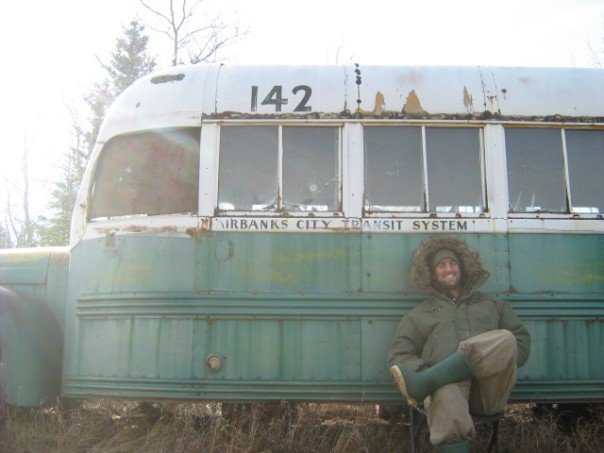
Christopher McCandless with the "Magic Bus" where he died


I preached this sermon on Pentecost 23 (October 19) 2008. The text from the Gospel included the memorable encounter in which Jesus was challenged about whether it was right to pay taxes. He replied by asking them to consider whose face was on the coin (Caesar's) and said, "‘Give therefore to the emperor the things that are the emperor’s, and to God the things that are God’s" (Matthew 22:15-22). Teasing out the meaning of this riddle is not as straightforward as it would appear, as it requires us to have discernment enough to look past things as they are in themselves and into our relationship with those things.

It's a complex theological dilemma that I attempting to explore. Lots of moving pieces. To make it easier I examined the real case of a man who renounced all worldy goods, yet seems to have been careless with his own life. I was speaking of Christopher McCandless, who starved to death in the wilderness of Alaska attempting to find wisdom in a Thoreau-like odyssey. I can see why this would be appealing, but his effort was flawed--not just because it resulted in his death, but because of the hubris inherit in the attempt. Consider this statement by a local Park Ranger (Peter Christian):
I am exposed continually to what I will call the ‘McCandless Phenomenon.’ People, nearly always young men, come to Alaska to challenge themselves against an unforgiving wilderness landscape where convenience of access and possibility of rescue are practically nonexistent […] When you consider McCandless from my perspective, you quickly see that what he did wasn’t even particularly daring, just stupid, tragic, and inconsiderate. First off, he spent very little time learning how to actually live in the wild. He arrived at the Stampede Trail without even a map of the area. If he [had] had a good map he could have walked out of his predicament […] Essentially, Chris McCandless committed suicide. (source)
What does it mean when a spiritual quest becomes so self-centered that it causes the kind of pain that only the death of a child or brother or friend can cause?

I'm reminded of Franz Khafka's short story, "The Hunger Artist." It's a parable about Art and the Artist but it also about the kind asceticism that is beyond self:
He might fast as well as he could—and he did—but nothing could save him any more. People went straight past him. Try to explain the art of fasting to anyone! If someone doesn’t feel it, then he cannot be made to understand it. The beautiful signs became dirty and illegible. People tore them down, and no one thought of replacing them. The small table with the number of days the fasting had lasted, which early on had been carefully renewed every day, remained unchanged for a long time, for after the first weeks the staff grew tired of even this small task. And so the hunger artist kept fasting on and on, as he once had dreamed about in earlier times, and he had no difficulty succeeding in achieving what he had predicted back then, but no one was counting the days—no one, not even the hunger artist himself, knew how great his achievement was by this point, and his heart grew heavy. And when once in a while a person strolling past stood there making fun of the old number and talking of a swindle, that was in a sense the stupidest lie which indifference and innate maliciousness could invent, for the hunger artist was not being deceptive—he was working honestly—but the world was cheating him of his reward.

Many days went by once more, and this, too, came to an end. Finally the cage caught the attention of a supervisor, and he asked the attendant why they had left this perfectly useful cage standing here unused with rotting straw inside. Nobody knew, until one man, with the help of the table with the number on it, remembered the hunger artist. They pushed the straw around with a pole and found the hunger artist in there. “Are you still fasting?” the supervisor asked. “When are you finally going to stop?” “Forgive me everything,” whispered the hunger artist. Only the supervisor, who was pressing his ear up against the cage, understood him. “Certainly,” said the supervisor, tapping his forehead with his finger in order to indicate to the spectators the state the hunger artist was in, “we forgive you.” “I always wanted you to admire my fasting,” said the hunger artist. “But we do admire it,” said the supervisor obligingly. “But you shouldn’t admire it,” said the hunger artist. “Well then, we don’t admire it,” said the supervisor, “but why shouldn’t we admire it?” “Because I had to fast. I can’t do anything else,” said the hunger artist. “Just look at you,” said the supervisor, “why can’t you do anything else?” “Because,” said the hunger artist, lifting his head a little and, with his lips pursed as if for a kiss, speaking right into the supervisor’s ear so that he wouldn’t miss anything, “because I couldn’t find a food which I enjoyed. If had found that, believe me, I would not have made a spectacle of myself and would have eaten to my heart’s content, like you and everyone else.” Those were his last words, but in his failing eyes there was the firm, if no longer proud, conviction that he was continuing to fast. (source)


You see, spiritually masterful seekers--people like the Desert Fathers and Thomas Merton and St. John of the Cross adopt a discipline such as fasting or silence with a detachment that makes their answers to the question, "Why do you do this?" difficult to hear. Ask a mystic that and they are likely to give you a shrug and an answer like, "I do it because it is there to be done." They aren't being flippant, and there is a certainly skillfulness and intentionality in their choices. And yet, and yet they value these practices little next to the surpassing value of knowing God. Do you see the difference between this approach and that of Christopher McCandless?

Here's another example. When you are teaching someone to shoot a pistol for the first time they inevitably hold the gun too tightly (for fear of dropping it with the recoil, I suppose). The tension makes the shooters arm shake a little, throwing off the aim. As the student gets used to shooting they learn to relax the grip and achieve a kind of relaxed firmness. Firm but relaxed. That's precisely the kind of way we should be holding best spiritual tool, our own lives, in our hand.

Christopher's mistake was becoming too attached his fantasies of how he would attain wisdom to pay heed to the several wise people who tried to give him advice that would have saved his life.

I guess you can tell this dilemma strikes close to my heart. I know what this struggle is like. I'm the guy that spent 24 hours naked in the woods once because I wanted to know "what is necessary." Well, in turns out that shoes are pretty damn necessary! Anyway, here's the sermon...


Here's a direct link to the MP3 file...

-t

Wednesday, October 8, 2008

Liturgy and The Cloud of Unknowing

I'm very proud of the Contemplative Eucharist that we do on Wednesday mornings. It's a very special achievement to have gotten that baby off the ground. And now that it's gaining more momentum I'm beginning to see even more potential.

Margo Sawyer - Cloud of Unknowing, 2005

With the encouragement of my staff I've been gradually adding a bit more instruction and discussion at the end of it. Last week we talked about The Cloud of Unknowing--a 14th Century manual for contemplative spirituality. So this week I brought my copy and read the group a paragraph taken from random:
In this way you can see that we must concentrate our whole attention on this lowly movement of love in our will. To all other forms of sweetness or consolation, however pleasant or holy (if we be allowed to put it in this way) we should show a sort of indifference. If they come, welcome them; but do not depend on them, because they are weakening things; it takes too much out of you to stay for long in such sweet feelings and tears. And you may even be tempted to love God for the sake of having them. You will know if this is so by seeing whether you complain unduly when they are absent. And if you do, your love is not yet pure or perfect. For a love that is pure and perfect, though it admits that the body is sustained and consoled when such sweet feelings or tears are present, does not complain when they are missing, but is really pleased not to have them, if it is the will of God. And yet in some people contemplation is normally accompanied by consolations of this sort, while there are others who have such sweetness and comfort but seldom. (The Cloud of Unknowing, Chapter 50, Paragraph 1, Trans. Clifton Wolters)
So many people come to religion for an experience--yet if you strive for a more perfect love you must cultivate a "kind of indifference" to the consolations and sweet feelings that occasionally come with the spiritual life. I think of liturgies that are specifically designed to manipulate people emotionally in order to give them a feeling of catharsis by the end. The Contemplative Tradition teaches that such worship draws us further from God in that our faith becomes depending on what get out of it, emotionally. If you would have perfect love, then you must accept whatever spirituality presents itself in this moment, right now, and not lust after something else. It's a fantastically powerfully teaching that few are really to hear.

The bishop only gave me permission to do the Contemplative Eucharist until All Saints' (Nov. 1st). I'm hoping he will renew permission after that, but it's possible he may not. If he refuses I'll be upset, of course, and I'll argue vigorously on behalf of this group. But the System I'm a part of doesn't care for innovation, and that's a reality I have to accept, as well. So I'll have to write a letter to the bishop soon to plead for group to continue. Stay tuned...

-t

Tuesday, October 7, 2008

Eucharist

I have to say that the opportunity to celebrate the Holy Eucharist is one of the great joys in my life. This morning we had our "Traditional Communion" (Trad-Com, as we sometimes call it) from the BCP. One of the advantages of the traditional liturgies, IMHO, is that they allow the celebrant the luxury of introspection. Because there is so much less interaction with the congregation, I find that I can really focus on what's going on internally. This is even more true with Eastward Celebration (back to the people).

One of the things I really miss about St. Mary Magdalene's was the 7:15 AM Holy Eucharist on Tuesdays and Thursday. It seemed possible, for once, to do a perfect liturgy: every step, every gesture, every little bit done in a precise, intentional, and planned way. When I was in "the zone" celebrating Mass that way I found that the formalism enhanced my ability to be present to the Holy Spirit. I'll never forget standing on the blue carpet in the lady chapel and elevating the chalice to the height where I could just see, in the reflection, the congregation behind me.

The sensibility of Sunday worship at COTM privileges an entirely different experience: we are willing to do church without even trying to attain any kind of perfectibility. We are all about the messy and fun encounter of God with a community of imperfect, sometimes crazy, always energetic people.

-t

Tuesday, September 30, 2008

A Monotheistic Traffic Jam

Image (c) NYT

Doug C. points me to this article in the NYT about the coincidence of Rosh Hashana and Ramadan this year creating an unusual mix of Jewish and Muslim devotion in the Holy Land:
The result has been a kind of monotheistic traffic jam in September along the paths of the tiny walled Old City, especially as dawn approaches each day. The Muslims and Jews walk past one another, often intersecting just at the Via Dolorosa of Christian sanctity, as they hurry to their separate prayer sessions: the Muslims above at the Dome of the Rock, the Jews just below at the Western Wall.

It would be wrong to call these tense encounters, because there are essentially no encounters at all. Words are not exchanged. Religious women in both groups — head, arms and legs covered in subtly distinct fashion — look past one another as if they took no notice. Like parallel universes with different names for every place and moment they both claim as their own, the groups pass in the night. (source)

I have never been to Jerusalem, but it's high on my list of places to go. I'd love to spend some time at St. George's College studying. Sigh. Someday...

-t

Wednesday, September 24, 2008

Time and Timelessness

Bede's post this week is a very interesting discussion of those moments when the barriers between this moment and the next or this person and the next seem to dissolve. He describes feeling this way about time itself on his recent trip to Turkey.
I think these experiences are pretty common. I think, in fact, that they happen with both frequency and regularity. But in our radically secular culture we are trained to ignore them. And if they are strong enough that we have to notice them, we almost never, ever mention them to another person. People in our society don't talk about that sort of thing. You have to be someone pretty quirky, like a monk or a teen, to do that. But these experiences of awareness of the spiritual dimension of things are part of life. People who do brain research can even point to the places in the brain where they happen. They are part of the gift of our human nature; God pulling us to that place where boundaries aren't what we thought, and where we are really one with each other and with the world as it is and as it was. Quite a thing for an old man and a young man to share. (source)

Bede also talks about the role of meditation in noticing such things:
I first began noticing it in meditation. Meditation is an old and familiar experience to me, and the technique is part of my ordinary consciousness: attend to your breath (or whatever you're using), when you notice that you've drifted away, bring yourself back to the present, and do that as many times as necessary, with a gentle but firm touch. So if I'm sitting there meditating and find a thought of, say, the city of Sardis in Turkey coming into my mind, I just label it as "thinking", and bring myself back to the present. The trouble is that I'm no longer sure that Sardis is part of the past. What if that ancient city, those ancient ruins, are actually part of my present? This isn't anything that I'm thinking my way into. It's just happening. I can't seem to muster up the energy necessary to regard Sardis as a "distraction", because it seems very much a part of now. (source)

The Bridge in West Cornwall

I've noticed this sort of thing myself from time-to-time. For instance, a few years ago I was visiting my therapist at the time, Mary, up in a place called West Cornwall, Connecticut. It's a beautiful New England village in a small river valley. It is best known for an old-fashioned covered bridge across the Housatonic River. I was approaching this red bridge walking along the bank when I noticed--I mean really noticed--the sight and sound of the river flowing over the rocks in the river. Suddenly I felt as though I was a part of that river and that it was part of me. I sat down on the bank and stayed with the feeling until it began to fade.

It's a wonderful thing to notice, and I think Bede is right that pretty much everybody has these moments. It's too bad we are conditioned to ignore them, as they do reveal something very important about the nature of things.

-t

Sunday, June 22, 2008

Meditation as the Craft of Thought

Deirdra Good (NT prof. at General Theological Seminary in NYC) points out this interesting book on her blog:
This astonishing book was the subject of one of our workshops: Mary Carruthers, The Craft of Thought. Meditation, Rhetoric, and the Making of Images, 400-1200. Cambridge: Cambridge University Press, 1998. Pp. 399. ISBN 0-521-58232-6. $59.95....

For medieval monastic culture, meditation, and not rational argument, is the path to proper remembrance. And for monks as for artisans, the notion of "craft" implies the proper use of the body as well as a craftiness of mind. So, this is a book about meditation as a "craft" that presupposes the mastery of all of the mind's "tools" that are appropriate to the soul's own special vocation, which is to employ proper books, "places" and buildings, and images (all of which involve as well the participation of a pure and well trained body) in the quest to know God. (source)


So much of the work of Christian spirituality is about proper remembrance--it makes sense to see meditation as the craft that makes this possible. I'm struck that we don't teach this nearly enough in church on Sundays. I mean, meditation is often one of the next things Christians are exposed to in their developing spiritual lives once they look beyond Sundays, but we don't look at it much on Sundays. Sometimes we'll have silence in liturgy or sing in a contemplative manner. But that isn't really teaching meditation, per se.

Once I gave a children's sermon at SMM in which I taught them about meditation and even did a five minute sit with them. Perhaps I should do something similar at COTM...

-t

Friday, May 16, 2008

Spiritual Partnership

My attention was attracted to this story about two American Buddhist teachers, Michael Roach and Christie McNally, a man and woman, who are living together in a yurt in Arizona. What makes this remarkable is that they say they are celibate but have also vowed to never be more than 15 feet apart. Even more interestingly, he insists on keeping his monastic vows.

Male-female spiritual partnerships are not unknown in Tibetan Buddhism. In order to practice "Highest Yoga Tantra," for instance, an aspirant must give up his monk vows (including celibacy) and begin having very ritualized sex with a compatible adept. This kind of Tantra is a real fascination for Westerners, of course, although I don't think it's common nor nearly as "fun" as it sounds to most people. It's a very disciplined endeavor in real life--one of the main practices involves maintaining a high level of arousal for long periods of time (like, hours) without orgasm. But, again, one must give up being a monk in order to practice this form of Tibetan spiritual discipline.

An anthropologist might say that this phenomenon is a kind of "transgressive sacrality"--that is, a religious practice which derives it's efficacy from it's violation of religious taboo:
Transgressive sacrality’ within a religious tradition is something completely different [from heresy] for, though violating the interdictions and observances of the tradition in question, it does not seek to replace the latter. Instead it lays claim to a superior degree and second order of spirituality derived precisely from the violation of socioreligious interdictions whose general validity and binding force is not at all questioned by the transgressor. In fact, transgressive sacrality cannot operate without the existence of such binding and powerful taboos, and often presents itself as an esoteric form of the mother-religion, the latter serving as the exoteric prerequisite and recruiting ground for it. (source)

The idea of transgressive sacrality is often linked with the "crazy wisdom" tradition within Buddhism--esteemed teachers violating the rules as a kind of pedagogy. Living a Paradox as a way to break through spiritual materialism.

But this couple is not doing HYT (Highest Yoga Tantra)--but instead are trying to model a kind of male-female spiritual partnership of a different kind. They describe their reasons for doing this thusly:
One, he felt that it was impossible to keep secrets in this age of Google Earth. Two, he decided that if Buddhism was really going to succeed in America, it would have to be more inclusive of women.

“If these ideas that will help people are going to make it in the West,” Ms. McNally said, “it can’t be a male-dominated culture, because people are not going to accept that.” (source)

They are transgressive not because they are having sex (which they say aren't), but because they are challenging traditional notions of gender and relationship within the Tibetan Buddhist tradition. Monks aren't supposed to do this kind of thing.

But their practice — which even they admit is radical by the standards of the religious community whose ideas they aim to further — has sent shock waves through the Tibetan Buddhist community as far as the Dalai Lama himself, whose office indicated its disapproval of the living arrangement by rebuffing Mr. Roach’s attempt to teach at Dharamsala, India, in 2006. (In a letter, the office said his “unconventional behavior does not accord with His Holiness’s teachings and practices.”) (source)

Yet there is something undeniably appealing about this kind of practice. It's marriage times ten--an exercise is attending to someone other than yourself!
They eat the same foods from the same plate and often read the same book, waiting until one or the other finishes the page before continuing. Both, they say, are practices of learning to submit one’s will to that of another. (source)

Marriage is a spiritual discipline, and I think looking at these kinds of extreme examples from other traditions can be helpful for understanding Christian marriage. For one thing, if gives us a way to understand intimacy that is not necessarily sexual.

-t

Wednesday, May 7, 2008

The Return

A friend of mine, a Rhode Scholar whom I dated briefly in High School, sends me this poem by Geneen Marie Haugen.

The Return

Some day, if you are lucky,
you'll return from a thunderous journey
trailing snake scales, wing fragments
and the musk of Earth and moon.

Eyes will examine you for signs
of damage, or change
and you, too, will wonder
if your skin shows traces

of fur, or leaves,
if thrushes have built a nest
of your hair, if Andromeda
burns from your eyes.

Do not be surprised by prickly questions
from those who barely inhabit
their own fleeting lives, who barely taste
their own possibility, who barely dream.

If your hands are empty, treasureless,
if your toes have not grown claws,
if your obedient voice has not
become a wild cry, a howl,

you will reassure them. We warned you,
they might declare, there is nothing else,
no point, no meaning, no mystery at all,
just this frantic waiting to die.

And yet, they tremble, mute,
afraid you've returned without sweet
elixir for unspeakable thirst, without
a fluent dance or holy language

to teach them, without a compass
bearing to a forgotten border where
no one crosses without weeping
for the terrible beauty of galaxies

and granite and bone. They tremble,
hoping your lips hold a secret,
that the song your body now sings
will redeem them, yet they fear

your secret is dangerous, shattering,
and once it flies from your astonished
mouth, they--like you--must disintegrate
before unfolding tremulous wings.

--Geneen Marie Haugen


-t