Today I spent some time in the office answering e-mails, a few phone calls, and I made a pastoral visit.
I can't really talk about the interesting adventure that was that pastoral visit (ever put together shelves on such a visit). So instead I'll talk about the interesting adventure that is the new Adobe CS4 Suite. This is a set of professional-level programmes for producing all kinds of media including websites (Dreamweaver), photos (Photoshop), movies (Premiere Pro), etc. I've been using CS3 for a while, but there are at least three features I found missing, all of which have been resolved with the latest version.
First, the old version of the Adobe Suite did not have the ability to take advantage of the complete power of my workstation (ORAC)--principally in that it didn't take advantage of the 64-bit architecture (though most of the suite was able to use the four-processors simultaneously). The new version makes much more efficient use of the latest processors/operating systems.
Second, I was always frustrated that Premiere Pro Couldn't import the MP4 files from my Flip HD camera. The Flip Cam takes surprisingly good footage considering that it is very small (easily fits in a chest pocket), but I was limited to using the editing software that came with the camera. I had yet to find a good (lossless) way to convert the footage into a format Premiere Pro could work with. So it was good for spontaneous, informal video snapshots, but that was it. Now, however, that problem with CS4 is solved! It has no problem at all taking the footage at 720p and editing it.
Third, here is a feature I didn't know I wanted until someone invented it: speech recognition. Basically, CS4 can create a transcription of the speech in a video that is then searchable as meta-data. Searchable not only from within Premiere Pro, but from within other programmes like Adobe Bridge. Imagine you just shot a three hour interview with two cameras. That's six hours of footage, and you want to find where your subject said something distinctive like, "it was at that moment that I knew that pickles are good in hamburgers." Rather than have to "scrub" (fast forward) through hours of footage, you can simply search through the automatically generated transcript! How cool is that? Here's a demo:
There are lots of other improvements, as well. The media encoder is much improved, especially because you can have it running in the background while you do other work. There are also a lot more pre-sets and options for importing and exporting data. it's all very, very cool.
-t
Showing posts with label film. Show all posts
Showing posts with label film. Show all posts
Saturday, May 23, 2009


Thursday, March 19, 2009
Sunday, March 8, 2009
Video Workflow for the Geeky...
Okay, here's the workflow for posting that kind of video for those interested in such things...
I record the video of the service with a Canon HV-20 camcorder on a tripod at 1060i30 resolution. I also record the audio with an M-Audio Microtrack-II (MP3 at 224kbps / 44.1kHz) using a small stereo condenser mic clipped to the same stand that is holding the wireless handheld for the PA system).
I transfer the audio file to ORAC (my computer) and load it into Adobe Audition 3.0. I cut out the sermon, fix the levels and any problems, then save it at 128kps/44.1kHz and upload it to G-Cast where I can pull it later.
Next, I capture the video to my hard drive using HDVSplit. It's a very handy little app that does a good job of capture and happens to be free, too! Normally at this point I just capture what I need, as doing the whole tape takes about an hour.
In Adobe Premiere Pro CS3 I start a new project with the presets for 720p30. I copy and paste the title sequence from the last sermon video into the new project. I modify the things that need modifying and then put the new sermon video in place. Adjust the image, crop and zoom, etc. I then swap the audio track from the video camera with the audio I recorded with the Microtrack and sync them. This step, replacing the audio, makes a HUGE difference.
Once all that's done I export using the Adobe Media Encoder to a Flash video file (.flv) at 425X240, 29.97fps, 1.8kbps, using On2VP6 codec. 10 minutes equals about 150MB. I need to do some experimenting to find the right bandwidth sweet spot to get the size down, but that's not bad as long as my audience has broadband. Rendering an 11 minute file takes about 8 minutes thanks to ORAC's quad core.
At this point I upload the flv file to the COTM server using Dreamweaver (though you can FTP straight from Premiere Pro). I update an XML playlist to make sure the video gets pulled into my video player on the COTM website. And I can make a stand-alone viewing embed video (like the one below) using the same JWZ Player applet. Note that to pull videos from the COTM website onto the blog using the JWZ Player it is essential to have a "crossdomain.xml" file in the root directory of the COTM website.
I know, that sounds really complicated, doesn't it? In some ways it would be easier just to upload everything to You Tube or another video hosting website. But I like the added control of configuring my own player. I also like not being limited to the 10 minutes You Tube allows. Still, these 150MB files chew up server space real quick!
1ee7 users may note that I'm filming in 1060i and editing in 720p. The reason for that is simply that my video camera can't shoot in a progressive 30fps mode (not 720p nor 1080p), but flash does a better job with progressive video--so I have to deinterlace anyway and I might as well do so is such a way as to preserve some of the HD detail. Might be interesting to try the 1080p editing mode for comparison. But you really don't want to shink it down to 425X240 until the very end.
-t
I record the video of the service with a Canon HV-20 camcorder on a tripod at 1060i30 resolution. I also record the audio with an M-Audio Microtrack-II (MP3 at 224kbps / 44.1kHz) using a small stereo condenser mic clipped to the same stand that is holding the wireless handheld for the PA system).
I transfer the audio file to ORAC (my computer) and load it into Adobe Audition 3.0. I cut out the sermon, fix the levels and any problems, then save it at 128kps/44.1kHz and upload it to G-Cast where I can pull it later.
Next, I capture the video to my hard drive using HDVSplit. It's a very handy little app that does a good job of capture and happens to be free, too! Normally at this point I just capture what I need, as doing the whole tape takes about an hour.
In Adobe Premiere Pro CS3 I start a new project with the presets for 720p30. I copy and paste the title sequence from the last sermon video into the new project. I modify the things that need modifying and then put the new sermon video in place. Adjust the image, crop and zoom, etc. I then swap the audio track from the video camera with the audio I recorded with the Microtrack and sync them. This step, replacing the audio, makes a HUGE difference.
Once all that's done I export using the Adobe Media Encoder to a Flash video file (.flv) at 425X240, 29.97fps, 1.8kbps, using On2VP6 codec. 10 minutes equals about 150MB. I need to do some experimenting to find the right bandwidth sweet spot to get the size down, but that's not bad as long as my audience has broadband. Rendering an 11 minute file takes about 8 minutes thanks to ORAC's quad core.
At this point I upload the flv file to the COTM server using Dreamweaver (though you can FTP straight from Premiere Pro). I update an XML playlist to make sure the video gets pulled into my video player on the COTM website. And I can make a stand-alone viewing embed video (like the one below) using the same JWZ Player applet. Note that to pull videos from the COTM website onto the blog using the JWZ Player it is essential to have a "crossdomain.xml" file in the root directory of the COTM website.
I know, that sounds really complicated, doesn't it? In some ways it would be easier just to upload everything to You Tube or another video hosting website. But I like the added control of configuring my own player. I also like not being limited to the 10 minutes You Tube allows. Still, these 150MB files chew up server space real quick!
1ee7 users may note that I'm filming in 1060i and editing in 720p. The reason for that is simply that my video camera can't shoot in a progressive 30fps mode (not 720p nor 1080p), but flash does a better job with progressive video--so I have to deinterlace anyway and I might as well do so is such a way as to preserve some of the HD detail. Might be interesting to try the 1080p editing mode for comparison. But you really don't want to shink it down to 425X240 until the very end.
-t
Thursday, February 26, 2009
PAL to NTSC
So I bought some DVD's from England at the Fresh Expressions Conference. I get them home and discover that they won't play on my DVD player. Of course, I realized, they are in PAL format, not NTSC. The NTSC format is what we use for TV in North America and Japan. NTSC is what they use in the UK, Europe, and many other places. The difference, incidentally, came about back in the days with everything was analog and the power grid in North America cycled phases at 60Hz and the UK was on a 50Hz system. Back then it was easier to simply come up with a new format for a TV signal stream than make TV's smart enough to overcome the difference.
Anyway, it's not a big deal since you can buy PAL-compatible DVD players or simply play it on most computers. But I'm too much of a techie to let that go by. So I stopped by my local consumer video production outfit and they said they would be happy to do the conversion: for about $40-60/video! Yikes! So I decided to do it myself.
It turns out that doing the conversion yourself is not a straightforward process (unless you pay for software specifically designed to do it). So it took a few tries with various free video programmes until I finally cracked it and got a disc burned. Here's my path, for those of you interested such things.
I feel like I accomplished something figuring this out. And now I can give my wardens and others a DVD that will play in their home players!
-t
Anyway, it's not a big deal since you can buy PAL-compatible DVD players or simply play it on most computers. But I'm too much of a techie to let that go by. So I stopped by my local consumer video production outfit and they said they would be happy to do the conversion: for about $40-60/video! Yikes! So I decided to do it myself.
It turns out that doing the conversion yourself is not a straightforward process (unless you pay for software specifically designed to do it). So it took a few tries with various free video programmes until I finally cracked it and got a disc burned. Here's my path, for those of you interested such things.
- Copy the video files (VOBs) onto your hard drive. Remove any copy protections in the process. (I used DVD Shrink.)
- Transcode from 25fps to 30 fps. VSO DivxToDVD was supposed to work for this, but didn't. So I used the trial version of Blaze Media Pro instead.
- Build a new DVD using the transcoded files. I used Nero Vision for this, which isn't free, but there are similar programmes that will do the same thing.
I feel like I accomplished something figuring this out. And now I can give my wardens and others a DVD that will play in their home players!
-t
Tuesday, February 24, 2009
"One Size Fits All?"

Those of you interested in emerging church, missional church, or fresh expressions will be interested in this documentary recently released about Canadian Church life.
You can purchase a copy through the Wycliffe Bookstore (I believe) or from the movie's website.
-t
Wednesday, January 21, 2009
Atom Agoyan's "Adoration"
A few days ago Betsy and attended a special screening of Atom Egoyan's new movie Adoration. Egoyan is a Canadian film maker known for some remarkable films like Exotica (1994), The Sweet Hereafter (1997), and (my favorite of his so far) Ararat (2002). The screening was held at Innis College at the University of Toronto, where Egoyan is a Distinguished Visitor. He showed up after the screening to answer questions from the audience for about half an hour.
Like many of Egoyan's films, questions of identity as mediated by both history and the representation of history are front and centre. Egoyan is also very interested in how trauma is ritualized and socially processed.
This has obvious roots in Egoyan's biography--it was when he came to the U of T as an Undergrad that he began learning about his Armenian heritage and the legacy of the genocide. At the time Father Harold Nahabedian (also of Armenian heritage) was the Chaplain at Trinity College. Harold taught Egoyan the Armenian Alphabet and other cultural lessons, and Egoyan remembers that time fondly.
During the Q and A period I asked Egoyan about the relationship between his own experience of coming-of-age and the appearance of that theme in his work. He didn't really answer the question, but Betsy, my wife-the-art-historian, pointed out that artists rarely have good answers as to why they create certain things. It's part of the old "Fallacy of Authorial Intention" problem familiar to anyone who has studied critical theory. The better question is probably "how" they create. My sister Lynne used to interview a lot of artists, I bet she would back me up on that.
Here is the trailor for Adoration:
Good movie. Heavy on character study.
-t
Like many of Egoyan's films, questions of identity as mediated by both history and the representation of history are front and centre. Egoyan is also very interested in how trauma is ritualized and socially processed.
This has obvious roots in Egoyan's biography--it was when he came to the U of T as an Undergrad that he began learning about his Armenian heritage and the legacy of the genocide. At the time Father Harold Nahabedian (also of Armenian heritage) was the Chaplain at Trinity College. Harold taught Egoyan the Armenian Alphabet and other cultural lessons, and Egoyan remembers that time fondly.
During the Q and A period I asked Egoyan about the relationship between his own experience of coming-of-age and the appearance of that theme in his work. He didn't really answer the question, but Betsy, my wife-the-art-historian, pointed out that artists rarely have good answers as to why they create certain things. It's part of the old "Fallacy of Authorial Intention" problem familiar to anyone who has studied critical theory. The better question is probably "how" they create. My sister Lynne used to interview a lot of artists, I bet she would back me up on that.
Here is the trailor for Adoration:
Good movie. Heavy on character study.
-t
Thursday, December 25, 2008
The von Trapp Family
Remember the von Trapp family from The Sound of Music? For sometime the family has run a ski lodge in Stowe, Vermont, near where my Uncle lives. The New York Times is running an article today profiling the handover of the business to the next generation.
-t
-t
Sunday, September 14, 2008
No Country for Old Men - Post Script
Seeing my first post on the topic, a friend pointed me to an article in Wycliffe's newsletter about the movie "No Country for Old Men."
In "Praying the Psalms with No Country for Old Men," David Tiessen posits that NCFOM, like the psalms, explores the reality of a violent and desperate age and yet points to a distant glowing hope:
I would add that the movie seems to have an embedded critique about the "in my day things weren't so bad" argument. The fact is that "this country" has always been hard on people. So what does it mean, philosophically, that we feel such displacement, as though we were more suited to another age?
-t
In "Praying the Psalms with No Country for Old Men," David Tiessen posits that NCFOM, like the psalms, explores the reality of a violent and desperate age and yet points to a distant glowing hope:
In the spare, minimalist terms of old westerns such as "The Good, The Bad and the Ugly," the film offers a meditation on the shift from the 'old country' of the trusting relations upon which neighbourliness and care for strangers is built and in which justice would prevail, to the emerging 'new country' of the violence of selfish greed and remorseless individualism which drives even the law to despair. The march of violence seems inexorable and inevitable, and as the film progresses we discover through and along with the characters the alternatives before them: join the game for one’s own gain but ultimately succumb to the inevitability of a violent end; risk resistance at the cost of the despair and exhaustion of watching the wicked triumph; resist the game on alternative (nonviolent) terms. In this film the results of these alternatives don’t look much different – it is always the violent and the wicked who seem to triumph: there is no country left for the ‘old men’ who presume the good. It is the bad and the ugly who win. It is Psalm 10, verses 1-11.
....Yes, the march of violence seems inevitable, but in the end there is a glimmer of hope that alternative forms of resistance are right in themselves and, at the very end, there is a final ‘verse’ that is the film’s prayer and benediction: Where it seems that God has all but abandoned us to the violent night, there remains the dream of a glowing fire somewhere up ahead in the dark, beckoning us on. With that, "No Country for Old Men" offers our culture a contemporary Psalm, turning us in the end to listen and look again for God in the dark. (source)
I would add that the movie seems to have an embedded critique about the "in my day things weren't so bad" argument. The fact is that "this country" has always been hard on people. So what does it mean, philosophically, that we feel such displacement, as though we were more suited to another age?
-t
Friday, September 12, 2008
No Country for Old Men
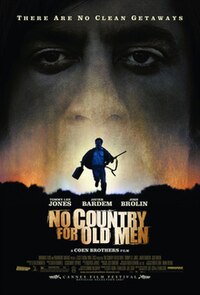
We saw the movie "No Country For Old Men," last night. It's a very powerful film that explores fate, change, and the elemental forces that drive out lives. Haunting ending. I'm trying to discern about whether (and how) to preach about it.
-t
Friday, July 18, 2008
Batman: The Dark Knight

At the moment I'm pretty stressed out trying to get everything done before I leave on Sunday. So I was pleased to receive an invitation to a special pre-release showing of the new Batman movie. It was fantastic. Much better than the other movies in the series. I especially liked the fact that it was actually surprising. A number of times the film went in a totally different direction than I expected. Seeing Heath Ledger perform so well as The Joker just reconfirms what a tragedy his death was.
(As an aside: I recently read an interview with Dr. Drew Pinsky where he criticized Heath's family and friends for not being more forthright about how the abuse of prescription drugs led to his death. Pinsky is shifting from sex-education to drug-abuse-education because he thinks this has become an even worse public health menace than HIV.)
Maggie Gyllenhaal also does a terrific job.
Thumbs up all around. It manages to sustain a sense of darkness and menace throughout. Little wonder it's getting such stellar reviews...
-t
Sunday, July 13, 2008
The Burning Fuse
Sorry I haven't been blogging like normal. Friday was crazy busy and Saturday was a loss because the power was out all day at the church (Hydro was replacing a pole that someone ran into many months ago).
The fuse is burning on the house project. I'm hoping to hit at least three open houses today. I'm hoping to drag along a couple I know that are smarter than me for advice and support. Hard doing this without the wife! I know--it's not worth it to get too stressed out, but a certain amount of anxiety is useful for getting stuff done!
Watched "2001: A Space Odyssey" for the umpteenth time last night. What a visionary film. An film that isn't ridiculed for beginning with the caption "The Dawn of Man" is worth watching, IMHO. Kubrick is definitely one of my favorite directors of all time. Right up there with Fellini and Francis Ford Coppola. Kubrick could do so much without words because he trusted the camera and the audience in a way that most directors/producers can't these days.
A fine day at church. Attendance still summer-soft. It will probably get worse when I'm away. But I felt very good about my sermon and good about a few one-on-one contacts I made after the service. It's nice to be able to give.
-t
The fuse is burning on the house project. I'm hoping to hit at least three open houses today. I'm hoping to drag along a couple I know that are smarter than me for advice and support. Hard doing this without the wife! I know--it's not worth it to get too stressed out, but a certain amount of anxiety is useful for getting stuff done!
Watched "2001: A Space Odyssey" for the umpteenth time last night. What a visionary film. An film that isn't ridiculed for beginning with the caption "The Dawn of Man" is worth watching, IMHO. Kubrick is definitely one of my favorite directors of all time. Right up there with Fellini and Francis Ford Coppola. Kubrick could do so much without words because he trusted the camera and the audience in a way that most directors/producers can't these days.
A fine day at church. Attendance still summer-soft. It will probably get worse when I'm away. But I felt very good about my sermon and good about a few one-on-one contacts I made after the service. It's nice to be able to give.
-t
Saturday, May 17, 2008
Iron Man
Last night Betsy and I went out on a double date with friends to see the movie "Iron Man"--it was a fine movie for what it was, a summer popcorn flick. Not the sort of thing that teaches you anything new about the human experience, or changes one in any significant way, but it was entertaining enough!
After the movie we went to the Duke of York pub for supper. It was nice walking in the Yorkville area at night with the lights and the people milling around. Got home feeling pleasantly full. Betsy and I have a great life.
Last night I dreamt that I forgot to take the communion bread out of the freezer for the Chancel Guild when I came to church Sunday morning. I do forget to do that sometimes, but it's a minor thing, they can always throw one into the microwave. I had some other unusual dreams, too, including one where I was playing Black Jack at a casino and doing quite well using the Martingale System.
The Martingale System is a betting strategy useful in situations where you are making consecutive bets, with approximately 50% chance and win the amount bet. Basically, every time you loose you double the amount your are betting in the next round. For example, after loosing four dollars you bet bet eight, which means that you recover the loss if you win. If you loose, you bet sixteen. So even if you loose several times in a row, you will make back your money when you finally do win.
The problem is that this model assumes infinite wealth and no limits on how much you can bet. In real life, neither of these are true--all it takes is a few losses in a row to exceed the available cash for betting and also exceed the table limits. In fact, that's one of the reasons why casinos have table limits--to defeat this kind of betting strategy. But it doesn't really matter, since you can mathematically demonstrate that as long as the amount of money you have available for betting is finite, you will eventually run into a loosing streak long enough to bankrupt yourself!
Here's the math, for those of you that like math:
The trade in this system is steady gain at the risk of a string of losses.
I think they should teach game theory in seminary. It's important to be able to evaluate strategies in any kind of leadership.
-t
After the movie we went to the Duke of York pub for supper. It was nice walking in the Yorkville area at night with the lights and the people milling around. Got home feeling pleasantly full. Betsy and I have a great life.
Last night I dreamt that I forgot to take the communion bread out of the freezer for the Chancel Guild when I came to church Sunday morning. I do forget to do that sometimes, but it's a minor thing, they can always throw one into the microwave. I had some other unusual dreams, too, including one where I was playing Black Jack at a casino and doing quite well using the Martingale System.
The Martingale System is a betting strategy useful in situations where you are making consecutive bets, with approximately 50% chance and win the amount bet. Basically, every time you loose you double the amount your are betting in the next round. For example, after loosing four dollars you bet bet eight, which means that you recover the loss if you win. If you loose, you bet sixteen. So even if you loose several times in a row, you will make back your money when you finally do win.
The problem is that this model assumes infinite wealth and no limits on how much you can bet. In real life, neither of these are true--all it takes is a few losses in a row to exceed the available cash for betting and also exceed the table limits. In fact, that's one of the reasons why casinos have table limits--to defeat this kind of betting strategy. But it doesn't really matter, since you can mathematically demonstrate that as long as the amount of money you have available for betting is finite, you will eventually run into a loosing streak long enough to bankrupt yourself!
Here's the math, for those of you that like math:
Let q be the probability of losing (e.g. for roulette it is 20/38). Let y be the amount of the commencing bet (e.g. $10 in the example above). Let x be the finite number of bets you can afford to lose.
The probability that you lose all x bets is qx. When you lose all your bets, the amount of money you lose is
The probability that you do not lose all x bets is 1 − qx. If you do not lose all x bets, you win y amount of money. So the expected profit per round is
Whenever q > 1/2, the expression 1 − (2q)x < 0 for all x > 0. That means for any game where it is more likely to lose than to win (e.g. all chance gambling games), you are expected to lose money on average. Furthermore, the more times you are able to afford to bet, the more you will lose. (source)


The trade in this system is steady gain at the risk of a string of losses.
I think they should teach game theory in seminary. It's important to be able to evaluate strategies in any kind of leadership.
-t
Saturday, February 9, 2008
Ikea
Today I spent some time moving the chairs in the church around into their Lent configuration. After that I went to Ikea to buy a coffee table for my office. Ikea is just this side of a cult, IMHO. Someone should do a paper on the theology of Ikea. You just know everything there must have been designed on Macs.
I'll post something longer tomorrow. Right now I'm a bit tired. This morning when I decided to sleep in, I realized that I have been under a tremendous amount of stress at work and that I need to dial my engagement back a smidgen--God knows there already enough dysfunctional/codependent priests out there.
BTW, I just saw the movie "Breach." There is a nice long shot the interior of Church of the Redeemer (COTM's mother parish). It only took me about two seconds to recognize it, despite the set dressing!
-t
I'll post something longer tomorrow. Right now I'm a bit tired. This morning when I decided to sleep in, I realized that I have been under a tremendous amount of stress at work and that I need to dial my engagement back a smidgen--God knows there already enough dysfunctional/codependent priests out there.
BTW, I just saw the movie "Breach." There is a nice long shot the interior of Church of the Redeemer (COTM's mother parish). It only took me about two seconds to recognize it, despite the set dressing!
-t
Subscribe to:
Posts (Atom)