Louis Slotin was a Canadian Physicist who was killed in an accident during the Manhattan Project. He was not the only person to do, nor even the only one to be poisoned by radiation because of an experiment gone bad. I spoke about him on Sunday in my sermon, so I thought I would share this excellent re-enactment of his accident from the movie "Fat Man and Little Boy"
As far I know the recreation is pretty accurate. Slotin died nine days later in great pain with his parents by bedside.
Showing posts with label history. Show all posts
Showing posts with label history. Show all posts
Wednesday, November 18, 2015


Tuesday, November 17, 2015
Inherited and New Monasticism, with Sister CJ, SSJD

The Sisters of Saint John the Divine invite women between the ages of 22 and 40 to explore an expression of new monasticism rooted in the Anglican tradition. Companions will develop a rhythm of life including public and private prayer, engage in service to others, and learn to live in intentional community.... Room and board are provided, and most living expenses are covered by the Sisterhood. Companions, in turn, use their gifts to share in the work of ministry and have the same free time, retreat opportunities, and vacation as the Sisters. (source)
My spirituality has been greatly enriched by my relationship with a monastic community (The Order of the Holy Cross), and I commend it to anyone wishing to go deeper in faith and spirit.
Friday, August 13, 2010
Steps at Canterbury
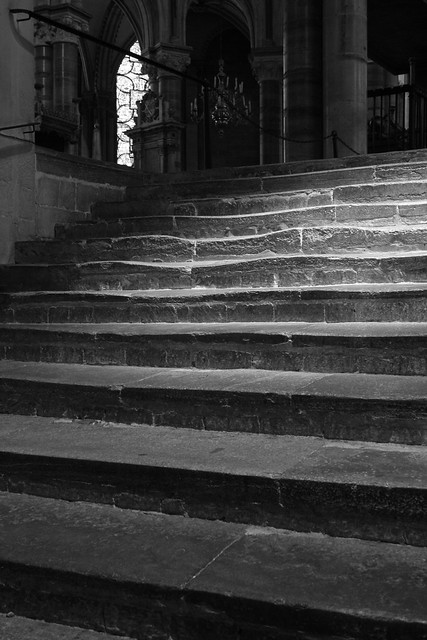
I've wanted to take this photograph for a long time. These are the steps leading to the shrine at Canterbury--much worn from Pilgrim feet. Pretty cool, heh?
-t
A Brief Note from the Land of Paternity
Yep, I'm still alive. But this summer I haven't been in a space that really facilitates blogging. Which is too bad, since I've got a lot of blog material piling up in my brain. But I find that blogging is tied to my preaching, so since I'm not preaching this summer I'm not spending time in the head space that leads to blogging.
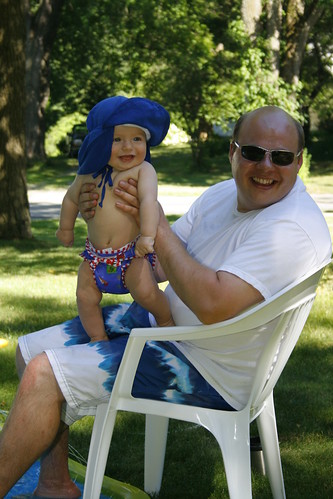
This summer has been wonderful--three whole months off to be with Henry and to visit family and give Betsy a chance to get back on track with her studies. It's going remarkably well, and our little guy is growing into a champ. We dragged him to NJ, PA, DC, Calgary, and Banff! He did great, which means he probably will have some of his parents' wander-lust. I think, from our experience, that the key to travelling with an infant is to relax and adapt. Adapt, adapt, adapt. Sometimes I find myself thinking, "Where can I change Henry," even when he isn't with me.
People always want to know how he is sleeping. Lately (the past few months) his sleeping has really settled down into a nice pattern. Unless he has a cold or is teething, he will typically go to sleep at around 8:30 PM and wake up at 3:00 AM. Then Betsy will nurse him and he'll sleep again from about 3:30 until 7 AM. We do the morning routine and then he'll have a mid-morning nap (for about an hour) and a longer mid-afternoon nap. Our pediatrician has recommended giving him only water at the nighttime feeding to get him out of that habit, but we aren't quite there yet.
It's interesting to talk to other parents and realize that people get quite passionate about how they get their children to sleep at night. I've heard several couples talk about the "Cry-it-out" method as painful but ultimately worth it. We did the opposite and seemed to have fine results, which just goes to show that parents should simply do the research and pick their strategy and make it work.
Speaking of Henry's sleep patterns... It may not be very PC of him, but he really likes furs. Someone (CK) gave us a sheep skin for his crib. It is similar to the ones sold at Ikea, but this one can be machine washed at home. It's brilliant. Henry loves the soft feeling of the sheep fur under him and we believe it does a good job of keeping him warm when it's cold and dry when it's warm. There is something primal about putting your baby to sleep on an animal skin that appeals to me, too.
When we visited the Glenbow Museum in Calgary we let Henry touch a buffalo skin they had out as part of a hands-on fur-trade exhibit. His eyes lit up immediately with him favourite texture--softness. I thought it would be very cool to have a whole buffalo-skin rug to put down on the floor for him to play on, but then I discovered that these suckers cost about a $1,000! My David Thompson and Charlotte Small fantasies of Canadian child-rearing ended there.
Side note for non-Canadians: David Thompson was a great explorer and surveyor of the Canadian West. He mapped out 3.9 million square kilometres of wild frontier with nothing more than compass, watch, sextant, thermometer, and a nautical almanac. His journeys make Lewis and Clark look like silly boys on a late night, suburban Taco Bell run. Even more remarkably, David Thompson's half-Indian wife, Charlotte Small, came with him on many of these journeys and bore him 13 children along the way. Think about that... thirteen children while travelling 3.5 times as far as the Lewis and Clark Expedition. They were married for 58 years before he died, which is the longest marriage on record in pre-confederation Canada. She died a few months after him.
 Right now I'm reading a biography of David Thompson called Epic Wanderer: David Thompson and the Mapping of the Canadian West by D'Arcy Jenish. It's a good read that gives you a sense of what the 18th and early 19th Century fur-trade in Colonial Canada was like. I am particularly fascinated with the details of how they managed to live on the frontier as well as what relations with the First Nations were like ("complex" probably sums up both). Anyway, a good summer read if you into that kind of history.
We've been going to a bunch of a different churches since we've had time off from Messiah. I'm looking forward to writing about that experience. I found our visits to non-Anglican churches particularly valuable. Stay tuned!
-t
This summer has been wonderful--three whole months off to be with Henry and to visit family and give Betsy a chance to get back on track with her studies. It's going remarkably well, and our little guy is growing into a champ. We dragged him to NJ, PA, DC, Calgary, and Banff! He did great, which means he probably will have some of his parents' wander-lust. I think, from our experience, that the key to travelling with an infant is to relax and adapt. Adapt, adapt, adapt. Sometimes I find myself thinking, "Where can I change Henry," even when he isn't with me.
People always want to know how he is sleeping. Lately (the past few months) his sleeping has really settled down into a nice pattern. Unless he has a cold or is teething, he will typically go to sleep at around 8:30 PM and wake up at 3:00 AM. Then Betsy will nurse him and he'll sleep again from about 3:30 until 7 AM. We do the morning routine and then he'll have a mid-morning nap (for about an hour) and a longer mid-afternoon nap. Our pediatrician has recommended giving him only water at the nighttime feeding to get him out of that habit, but we aren't quite there yet.
It's interesting to talk to other parents and realize that people get quite passionate about how they get their children to sleep at night. I've heard several couples talk about the "Cry-it-out" method as painful but ultimately worth it. We did the opposite and seemed to have fine results, which just goes to show that parents should simply do the research and pick their strategy and make it work.
Speaking of Henry's sleep patterns... It may not be very PC of him, but he really likes furs. Someone (CK) gave us a sheep skin for his crib. It is similar to the ones sold at Ikea, but this one can be machine washed at home. It's brilliant. Henry loves the soft feeling of the sheep fur under him and we believe it does a good job of keeping him warm when it's cold and dry when it's warm. There is something primal about putting your baby to sleep on an animal skin that appeals to me, too.
When we visited the Glenbow Museum in Calgary we let Henry touch a buffalo skin they had out as part of a hands-on fur-trade exhibit. His eyes lit up immediately with him favourite texture--softness. I thought it would be very cool to have a whole buffalo-skin rug to put down on the floor for him to play on, but then I discovered that these suckers cost about a $1,000! My David Thompson and Charlotte Small fantasies of Canadian child-rearing ended there.
Side note for non-Canadians: David Thompson was a great explorer and surveyor of the Canadian West. He mapped out 3.9 million square kilometres of wild frontier with nothing more than compass, watch, sextant, thermometer, and a nautical almanac. His journeys make Lewis and Clark look like silly boys on a late night, suburban Taco Bell run. Even more remarkably, David Thompson's half-Indian wife, Charlotte Small, came with him on many of these journeys and bore him 13 children along the way. Think about that... thirteen children while travelling 3.5 times as far as the Lewis and Clark Expedition. They were married for 58 years before he died, which is the longest marriage on record in pre-confederation Canada. She died a few months after him.
 Right now I'm reading a biography of David Thompson called Epic Wanderer: David Thompson and the Mapping of the Canadian West by D'Arcy Jenish. It's a good read that gives you a sense of what the 18th and early 19th Century fur-trade in Colonial Canada was like. I am particularly fascinated with the details of how they managed to live on the frontier as well as what relations with the First Nations were like ("complex" probably sums up both). Anyway, a good summer read if you into that kind of history.
 We've been going to a bunch of a different churches since we've had time off from Messiah. I'm looking forward to writing about that experience. I found our visits to non-Anglican churches particularly valuable. Stay tuned!
-t
Saturday, September 12, 2009
Alan Turning (Finally) Gets an Apology
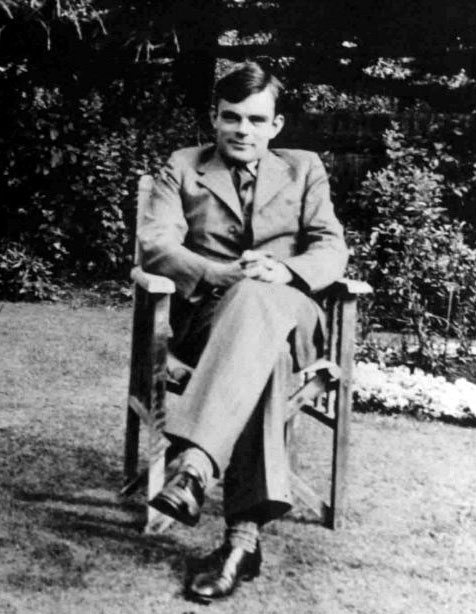
It's no exaggeration to say that Alan Turing was one of the greatest minds of the modern age. His work as a mathematician created the foundation for computer science. Even though crude computers were just being built, he came up with theories about Artificial Intelligence that are still influential. His contributions in other fields, such as Chemistry, that are also substantial.
His genius became essential to the Allied efforts to break the German Enigma Code in WWII. Working for the British Government, Turing created and refined methods to break the most complex cypher in use. it's difficult to imagine how difficult this problem was to solve, but to give you a sense: consider that there are 10 to the 22nd power possible combinations in the Enigma code. That means 1,000,000,000,000,000,000,000 possible codes. Turning figured out how to use a simple computer to test these possible solutions. To do this, he invented the logic behind "the bombe"--a cryptanalytic machine that tested possible Enigma code settings.
Professor Jack Good, cryptanalyst working at the time with Turing at Bletchley Park, later said: "Turing's most important contribution, I think, was of part of the design of the bombe, the cryptanalytic machine. He had the idea that you could use, in effect, a theorem in logic which sounds to the untrained ear rather absurd; namely that from a contradiction, you can deduce everything." (source)
Eventually his team was breaking 3,000 messages a day! We cannot underestimate how important this contribution was to the war effort.
Turing was relatively open about being homosexual during the war, but after the war was prosecuted for "Gross Indecency" and given the choice of chemical castration (through hormone injections) or jail. He chose castration and underwent the procedure. He was stripped of his security clearances. In 1954, a year after his conviction, he was found dead in his home from cyanide poisoning. The circumstances are ambiguous, which suggests that his death may have been accidental (from the careless handling of lab chemicals) or even murder. The assassination theory is based on the anxiety at the time of the KGB compromising people using homosexuality to entrap them. This was the time of the Cambridge Five, after all.
Suicide is the most likely answer. Indeed, he did report feeling hounded by the crown. The court-ordered hormone injections led to some disturbing side effects, like the growth of breasts, that he had to live with. He was only 41 when he died. Who knows what his contributions could have been had he lived longer.
Recently the British Government finally apologized for its treatment of Turing after the war. About time!
-t
Friday, June 5, 2009
The Tay's....
 People sometimes ask me where the name "Tay" comes from. Actually, it's a very old family name. I was named after William Tay, who came over to America in the 17th century. I assume he was Scottish given that "Tay" is both the name of a town, a loch, and the longest river in Scotland. A ship's register has his occupation listed as "distiller of strong spirits." We believe he was born in 1608. He married Grace Newell in Roxbury, Massachusetts in 1644. She was 13 years younger than he (23 to his 36). Together they had eight children (Grace, John, Isaiah, Abiel, Peter, Nathaniel, Jeremiah, and Elizabeth). He lived to be 75. His wife managed an impressive 91 years!
Nathaniel married and had eight more kids. Among them, another William Tay, whom I believe is the William Tay that fought in the French and Indian Wars as an officer commissioned by Samuel Adams. This William married Abigail Jones and the two of them had one child, Samuel Tay.
 Samuel fought on the Patriot side of the American Revolution, rising through the ranks. Quite a few other men with the surname of "Tay" are listed on the Patriots' Rolls as being from the town of Woburn, so I suspect they were all cousins and siblings. The Woburn Militia was one of the principal combatants at the Battle of Concord Bridge, which was the first Patriot victory of the Revolutionary War.
 After the war Samuel and his wife had one son, another Samuel. Several more Samuels follow down the line until you get to Samuel Wright Tay, also known as "Tutu" (the Hawaiian word for "Elder." He moved to Hawai'i in 1910 with his wife. At that time Hawai'i was a U.S. Territory with lots of agricultural production. His skills an engineer were no doubt in demand! They had no sons, so "Tay" died out as a surname, however it continued as a given name.
 Their daughter Alice Elizabeth Tay married my grandfather, William Washburn Moss, Jr., and the two eventually settled back in Hawai'i after spending some time in New England and having three kids. One of them was my father. I'm not sure how my parents chose "William Tay" in particular, other than it is a historic name in our family, but I'm glad they did.
So... That's the basic story of my name!
-t
Sunday, March 15, 2009
Torture
A stunning article in the NYTimes by Mark Danner (itself a condensation of a longer article he wrote for the New York Review of Books) details the best record yet about the torture conducted on suspected terrorists in the "Black" Prison programme. The article is based primarily on the classified report written by the Red Cross based on their extensive interviews with prisoners who had been transfered from the "black" prisons to Gitmo. It's chilling reading, and has the ring of authenticity.
One of the things that is striking to me about all this is that two former CIA Operatives that I have known were both highly critical of the use of torture. One told me that he had conducted or supervised many interrogations, including some were local officials used torture, and his cold-blooded experience was that torture was simply not as affective as other means. "There is no magic to it," he told me, "you simply keep asking the same question over and over again. It just takes time, that's all." Further he told me of disgust for what he was hearing about in the "war on terror": "I find it professionally insulting."
A third source, whom I haven't met, is Slow Burn, a book by former CIA operative named Orrin DeForrest about his experiences as an interrogator in Vietnam. Essentially, DeForrest replaced crude, cruel, and ineffective methods with a system of interrogation that (according to his account) was successful but too late to effect the war's outcome. Again, this is the voice of an experienced interrogator who found that torture was not the best way to get valuable intelligence from people.
But even if torture were effective in getting information, there are still powerful moral and even purely utilitarian arguments against employing it. Danner summs it up:
There is talk of some kind of Truth Commission. I sure hope that happens for the sake of our national conscience.
-t
One of the things that is striking to me about all this is that two former CIA Operatives that I have known were both highly critical of the use of torture. One told me that he had conducted or supervised many interrogations, including some were local officials used torture, and his cold-blooded experience was that torture was simply not as affective as other means. "There is no magic to it," he told me, "you simply keep asking the same question over and over again. It just takes time, that's all." Further he told me of disgust for what he was hearing about in the "war on terror": "I find it professionally insulting."
A third source, whom I haven't met, is Slow Burn, a book by former CIA operative named Orrin DeForrest about his experiences as an interrogator in Vietnam. Essentially, DeForrest replaced crude, cruel, and ineffective methods with a system of interrogation that (according to his account) was successful but too late to effect the war's outcome. Again, this is the voice of an experienced interrogator who found that torture was not the best way to get valuable intelligence from people.
But even if torture were effective in getting information, there are still powerful moral and even purely utilitarian arguments against employing it. Danner summs it up:
As I write, it is impossible to know definitively what benefits — in intelligence, in national security, in disrupting Al Qaeda — the president’s approval of use of an “alternative set of procedures” might have brought to the United States. Only a thorough investigation, which we are now promised, much belatedly, by the Senate Intelligence Committee, can determine that.
What we can say with certainty, in the wake of the Red Cross report, is that the United States tortured prisoners and that the Bush administration, including the president himself, explicitly and aggressively denied that fact. We can also say that the decision to torture, in a political war with militant Islam, harmed American interests by destroying the democratic and Constitutional reputation of the United States, undermining its liberal sympathizers in the Muslim world and helping materially in the recruitment of young Muslims to the extremist cause. By deciding to torture, we freely chose to embrace the caricature they had made of us. The consequences of this choice, legal, political and moral, now confront us. Time and elections are not enough to make them go away. (source)
There is talk of some kind of Truth Commission. I sure hope that happens for the sake of our national conscience.
-t
Monday, February 23, 2009
The 1848 Jenks Carbine
When I was a kid living in Kansas my dad had three antique rifles hanging over the couch in the living room. One was a colonial flintlock musket made in the 18th century. The second was a muzzle loading civil war era musket of a type that saw a lot of action in that war. It's still in great condition--in fact my dad and I would load it up with black powder and shoot it the back yard sometimes!

1848 Jenks Carbine
The third rifle was much more unusual--an 1848 Jenks navy carbine. It's a short, light-weight rifle designed for use on a ship. We nicknamed it "Tiny." I imagine it was possibly used in ship-to-ship battles or possibly on patrols sent ashore. Who knows how far around this world this rifle may have gone. When I was a kid I was allowed to play with this rifle when I had permission (keep in mind, this in an antique and perfectly safe).
Anyway, my dad decided to donate the rifle to the NRA firearms museum. The NRA blog says this was the first donation they've received from Hawai'i and that they expect to put it on display. Kind of neat to know that something I played with as a kid is now in a museum.
My dad notes the following:
-t
The third rifle was much more unusual--an 1848 Jenks navy carbine. It's a short, light-weight rifle designed for use on a ship. We nicknamed it "Tiny." I imagine it was possibly used in ship-to-ship battles or possibly on patrols sent ashore. Who knows how far around this world this rifle may have gone. When I was a kid I was allowed to play with this rifle when I had permission (keep in mind, this in an antique and perfectly safe).
Anyway, my dad decided to donate the rifle to the NRA firearms museum. The NRA blog says this was the first donation they've received from Hawai'i and that they expect to put it on display. Kind of neat to know that something I played with as a kid is now in a museum.
My dad notes the following:
The curator of the museum has determined by serial number that it was issued to the Navy's Pacific Squadron in the late 1840's and early 1850's. That squadron was largely in the far east, and saw action in China in the mid 1850's.
-t
Thursday, September 11, 2008
PhotoSynth of Hagia Sophia
This is a PhotoSynth created by National Geographic of Hagia Sophia
I love how this technology makes it so intuitive to visualize the thee-dimensional space.
-t
I love how this technology makes it so intuitive to visualize the thee-dimensional space.
-t
Saturday, August 2, 2008
More Pictures from Istanbul Adventures


A Trip to the Hamam
Sorry for the lack of postings yesterday--Betsy has been sick the last two days and that has hampered our operational effectiveness somewhat. But we did manage to see the Archeological Museum and the Blue Mosque.
For lunch we met with Ian Sherwood (Anglican Chaplain to the British Consulate). Needless to say, he has had a colorful twenty-year cure here! We met again in the evening for a cocktail party he had in the Rectory. There were a bunch of expat friends of Ian's, mostly Brits and Americans. Many of these folks have lived for various periods in places all over the world. One American business woman we met has been abroad for fifteen years. She and the others told us their consensus that Istanbul is an amazing city, but difficult to live in. Everything just takes a lot more work to accomplish. There are also some things one never gets used to, the bad smells and dirty streets among them.
Even more interesting was my trip to a historic Hamam (Turkish Bath) known as the Çemberlitaş Hamam just before supper time.

Çemberlitaş Hamam's "hot room"
This particular turkish bath was built in the 16th Century and is one of the city's most beautiful. It's located just across the street from the "burnt column" erected by Constantine I. The entrance is not particularly interesting. Once inside, I was at a reception desk. A young English-speaking expat-type let me select my experience from a menu. I chose the "Traditional" bath which includes a soap massage.
From there I entered the "cold room." This is the only co-ed part of the bath. Here is a place to sit and have a tea or juice after your bath. But first an attendant took me to a tier of changing rooms above the "cold room." I was handed a token for my soap massage, a unopened box with a pair of bathing mits, a towel, and spa slippers. I changed into the towel in the cubicle. (You are not really supposed to be naked in the "public" spaces in the bath.) I emerged in my towel and slippers and locked the cubicle behind me. I felt pretty comfortable that my stuff was secure, especially since the attendant is right there watching and I had the key.
From there I was ushered downstairs through the "warm room" into the "hot room." I gather that normally people linger in the "warm room" for a time, but I think today the place was doing a brisk business and wanted to move people along. At the moment I didn't know enough to protest.
In the "hot room" my glasses immediately fogged up and I realized how stupid I was to even bring them this far. An attendant took my token. I later realized that I had become, at this moment, his responsibility. The "hot room," pictured above, is an octagonal room as hot and wet as you would expect. I could see that men were choosing to either lie down on the heated slab in the center or sitting around the periphery. Thinking it would be a little cooler around the periphery, I picked a spot and sat down. I then realized that the entire floor, not just the slab in the center, is heated. Everything is marble and it's all warm or hot.
I watched the other bathers. People were using shallow silver bowels to pour water from sinks onto themselves as a kind of rinse. This made sense to me, so took a bowl and rinsed myself with water from the sink embeded in the wall next to me. It felt good, in the heat, to feel completely drenched in warm water. I sat there letting the heat penetrate.
A group of American college-aged guys rambled in, annoying some of the locals with their loud awkwardness. I tried to pretend I had nothing in common with them. I had seen them before on the street--back then they had been looking at the Hamam entrance uncertainly while their girlfriend's tugged at their elbows. No doubt the girlfriends were next door in the women' section of the bath.
After about 20 minutes stewing I was motioned over by one of the bath attendants. He was a hairy, pot-bellied guy wearing a towel (blue for attendants, red for clients). I would have preferred a beautiful but surprisingly strong Swedish or German lass, but I guess like is attracted to like. Ah, well.
First the guy rinsed me off with warm/hot water. Then he had me lie down face up on the hot slab. He put my glasses and keys aside and opened the box of massage mittens. Mittens on, he massaged my head, chest, and arms a bit. Then he came over with what looked like a huge ball of soap suds. He kind of dabbed this on me to cover me with sudsy foam. Next, the massage began in earnest.
I've heard horror stories about how rough these guys can be, especially at they attempt to make joints and backs crack. But in truth I found this all very mild. I think they go easy on the tourist-types. Still, the two EMT backboards I noticed on my walk through the "cold room" tell me that injury is not at unknown happening. As it was, I never felt like he was going to break me.
After massaging my chest and arms with the soap and mitten he had me flip over so he could do my back and legs. After that he led me over to the periphery of the room and had me sit next to a sink. He applied shampoo to my hair and more soap to the rest of my head, massaged it, then rinsed it off with warm water. He escorted me through the "warm room" to a side room with private shower stalls where he instructed me to take a quick shower to scrub the parts he didn't get. Done with that, I traded towels for a fresh set and was ushered back to my changing room.
Dry and changed I met my attendant downstairs in the "cold room" to give him his tip and then enjoyed a nice glass of freshly squeezed orange juice while I let my body re-acclimate. Total cost (including public-transit across the Golden Horn, tips, etc.): 50 Lira (approx. $44.39 CAD/USD). This is relatively expensive as these places go, but the price buys the beauty and history and the fact that about 50% of their clients are foreigners for whom this is their first Hamam experience. Total time (walking-in to walking-out) was about 50 minutes. I think they rushed me through faster than usual because of the higher-than-normal rush of people.
Another thing to do differently: I think I would have enjoyed it even more if I had someone to talk to during the bath. Originally I had wanted to go with our Greek friend from Yale, Vasileios, but he was occupied with family in town. Also, he was worried about getting too harsh a massage (as he did last time). But as I said, they were gentle with me. I suppose one can also give feedback of the "eeeiiii" variety during the proceedings. I understand there are some Turkish Baths in Toronto--I'll have to find out if they are the real deal or something scuzzy....
-t
For lunch we met with Ian Sherwood (Anglican Chaplain to the British Consulate). Needless to say, he has had a colorful twenty-year cure here! We met again in the evening for a cocktail party he had in the Rectory. There were a bunch of expat friends of Ian's, mostly Brits and Americans. Many of these folks have lived for various periods in places all over the world. One American business woman we met has been abroad for fifteen years. She and the others told us their consensus that Istanbul is an amazing city, but difficult to live in. Everything just takes a lot more work to accomplish. There are also some things one never gets used to, the bad smells and dirty streets among them.
Even more interesting was my trip to a historic Hamam (Turkish Bath) known as the Çemberlitaş Hamam just before supper time.
This particular turkish bath was built in the 16th Century and is one of the city's most beautiful. It's located just across the street from the "burnt column" erected by Constantine I. The entrance is not particularly interesting. Once inside, I was at a reception desk. A young English-speaking expat-type let me select my experience from a menu. I chose the "Traditional" bath which includes a soap massage.
From there I entered the "cold room." This is the only co-ed part of the bath. Here is a place to sit and have a tea or juice after your bath. But first an attendant took me to a tier of changing rooms above the "cold room." I was handed a token for my soap massage, a unopened box with a pair of bathing mits, a towel, and spa slippers. I changed into the towel in the cubicle. (You are not really supposed to be naked in the "public" spaces in the bath.) I emerged in my towel and slippers and locked the cubicle behind me. I felt pretty comfortable that my stuff was secure, especially since the attendant is right there watching and I had the key.
From there I was ushered downstairs through the "warm room" into the "hot room." I gather that normally people linger in the "warm room" for a time, but I think today the place was doing a brisk business and wanted to move people along. At the moment I didn't know enough to protest.
In the "hot room" my glasses immediately fogged up and I realized how stupid I was to even bring them this far. An attendant took my token. I later realized that I had become, at this moment, his responsibility. The "hot room," pictured above, is an octagonal room as hot and wet as you would expect. I could see that men were choosing to either lie down on the heated slab in the center or sitting around the periphery. Thinking it would be a little cooler around the periphery, I picked a spot and sat down. I then realized that the entire floor, not just the slab in the center, is heated. Everything is marble and it's all warm or hot.
I watched the other bathers. People were using shallow silver bowels to pour water from sinks onto themselves as a kind of rinse. This made sense to me, so took a bowl and rinsed myself with water from the sink embeded in the wall next to me. It felt good, in the heat, to feel completely drenched in warm water. I sat there letting the heat penetrate.
A group of American college-aged guys rambled in, annoying some of the locals with their loud awkwardness. I tried to pretend I had nothing in common with them. I had seen them before on the street--back then they had been looking at the Hamam entrance uncertainly while their girlfriend's tugged at their elbows. No doubt the girlfriends were next door in the women' section of the bath.
After about 20 minutes stewing I was motioned over by one of the bath attendants. He was a hairy, pot-bellied guy wearing a towel (blue for attendants, red for clients). I would have preferred a beautiful but surprisingly strong Swedish or German lass, but I guess like is attracted to like. Ah, well.
First the guy rinsed me off with warm/hot water. Then he had me lie down face up on the hot slab. He put my glasses and keys aside and opened the box of massage mittens. Mittens on, he massaged my head, chest, and arms a bit. Then he came over with what looked like a huge ball of soap suds. He kind of dabbed this on me to cover me with sudsy foam. Next, the massage began in earnest.
I've heard horror stories about how rough these guys can be, especially at they attempt to make joints and backs crack. But in truth I found this all very mild. I think they go easy on the tourist-types. Still, the two EMT backboards I noticed on my walk through the "cold room" tell me that injury is not at unknown happening. As it was, I never felt like he was going to break me.
After massaging my chest and arms with the soap and mitten he had me flip over so he could do my back and legs. After that he led me over to the periphery of the room and had me sit next to a sink. He applied shampoo to my hair and more soap to the rest of my head, massaged it, then rinsed it off with warm water. He escorted me through the "warm room" to a side room with private shower stalls where he instructed me to take a quick shower to scrub the parts he didn't get. Done with that, I traded towels for a fresh set and was ushered back to my changing room.
Dry and changed I met my attendant downstairs in the "cold room" to give him his tip and then enjoyed a nice glass of freshly squeezed orange juice while I let my body re-acclimate. Total cost (including public-transit across the Golden Horn, tips, etc.): 50 Lira (approx. $44.39 CAD/USD). This is relatively expensive as these places go, but the price buys the beauty and history and the fact that about 50% of their clients are foreigners for whom this is their first Hamam experience. Total time (walking-in to walking-out) was about 50 minutes. I think they rushed me through faster than usual because of the higher-than-normal rush of people.
Another thing to do differently: I think I would have enjoyed it even more if I had someone to talk to during the bath. Originally I had wanted to go with our Greek friend from Yale, Vasileios, but he was occupied with family in town. Also, he was worried about getting too harsh a massage (as he did last time). But as I said, they were gentle with me. I suppose one can also give feedback of the "eeeiiii" variety during the proceedings. I understand there are some Turkish Baths in Toronto--I'll have to find out if they are the real deal or something scuzzy....
-t
Thursday, July 31, 2008
The Chora
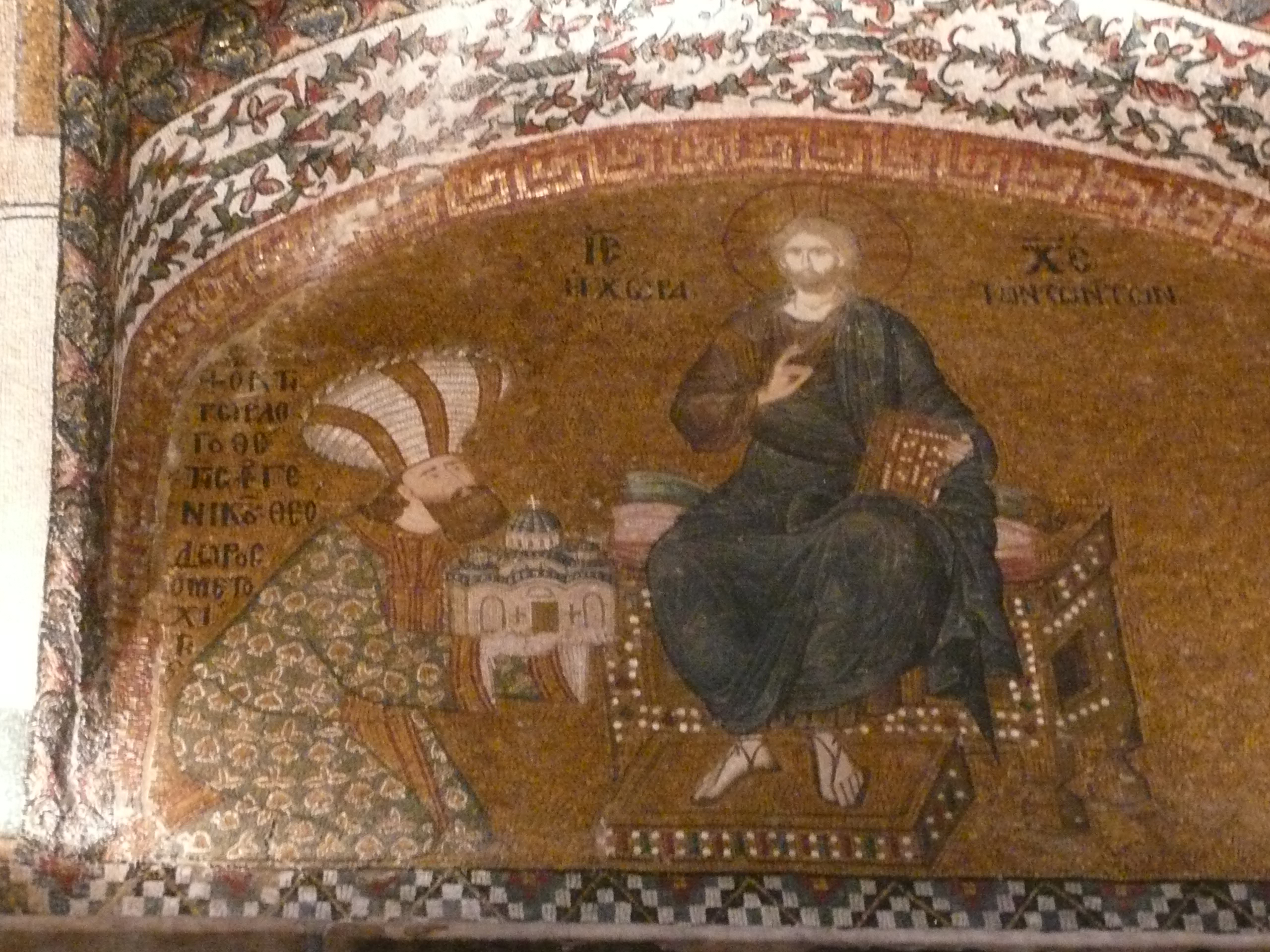
Today we saw Chora Church (pronounced "whore-ah")--also known as Kariye Camii. The name "Chora" is really just the last word of the formal greek title for the church: ἡ Ἐκκλησία του Ἅγιου Σωτῆρος ἐν τῃ Χώρᾳ (i.e.: the Church of the Holy Saviour in the Country). "Chora" means country. This church was located outside the walls built by Constantine (but was later enveloped by the growing city and the Theodosian walls built to protect the enlarged metropolis). The original church was built in the 5th century, but it went through several revisions (some necessitated by earthquakes, etc.). The most impressive parts of the current structure, including the elaborate mosaics and frescoes, were built in the 14th century. The man responsible for them, Theodore Metochites, was a rare man gifted academically and politically. He was the Byzantine equivalent of the Prime Minister at the height of his power, but then a regime change brought about his exile. He was allowed to return to Constantinople having promised to stay out of politics and be a monk at the Chora. This he did. In his last years he wrote that he hoped the Chora Church would secure his legacy until the end of the ages. It just might.
Impressive mosaics, frescos, and marble work fill the place--and yet so much is lost from it's Byzantine glory. We took a ton of pictures, but it's late and I need to get to bed. I'll just wrap up by saying that I'm enjoying this city more and more as I stay here. The place is electric with energy and vibrant in a dozen ways. Just walking down the streets is exhilarating.
-t
Wednesday, July 30, 2008
The Past Repeated
I won't write a long blog entry about today since Betsy already gave a play-by-play on her blog. Here's an excerpt:
As Betsy mentions later in her blog, I'll be thinking (and writing) more about the modern Christian church in Turkey at a later point. These folks are putting up with a lot of discrimination and hardship and it's not hard to see history repeating itself viz. the patristic era and today.
Also missing from her blog entry was a mention of the delicious snack we had after looking at architecture: some of the best pistachio baklava I've ever had topped with (what else) pistachio ice-cream. Istanbul is famous for it's baklava, which is a great carbo-tweak after a day of walking around the city.
-t
Our next visit was to the church of the Theotokos Pammakaristos (Church of the Joyous Mother of God). I have a special interest in this church because I wrote a paper about the parekklesion (side chapel) which has fantastic mosaics preserved inside. However, my interest focused on exterior facade of the parekklesion. There are corbels on this building too, which may be evidence that the exterior facade of the church delimited a space for some kind of activity (perhaps a ritual related to the burials inside the parekklesion?) outside the church. What was the function of the space defined by the canopies or banners supported by these corbels? I’m not sure. There is a very long inscription that runs along the string course (just above the lowest level of arches) and some other funky inscriptions higher up on the third level of windows and niches. Funerary? Festivals? Not sure and there just isn’t a lot of other evidence to draw from. (source)
As Betsy mentions later in her blog, I'll be thinking (and writing) more about the modern Christian church in Turkey at a later point. These folks are putting up with a lot of discrimination and hardship and it's not hard to see history repeating itself viz. the patristic era and today.
Also missing from her blog entry was a mention of the delicious snack we had after looking at architecture: some of the best pistachio baklava I've ever had topped with (what else) pistachio ice-cream. Istanbul is famous for it's baklava, which is a great carbo-tweak after a day of walking around the city.
-t
Pictures from Ephesus
Of course, we took a few hundred pictures at Ephesus. But here are just a few...

The excavation of the residences on the hill near the library are extraordinary. They've spent something like 40 years digging these houses out and were rewarded with beautiful frescos and mosaics.

If you look very closely you can see Betsy in blue at the bottom of the frame. This is the fascade of the once-great library of Celsus at Ephesus

A closer-up image of the stunning carving of the library at Ephesus

Me standing very close to where St. Paul once preached (the Theater in Ephesus).
-t


-t
Hierapolis and Selçuk Pictures...


-t
Tuesday, July 29, 2008
Ephesus
It's 1 A.M. local time. We just got into the flat in Istanbul that will serve as home base for the next week or so. It's compact, but has everything we need. The owner was even nice enough to leave milk, bread, a few eggs, and some tomatoes for us.
It was a full day. We slept soundly in the hotel by the sea in a town near Ephesus. In the morning we had a short turkish breakfast (olives, bread, watermelon, and a hard-boiled egg) before being picked up for our touring.
We spent the whole morning at Ephesus. The site has been well-preserved and much has been uncovered by a long-running Austrian project. Since the 1960's they have been digging out a set of dwellings built into the hillside near the great library of Celsus. The dig revealed some fantastic mosaics and frescos that give a very clear sense of what life was like for the upper-crust in a provincial capital city. The presentation of these ruins were very impressive--metal and glass walkways showed things off with nary a foot-tred.
The library fascade is even more beautiful in person than in the photographs. The details of the carving are extraordinary. There is also some evidence of the city's Christian history. Walking into the theater, I had the wonderful thought that both St. John the Evangelist and St. Paul once preached there. I stood near where the stage would have been and imagined myself in their position, preaching to a crowd of hundreds, perhaps more, in a bustling trade town--at the time the largest seaport on the Aegean.
As it typical on these group tours, historic site tend to alternate with "Turkish Culture" demonstrations--which is a way of saying they show you how they make things you can buy. It's one step up from an infomercial. So after Ephesus we stopped at a carpet co-op to learn all about how they make turkish carpets. Actually, this tour was quite informative and we saw some true masterpieces made by local women in their homes. One of the most impressive of these was silk, about 10 feet by 20 feet. It took the woman who made it 3 1/2 years of work. The list price was about $18,000 USD/CAD, which really means about $9,000 when the haggling is done. The carpet salesman told me that if we bought the same carpet in Toronto we would probably pay at least $30,000, and I tend to believe him. Even then, I think it would be a bargain considering that this is huge pure silk carpet that took a master several years to complete the intricate design.
I was sorely tempted to buy a prayer-sized cotton rug for my own meditation and devotions, but we just don't have $400 for something like that right now. Still, they did a good job of trying to sell it to us. Funny how sales jobs go through the same routine everywhere, I wouldn't have been surprised if they pitch guy had learned his craft in the U.S. or Canada. But he was a nice guy and true to his word about not pressuring us too much.
Lunch outside the carpet place was one of the best lunches I've had in Turkey so far. As is typical, there were hot and cold appetizers including olives, a tomato salad, and a seaweed dish topped with a delicious yogurt sauce. The main course was several kinds of simple grilled spiced meats and potato. I washed in down with the local beer (which is a surprisingly good pilsner).
After the carpet place we headed to the old Temple of Artemis. Little remains of this structure--once one of the Seven Wonders of the World. Much of the marble was carted off in the Byzantine era to build other monuments and places of worship for the new religion.
Next was the house that supposedly belongs to the Virgin Mary. While it seems quite possible that the Blessed Virgin Mary (and St. John the Evangelist) spent their last days in Ephesus, the claim that this particular house was hers is more dubious. The site was crowded and commercialized and it was hard to maintain a pious attitude. Still, I said some "Hail Marys" and thought pleasant things about the God Bearer. Yet this marion shrine, IMHO, is not nearly as spiritually or otherwise impressive as Our Lady of Guatalupe in Mexico City. Anyway, we saw the house (mostly a reconstruction) and had fresh squeezed O.J. and ice cream in the cafe.
Up until this point, our tour guide had not mentioned the next stop--a leather fashion show. I kid you not, we went from the house of the Blessed Virgin to a fashion show complete with strobe lights and gawdy club music. After the show we were shown into the shop to peruse the leather goods. Our tour guide waited outside looking disgusted by the whole thing as she sipped her apple tea. Lots of hovering salesmen and people from the cruise ships with sunburns and stickers on their shirts that identify to which tour of which ship they belong. Stupid. I mean, the leather was nice, but they didn't even try to pretend this was anything other than a sales job--no wonder it's last on the tour.
When we got back to Selcuk (a town near Ephesus) Betsy and I had time to walk to the old Basilica of St. John. This is where the Evangelist was buried. A large shrine church on the site was once one of the most impressive churches of the world. Earthquakes and then the Turkish conquest of the area in the 14th century left it in ruins, but the restoration underway since the 1920's has done a wonderful job. Enough remains to get a clear sense of the plan and the grandeur of the place. I was particularly impressed with the large baptistry. I've seen the cross-shaped font with steps going in before in some modern churches, and I suppose this was one of their models. Naturally, I stepped down and imagined what it would feel like.
From there it was back to the tour office in Selcuk where I am composing most of this message. While we waited for our ride to the airport I bought a sandwich for Betsy from a local vendor and a peach from a local farmer's market. People are friendly and helpful even though I no almost no Turkish. I do feel right at home, though, and think I've pretty much figured out the essentials of life in Turkey for a rolling Moss (gathering no stone).
Tomorrow we are meeting up with an old friend and collegue of Betsy's--Vasileios. He is a Greek Byzantianist that we always seem to be meeting in odd places. The first time that Betsy and I came to Toronto together we stayed with him. Then when he was studying at the Met in NYC we went and visited him there! Now we are in Turkey and he's here, too. Tomorrow he's going to show us a church that he has researched extensively (he even wrote a book on it). In the evening we are meeting with a friend of a friend who does good work in Istanbul.
I'll post some pics tomorrow. We're wiped tonight.
-t
It was a full day. We slept soundly in the hotel by the sea in a town near Ephesus. In the morning we had a short turkish breakfast (olives, bread, watermelon, and a hard-boiled egg) before being picked up for our touring.
We spent the whole morning at Ephesus. The site has been well-preserved and much has been uncovered by a long-running Austrian project. Since the 1960's they have been digging out a set of dwellings built into the hillside near the great library of Celsus. The dig revealed some fantastic mosaics and frescos that give a very clear sense of what life was like for the upper-crust in a provincial capital city. The presentation of these ruins were very impressive--metal and glass walkways showed things off with nary a foot-tred.
The library fascade is even more beautiful in person than in the photographs. The details of the carving are extraordinary. There is also some evidence of the city's Christian history. Walking into the theater, I had the wonderful thought that both St. John the Evangelist and St. Paul once preached there. I stood near where the stage would have been and imagined myself in their position, preaching to a crowd of hundreds, perhaps more, in a bustling trade town--at the time the largest seaport on the Aegean.
As it typical on these group tours, historic site tend to alternate with "Turkish Culture" demonstrations--which is a way of saying they show you how they make things you can buy. It's one step up from an infomercial. So after Ephesus we stopped at a carpet co-op to learn all about how they make turkish carpets. Actually, this tour was quite informative and we saw some true masterpieces made by local women in their homes. One of the most impressive of these was silk, about 10 feet by 20 feet. It took the woman who made it 3 1/2 years of work. The list price was about $18,000 USD/CAD, which really means about $9,000 when the haggling is done. The carpet salesman told me that if we bought the same carpet in Toronto we would probably pay at least $30,000, and I tend to believe him. Even then, I think it would be a bargain considering that this is huge pure silk carpet that took a master several years to complete the intricate design.
I was sorely tempted to buy a prayer-sized cotton rug for my own meditation and devotions, but we just don't have $400 for something like that right now. Still, they did a good job of trying to sell it to us. Funny how sales jobs go through the same routine everywhere, I wouldn't have been surprised if they pitch guy had learned his craft in the U.S. or Canada. But he was a nice guy and true to his word about not pressuring us too much.
Lunch outside the carpet place was one of the best lunches I've had in Turkey so far. As is typical, there were hot and cold appetizers including olives, a tomato salad, and a seaweed dish topped with a delicious yogurt sauce. The main course was several kinds of simple grilled spiced meats and potato. I washed in down with the local beer (which is a surprisingly good pilsner).
After the carpet place we headed to the old Temple of Artemis. Little remains of this structure--once one of the Seven Wonders of the World. Much of the marble was carted off in the Byzantine era to build other monuments and places of worship for the new religion.
Next was the house that supposedly belongs to the Virgin Mary. While it seems quite possible that the Blessed Virgin Mary (and St. John the Evangelist) spent their last days in Ephesus, the claim that this particular house was hers is more dubious. The site was crowded and commercialized and it was hard to maintain a pious attitude. Still, I said some "Hail Marys" and thought pleasant things about the God Bearer. Yet this marion shrine, IMHO, is not nearly as spiritually or otherwise impressive as Our Lady of Guatalupe in Mexico City. Anyway, we saw the house (mostly a reconstruction) and had fresh squeezed O.J. and ice cream in the cafe.
Up until this point, our tour guide had not mentioned the next stop--a leather fashion show. I kid you not, we went from the house of the Blessed Virgin to a fashion show complete with strobe lights and gawdy club music. After the show we were shown into the shop to peruse the leather goods. Our tour guide waited outside looking disgusted by the whole thing as she sipped her apple tea. Lots of hovering salesmen and people from the cruise ships with sunburns and stickers on their shirts that identify to which tour of which ship they belong. Stupid. I mean, the leather was nice, but they didn't even try to pretend this was anything other than a sales job--no wonder it's last on the tour.
When we got back to Selcuk (a town near Ephesus) Betsy and I had time to walk to the old Basilica of St. John. This is where the Evangelist was buried. A large shrine church on the site was once one of the most impressive churches of the world. Earthquakes and then the Turkish conquest of the area in the 14th century left it in ruins, but the restoration underway since the 1920's has done a wonderful job. Enough remains to get a clear sense of the plan and the grandeur of the place. I was particularly impressed with the large baptistry. I've seen the cross-shaped font with steps going in before in some modern churches, and I suppose this was one of their models. Naturally, I stepped down and imagined what it would feel like.
From there it was back to the tour office in Selcuk where I am composing most of this message. While we waited for our ride to the airport I bought a sandwich for Betsy from a local vendor and a peach from a local farmer's market. People are friendly and helpful even though I no almost no Turkish. I do feel right at home, though, and think I've pretty much figured out the essentials of life in Turkey for a rolling Moss (gathering no stone).
Tomorrow we are meeting up with an old friend and collegue of Betsy's--Vasileios. He is a Greek Byzantianist that we always seem to be meeting in odd places. The first time that Betsy and I came to Toronto together we stayed with him. Then when he was studying at the Met in NYC we went and visited him there! Now we are in Turkey and he's here, too. Tomorrow he's going to show us a church that he has researched extensively (he even wrote a book on it). In the evening we are meeting with a friend of a friend who does good work in Istanbul.
I'll post some pics tomorrow. We're wiped tonight.
-t
Monday, July 28, 2008
Some Pictures from Cappadocia


Back on the Road
Antibotics are a beautiful thing. 36 hours after starting the Cipro I was feeling improved. 48 hours and I think I'm pretty much cured. Yesterday we checked out of the cave hotel. Yes, parts of this hotel were actually carved out of the rock surface. Cappadocia is covered with this peculiar kind of volcanic rock that is soft to cave but strong enough to maintain its integrity. I wasn't completely well, but nonetheless checked onto the night bus to Pamukkale.
Ten very uncomfortable, cramped hours later we arrived. After an interminable delay twindling our thumbs at daybreak outside a travel agency office, someone came to take us to our hotel. We were only there for about four hours: long enough to shower and take a much-needed nap in the A/C.
I still wasn't hungry enough to eat much for lunch, but I did enjoy seeing the strange hot spring formations at Pamukkale. (I should have pictures to post soon). Yet even more interesting were the ruins of the city of Hierapolis. People have been living here since the 2nd Century B.C., but the place was abandoned by the 14th Century C.E. Many of the structures were damaged by earthquakes, but what remains is impressive. Betsy and I particularly enjoyed seeing some of the Byzantine-era churches on the site.
The cathedral, for example, had two features I noted. One was the Synthronon--a kind of half circle of seats used the priests behind the altar against the wall of the apse. Sitting there looking down the nave I could easily imagine presiding in the place. It has a nice feel as a church--not too big. The other thing I noticed was the adjoining baptistry. It was a large room with a huge font decorated with lovely marble. Having such as elevated view of baptism is a good thing to express architecturally, I think.
The last and most ambitious part of the site we visited was the Martyrium of St. Philip. It was a hot day and were exhausted and probably dehydrated, but we really pushed ourselves to the limit to climb the hill up to this ancient church. It's an usually church, so it was good to get some good pictures and video for Betsy. Then we climbed down and downed as much water as we could stand.
Back on the mini-bus a smooth ride to a town near Ephesus. This was soooo much better than the inter-city busses we have been braving. It was three hours, but with room to spread out and plenty of air circulating (alas, no AC). We stopped at a roadside service station where a man was selling one of my favorite drinks in the world--fresh squeezed orange juice. They sell this all over, and my interest was a good indication that my bug is mostly gone.
Indeed, by the time we settled into tonight's hotel I was hungry for the first time in days. Had Calamari and Chicken Shish.
Early to bed tonight (we really didn't sleep much on the bus last night) and tomorrow we'll see Ephesus. We also might get to the Basilica of St. John the Evangelist and also the last home of Blessed Mary. Strange to think that Mary, the mother of Jesus, used to haunt these grounds. Nor was this place foreign to John the Evangelist. Fascinating.
By the way, the town of Gorme, where we spent a few days, is a stone's throw from Nyssa (as in, St. Gregory of Nyssa). it's a small, small Christian world.
-t
Ten very uncomfortable, cramped hours later we arrived. After an interminable delay twindling our thumbs at daybreak outside a travel agency office, someone came to take us to our hotel. We were only there for about four hours: long enough to shower and take a much-needed nap in the A/C.
I still wasn't hungry enough to eat much for lunch, but I did enjoy seeing the strange hot spring formations at Pamukkale. (I should have pictures to post soon). Yet even more interesting were the ruins of the city of Hierapolis. People have been living here since the 2nd Century B.C., but the place was abandoned by the 14th Century C.E. Many of the structures were damaged by earthquakes, but what remains is impressive. Betsy and I particularly enjoyed seeing some of the Byzantine-era churches on the site.
The cathedral, for example, had two features I noted. One was the Synthronon--a kind of half circle of seats used the priests behind the altar against the wall of the apse. Sitting there looking down the nave I could easily imagine presiding in the place. It has a nice feel as a church--not too big. The other thing I noticed was the adjoining baptistry. It was a large room with a huge font decorated with lovely marble. Having such as elevated view of baptism is a good thing to express architecturally, I think.
The last and most ambitious part of the site we visited was the Martyrium of St. Philip. It was a hot day and were exhausted and probably dehydrated, but we really pushed ourselves to the limit to climb the hill up to this ancient church. It's an usually church, so it was good to get some good pictures and video for Betsy. Then we climbed down and downed as much water as we could stand.
Back on the mini-bus a smooth ride to a town near Ephesus. This was soooo much better than the inter-city busses we have been braving. It was three hours, but with room to spread out and plenty of air circulating (alas, no AC). We stopped at a roadside service station where a man was selling one of my favorite drinks in the world--fresh squeezed orange juice. They sell this all over, and my interest was a good indication that my bug is mostly gone.
Indeed, by the time we settled into tonight's hotel I was hungry for the first time in days. Had Calamari and Chicken Shish.
Early to bed tonight (we really didn't sleep much on the bus last night) and tomorrow we'll see Ephesus. We also might get to the Basilica of St. John the Evangelist and also the last home of Blessed Mary. Strange to think that Mary, the mother of Jesus, used to haunt these grounds. Nor was this place foreign to John the Evangelist. Fascinating.
By the way, the town of Gorme, where we spent a few days, is a stone's throw from Nyssa (as in, St. Gregory of Nyssa). it's a small, small Christian world.
-t
Friday, July 25, 2008
History Told by the Winners
This morning there was no running water when woke up, but by the time we finished breakfast it was working again and we had time for a quick shower before joining the tour. This was a pre-arranged tour, and there were good and bad things about it. On the plus side, we came away with a descent overview of this part for Cappadocia, On the negative side, we spent too little time exploring rock cut churches and monasteries and too much time giving local businesses a chance to sell us their pottery, wine, etc.

Looking liturgically east toward the altar (visible in the back) in one of the Goreme churches
Here a picture of the interior of a typical rock-cut church. This site was in use by Christian monastics up until the 1920's and features a number of different class rooms, refectories, living spaces, and chapels. Note the templon barrier (Byzantine version of a rood screen and a forerunner of the iconostasis now common in Orthodox churches. The altar is visible just beyond. It's square and about two feet per side. I stood at it and tried to imagine celebrating the Eucharist.

Frescos in apse
Here is an example of the elaborate fresco work contained in some of the churches. Note that even though there is no structural reason to do so, these churches conform to the layout of above-ground Byzantine churches with domes and vaults. Unfortunately, many of the Frescos have had the faces scratched off. Initially the tour guide (weak in both English and history) tried to tell us that they had simply fallen off. When someone on the tour asked how the damage could look so deliberate, the tour guide offered several theories that my art-historian wife thought were compelete B.S. One was that local children had defaced the images (unlikely given the both the height and the difficulty of the work). Another was that the Christians wanted to take pieces of the frescos with them "for good luck." The idea that these monks would have deliberately destroyed such beautiful works to take a handful of lucky plaster dust is pretty absurd. And even if they did, why scratch out only the faces? A much simpler explanation is that the destruction was the result of Islamic Iconoclasm. The same thing was at work when they painted over the mosaics in Hagia Sophia. This whole recasting of history to excuse the deliberate destruction of culture and the fact that our tour guide kept referring to the "prophet Jesus" was a good reminder that much of what we are seeing is being viewed through an Ottoman lens. In fact, it's only recently that Turkey has made much effort at preserving and showing it's Byzantine heritage.

An example of damaged frescos
Modern Turkey is very nationalistic. Lots of flags and patriotism. In fact, it's still technically illegal under "article 301" to say anything deemed to be "insulting to turkishness" which basically means being critical of either the current powers-that-be or even those of history. Freedom of speech is not a basic human right, here. What's interesting is that a lot of the 301 prosecutions may have been about thwarting E.U. Membership after all:
This brings up an interesting observation--we have yet to encounter even the slightest hint of anti-Americanism on this trip. True, we've mostly been in touristy areas and when asked where we are from answer honestly "Canada," but even when the subject of America has come up with our Turkish hosts they have never said anything critical. No one has been anything but nice to us.
Tomorrow more rock-cut stuff including an underground city.
-t

Here a picture of the interior of a typical rock-cut church. This site was in use by Christian monastics up until the 1920's and features a number of different class rooms, refectories, living spaces, and chapels. Note the templon barrier (Byzantine version of a rood screen and a forerunner of the iconostasis now common in Orthodox churches. The altar is visible just beyond. It's square and about two feet per side. I stood at it and tried to imagine celebrating the Eucharist.

Here is an example of the elaborate fresco work contained in some of the churches. Note that even though there is no structural reason to do so, these churches conform to the layout of above-ground Byzantine churches with domes and vaults. Unfortunately, many of the Frescos have had the faces scratched off. Initially the tour guide (weak in both English and history) tried to tell us that they had simply fallen off. When someone on the tour asked how the damage could look so deliberate, the tour guide offered several theories that my art-historian wife thought were compelete B.S. One was that local children had defaced the images (unlikely given the both the height and the difficulty of the work). Another was that the Christians wanted to take pieces of the frescos with them "for good luck." The idea that these monks would have deliberately destroyed such beautiful works to take a handful of lucky plaster dust is pretty absurd. And even if they did, why scratch out only the faces? A much simpler explanation is that the destruction was the result of Islamic Iconoclasm. The same thing was at work when they painted over the mosaics in Hagia Sophia. This whole recasting of history to excuse the deliberate destruction of culture and the fact that our tour guide kept referring to the "prophet Jesus" was a good reminder that much of what we are seeing is being viewed through an Ottoman lens. In fact, it's only recently that Turkey has made much effort at preserving and showing it's Byzantine heritage.

Modern Turkey is very nationalistic. Lots of flags and patriotism. In fact, it's still technically illegal under "article 301" to say anything deemed to be "insulting to turkishness" which basically means being critical of either the current powers-that-be or even those of history. Freedom of speech is not a basic human right, here. What's interesting is that a lot of the 301 prosecutions may have been about thwarting E.U. Membership after all:
In its short life the article has been heavily criticized, both in Turkey and outside.[22] A criticism heard in Turkey, and also voiced by some outside, is that it has turned into a tool of the nationalist "old guard", who, so is claimed, use it to press charges against people of international renown, not to stifle dissenting opinions but with the aim of thwarting the admission process to the EU. (source)
This brings up an interesting observation--we have yet to encounter even the slightest hint of anti-Americanism on this trip. True, we've mostly been in touristy areas and when asked where we are from answer honestly "Canada," but even when the subject of America has come up with our Turkish hosts they have never said anything critical. No one has been anything but nice to us.
Tomorrow more rock-cut stuff including an underground city.
-t
Wednesday, July 23, 2008
Cisterns and Mosques...
We have a few minutes before getting on the bus for Cappadocia, so I'll post a few notes about today.
Fantastic breakfast=late start. I'm very fond of the way they do breakfast in this country--lots of little tastes. Simple things well prepared. Today I even ate some raw honey comb. But once we did get moving we hit the streets pretty hard--walking several km in the process.
The first stop was a mosaic museum with pieces of the floor from the old palace (6th Century). The restoration project was a very big deal and as much on display as the actual mosaics.
Next we saw the former Church of SS. Sergius and Bacchus, now a Mosque. It's known as "Little Hagia Sophia" because of the shared floor plan. Back a few hundred years ago, Latin (Roman Catholic Clergy) were allowed to celebrate Mass in this otherwise Orthodox Church thanks to an obscure connection this place had to the West.
The Mosque Sexton (not sure his real title) spoke basically no English. But because we lingered more than most tourists in this quiet mosque (and perhaps because I put a health donation in the box and Betsy showed proper etiquette by covering her hair) he motioned me to follow him. When I did, he pulled back a piece of the carpet to reveal a large panel of glass floor--through that you could see some of the original mosaic (?) floor of the church.
Outside we refreshed ourselves in a quiet, shaded tea garden. A lady next to us tried to communicate, but she had absolutely no English, so we didn't get much further than relating that we are from Canada and are married.
Constantine's Column was a bit disappointing--it's completely covered by scaffolding as part of a restoration project. So we went ahead to the Binbirderik Cistern. Unlike the Basilica Cistern we saw yesterday, this one is drained and less dominating by tourist traffic. They did have some nice architectural models of important Byzantine structures, most of which have little remaining.
Next we feasted on Kebabs and a well-regarded place. We are quickly learning how to make sense of the food and drink culture around here! Now we'll be heading on a night bus out East. Not sure what kind of Internet Access we'll find!
-t
Fantastic breakfast=late start. I'm very fond of the way they do breakfast in this country--lots of little tastes. Simple things well prepared. Today I even ate some raw honey comb. But once we did get moving we hit the streets pretty hard--walking several km in the process.
The first stop was a mosaic museum with pieces of the floor from the old palace (6th Century). The restoration project was a very big deal and as much on display as the actual mosaics.
Next we saw the former Church of SS. Sergius and Bacchus, now a Mosque. It's known as "Little Hagia Sophia" because of the shared floor plan. Back a few hundred years ago, Latin (Roman Catholic Clergy) were allowed to celebrate Mass in this otherwise Orthodox Church thanks to an obscure connection this place had to the West.
The Mosque Sexton (not sure his real title) spoke basically no English. But because we lingered more than most tourists in this quiet mosque (and perhaps because I put a health donation in the box and Betsy showed proper etiquette by covering her hair) he motioned me to follow him. When I did, he pulled back a piece of the carpet to reveal a large panel of glass floor--through that you could see some of the original mosaic (?) floor of the church.
Outside we refreshed ourselves in a quiet, shaded tea garden. A lady next to us tried to communicate, but she had absolutely no English, so we didn't get much further than relating that we are from Canada and are married.
Constantine's Column was a bit disappointing--it's completely covered by scaffolding as part of a restoration project. So we went ahead to the Binbirderik Cistern. Unlike the Basilica Cistern we saw yesterday, this one is drained and less dominating by tourist traffic. They did have some nice architectural models of important Byzantine structures, most of which have little remaining.
Next we feasted on Kebabs and a well-regarded place. We are quickly learning how to make sense of the food and drink culture around here! Now we'll be heading on a night bus out East. Not sure what kind of Internet Access we'll find!
-t
Subscribe to:
Posts (Atom)