Wednesday, October 8, 2008

Liturgy and The Cloud of Unknowing

I'm very proud of the Contemplative Eucharist that we do on Wednesday mornings. It's a very special achievement to have gotten that baby off the ground. And now that it's gaining more momentum I'm beginning to see even more potential.

Margo Sawyer - Cloud of Unknowing, 2005

With the encouragement of my staff I've been gradually adding a bit more instruction and discussion at the end of it. Last week we talked about The Cloud of Unknowing--a 14th Century manual for contemplative spirituality. So this week I brought my copy and read the group a paragraph taken from random:
In this way you can see that we must concentrate our whole attention on this lowly movement of love in our will. To all other forms of sweetness or consolation, however pleasant or holy (if we be allowed to put it in this way) we should show a sort of indifference. If they come, welcome them; but do not depend on them, because they are weakening things; it takes too much out of you to stay for long in such sweet feelings and tears. And you may even be tempted to love God for the sake of having them. You will know if this is so by seeing whether you complain unduly when they are absent. And if you do, your love is not yet pure or perfect. For a love that is pure and perfect, though it admits that the body is sustained and consoled when such sweet feelings or tears are present, does not complain when they are missing, but is really pleased not to have them, if it is the will of God. And yet in some people contemplation is normally accompanied by consolations of this sort, while there are others who have such sweetness and comfort but seldom. (The Cloud of Unknowing, Chapter 50, Paragraph 1, Trans. Clifton Wolters)
So many people come to religion for an experience--yet if you strive for a more perfect love you must cultivate a "kind of indifference" to the consolations and sweet feelings that occasionally come with the spiritual life. I think of liturgies that are specifically designed to manipulate people emotionally in order to give them a feeling of catharsis by the end. The Contemplative Tradition teaches that such worship draws us further from God in that our faith becomes depending on what get out of it, emotionally. If you would have perfect love, then you must accept whatever spirituality presents itself in this moment, right now, and not lust after something else. It's a fantastically powerfully teaching that few are really to hear.

The bishop only gave me permission to do the Contemplative Eucharist until All Saints' (Nov. 1st). I'm hoping he will renew permission after that, but it's possible he may not. If he refuses I'll be upset, of course, and I'll argue vigorously on behalf of this group. But the System I'm a part of doesn't care for innovation, and that's a reality I have to accept, as well. So I'll have to write a letter to the bishop soon to plead for group to continue. Stay tuned...

-t

Tuesday, October 7, 2008

Eucharist

I have to say that the opportunity to celebrate the Holy Eucharist is one of the great joys in my life. This morning we had our "Traditional Communion" (Trad-Com, as we sometimes call it) from the BCP. One of the advantages of the traditional liturgies, IMHO, is that they allow the celebrant the luxury of introspection. Because there is so much less interaction with the congregation, I find that I can really focus on what's going on internally. This is even more true with Eastward Celebration (back to the people).

One of the things I really miss about St. Mary Magdalene's was the 7:15 AM Holy Eucharist on Tuesdays and Thursday. It seemed possible, for once, to do a perfect liturgy: every step, every gesture, every little bit done in a precise, intentional, and planned way. When I was in "the zone" celebrating Mass that way I found that the formalism enhanced my ability to be present to the Holy Spirit. I'll never forget standing on the blue carpet in the lady chapel and elevating the chalice to the height where I could just see, in the reflection, the congregation behind me.

The sensibility of Sunday worship at COTM privileges an entirely different experience: we are willing to do church without even trying to attain any kind of perfectibility. We are all about the messy and fun encounter of God with a community of imperfect, sometimes crazy, always energetic people.

-t

Talk About Inventive Liturgy...


It's good to be King. Mswati III of Swaziland recently presided at a ceremony in which "tens of thousands" (according to Reuters) of bare-breasted virgins competed in order to choose his 14th wife. As you might expect, Mswati is an absolute Monarch, the last in Sub-Saharan Africa.

You might think that having thousands of half-naked women parade by the king (dressed in a leopard-skin loin cloth) is part of some ancient and respectable tradition. Actually, the King instituted this "ceremony" in 1999! Lol.

-t

Take-Your-Pet-To-Church Sunday

In honor of St. Francis of Assisi we celebrated "Take-Your-Pet-To-Church Sunday" a few days ago. We really weren't sure what would happen. As it turns out, it wasn't nearly as chaotic as I had feared it might be. The pets that came were very well behaved and the kids were mesmerized by the Parrot and the lizards and the wonderful dogs and cats. I would consider doing it again next year!

-t

Saturday, October 4, 2008

Do-It-Yourself Audio

Lately I've been daydreaming about building my own stereo amplifier. In the process I stumbled on this website: DIY Audio Projects. It's all about the neat stuff you can make if you have a soldering iron and little bit of know-how. There is something deeply satisfying about these kinds of creations--having built my own computers, I know what that's like.

-t

The "Last" Supper?


-t

Friday, October 3, 2008

church nicknacks and whathaveyous

church nicknacks and whathaveyous
Dave Walker challenged his blog's readers to create pages to fill up the Google Results for "church nicknacks and whathaveyous"--here we go!

My favorite church nicknack is probably the table-top BBQ that we use for the Easter Vigil fire every year. Of course, it only gets used that one-time a year. For actual cooking we use a full-sized gas grill we keep out back.

What are your favorite church nicknack and whathaveyous?

-t

The Church Office


From Dave Walker's cartoon blog. Ah, yes, we can relate!

-t

Politics

I spent most of yesterday at Fresh Start, a Diocese-mandated continuing education program for priests taking up new appointments. This is my second year in the program, and after having been through most of this stuff already in three years of Momentum (also a Diocese-mandated program) I've about reached my fill. Certainly the didactic content is old hat. Three years of looking at PowerPoint slides with titles like, "Power, Authority, and Influence," gets a little old. The real value of these programs is the opportunity to share real ministry problems in an atmosphere of collegiality and trust. This kind of group problem solving really plays to the strengths of most pastor-types. Still, I think it might be helpful to condense or abandon most of the didactic material and replace it with prayer, discernment, and more "spiritual" stuff. I think most of us priests are more in need of that than more slides about dealing with parish conflict!

Came home--nursed Betsy (she has been feeling under the weather), made dinner, then watched the U.S. Vice Presidential Debate. It was a much better debate than the McCain-Obama debate last week--more substance and more civility. I was particularly impressed with the amount of time Palin and Biden spent talking to each other after the debate. They clearly enjoyed the exchange and have evident mutual respect. I'm very excited about this election. I even sent my (Absentee) Ballot off last week!

-t

Wednesday, October 1, 2008

Religiousity and America

Check out this chart created by the Pew Research Center that appeared on the New York Times the other day:


It appears to show that the wealthy of a nation is inversely related to how important people say that "religion" is to them. The United States in the one exception to this pattern--why? I wonder whether the way the question, "Is religion important to you?" is perceived in different cultures has something to do with it? On the other hand, I do know anecdotally that the U.S. is a much more "religiously" inclined country then, say, Canada. That doesn't mean more "spiritual," whatever that means, but at least it's more "religious."

Food for thought.

-t

Sermon - Pentecost 19 2008

I preached this sermon on Pentecost 19 (September 21) 2008. It's a nice little homily, but I need to slow down when I'm preaching. It's hard to keep the pace down when I get excited, though!


Here's a direct link to the MP3 file...


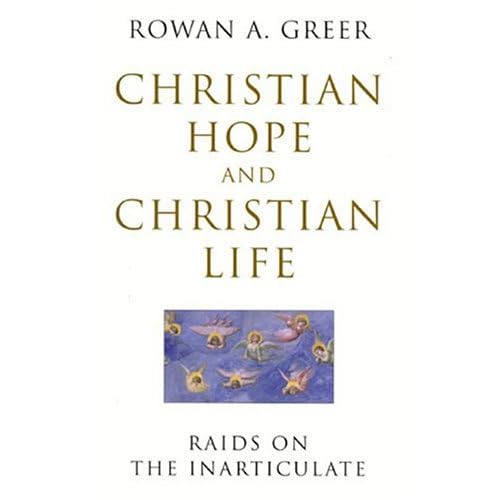
BTW, I mention Rowan Greer in this sermon. I highly recommend his book Christian Hope and Christian Life: Raids on the Inarticulate. In it he explores Christian Hope (Eschatology) in particular as it manifests in two broad traditions of thought. He spends a lot of time with some of the Patristic Fathers and has a patience for understanding the mindset of others that is beautiful to behold.

What is the destiny of the human soul in this life and the next? Dare we hope to “see God face to face,” or will our vision of God remain forever filtered “through a glass, darkly”? In this remarkable volume, Rowan A. Greer turns to the New Testament, the church fathers, and later writers to throw light on their own visions of the human soul. He suggests that Augustine of Hippo and Gregory of Nyssa represent two distinct strands of Christian thinking that find expression later in writers such as John Donne and Jeremy Taylor. Greer, who has trained two generations of historians and theologians in the rich thought of the early church, has succeeded in writing a volume that is both full of original scholarly insight and, by virtue of his elegant writing, accessible to laypeople and non-specialists. (Publisher's blurb)


I see that he has a new book out, as well, about miracles and our perception of them: The Fear of Freedom. If I ever chew through my current reading list I'll make room for that one...

-t

Homily for Lynne and Bob


Here's the recording of my homily from the wedding. I spoke about the meaning of love and the spiritual discipline of marriage. To do this I contrasted the cult of romantic love with the reality of long-term partnership. I ended with a challenge to have courage to always return again to the door of our hope and longing. By the end I was on a nice roll and feeling good.


Here's a direct link to the MP3 file...

-t