Wednesday, September 16, 2009

Busking...


This is from a well-known social experiment done a few years ago by the Washington Post. It has been repeated in other cities with similar results. I often think of this when I see Buskers trying to make a little money on the street or transit system of Toronto:

Washington, DC Metro Station on a cold January morning in 2007. The man with a violin played six Bach pieces for about 45 minutes. During that time approx. 2 thousand people went through the station, most of them on their way to work. After 3 minutes a middle aged man noticed there was a musician playing. He slowed his pace and stopped for a few seconds and then hurried to meet his schedule.

4 minutes later:
The violinist received his first dollar: a woman threw the money in the hat and, without stopping, continued to walk.

6 minutes:
A young man leaned against the wall to listen to him, then looked at his watch and started to walk again.

10 minutes:
A 3-year old boy stopped but his mother tugged him along hurriedly. The kid stopped to look at the violinist again, but the mother pushed hard and the child continued to walk, turning his head all the time. This action was repeated by several other children. Every parent, without exception, forced their children to move on quickly.

45 minutes:
The musician played continuously. Only 6 people stopped and listened for a short while. About 20 gave money but continued to walk at their normal pace. The man collected a total of $32.

1 hour:
He finished playing and silence took over. No one noticed. No one applauded, nor was there any recognition.

No one knew this, but the violinist was Joshua Bell, one of the greatest musicians in the world. He played one of the most intricate pieces ever written, with a violin worth $3.5 million dollars. Two days before Joshua Bell sold out a theater in Boston where the seats averaged $100.

This is a true story. Joshua Bell playing incognito in the metro station was organized by the Washington Post as part of a social experiment about perception, taste and people's priorities. The questions raised: in a common place environment at an inappropriate hour, do we perceive beauty? Do we stop to appreciate it? Do we recognize talent in an unexpected context?

One possible conclusion reached from this experiment could be this: If we do not have a moment to stop and listen to one of the best musicians in the world, playing some of the finest music ever written, with one of the most beautiful instruments ever made.... How many other things are we missing?


-t

Tuesday, September 15, 2009

Thoughts from a Tuesday

A busy day that started with some e-mails and phone calls and then the Trad Com (BCP Communion) service at Messiah. I regretted not transferring the Feast of Holy Cross to a Sunday, but at least I was able to transfer it to today! Not surprisingly, I had plenty to preach about on the Patronal Feast of OHC! A pleasant lunch with some of my parishioners followed.

In the early afternoon I drove down to Diocesan HQ for a meeting related to the Back to Church Sunday initiative. Bishop Poole was leading the meeting, but Bishop Johnson did stop by briefly to share some thoughts about the project. I couldn't help noticing that he was wearing a really flattering suit. And I admit thinking, "I wonder how many suits he had to buy when he became bishop?" Lol. He also shared that a new grand child was to be born immanently. Good for him.

After the meeting it was back to Messiah for a staff meeting. It went longer than usual, which I should have anticipated given that Eric is new on staff and it's the beginning of the church's programme year. We prayed briefly, then we debriefed last Sunday and planned for the next. Much of our time ended up focusing on the Confirmation Service/Bishop's Visitation/Back-to-Church Sunday marathon that will be September 27th! Now we've added a bouncy castle. Because everybody loves the bouncy castle! We also beginning to talk about the Christmas Pageant (yeah, really!).

In November Eric is going to the "Music that Makes Community Conference" in Atlanta. I've talked about paperless singing on this blog from time-to-time, and these conferences put on by the All Saints Company (the people that gave the world St. Gregory of Nyssa, San Francisco) are the place to go to learn about that. I'm thrilled that Eric is going. In fact, he wanted to go long before he was called to COTM. It's a three day conference/workshop teaching the techniques of so-called "paperless singing." It's a method of congregational worship that recovers much older methods of making music in community. It uses techniques like call-and-response, lining, rounds, etc. to get a congregation singing together. Inevitably it feels much more organic, free, and intimate than head-in-hymnal, everybody-follow-the-organ, style singing.

Needless to say, I'd love to go to this conference. The only problem is that the same week I'm going to this year's Preaching College at St. Clement's. This is an invitation-only intensive four-day workshop for preachers. I'm wondering whether I can miss the last half-day and take the red-eye to Atlanta? The other option is to attend the same conference a few months later in January in San Francisco. I love San Francisco--but at that point I'll have a new baby at home and (probably) no desire to travel! Besides, there is a nice synergy that will happen if Eric and I are BOTH at the same conference. I had such a blast the last time I went to an All Saints Company conference, I'd love to share that with one (or more) of my worship staff.

One of the things I love about Eric that we have a shared language for talking about liturgy. I have yet to come up with anything (a term, a hymn, a resource, anything) that he doesn't know about. I suspect he may have a better liturgical library than I do! Going to a conference like this will only take that shared language to the next level: shared experience!

So I'm trying to figure out how to make that trip work!

Lots of other challenges at work. Many of which I just can't talk about for obvious reasons. Suffice it to say, my plate is full.

Meanwhile, Betsy's belly is getting bigger. She's feeling great except for a little bit of joint soreness in her hips. She's been getting good advice via Facebook about that. We are both reading and studying pregnancy stuff like the nerds we are!

The weather in Ontario is starting to turn cool. It makes me think about the need to schedule a firewood delivery and do more canning. Maybe we'll get the farmer's market again this weekend...

-t

Classical Clerical Curfuffle #231


A priest friend of mine in another Diocese was showing off a newly baptized baby to his congregation when he remarked through the P.A., "Hmm, weighs less than my corgi..."

-t

Sunday, September 13, 2009

Saucing!

This morning Betsy and I got up a little early than normal for a Saturday and headed down to the St. Lawrence Street Market. We were there to pick up ingredients for a BBQ we are doing. First things first, a delicious p-meal bacon sandwich! Next, we headed to the farmer's market side to see what they had. While I was there I talked to one of the farmers about when the hot pepper crop will be coming in. He said that the large amount of rain and consequent loss of sunlight has delayed the growing season for both tomatoes and hot peppers, but there should be plenty of peppers coming to market in a week or two...

Back at home we processed another 20 lbs. of tomatoes into sauce. It's very satisfying to put 10 lbs. of onions and a whole bottle of red wine into the pot! Wonderful kitchen smells! I went off to do a service at church and when I came back Betsy had already made a fresh Salsa for the BBQ. More boiling and sauce making and cleaning up the house. Then we went to a friend's birthday party.

On the way home we stopped at a grocery store to get some things that we couldn't get at the market. Back at home, more cooking. Betsy made special patties and I made, sauce, of course. Now that's over and I can start going to bed!

-t

Saturday, September 12, 2009

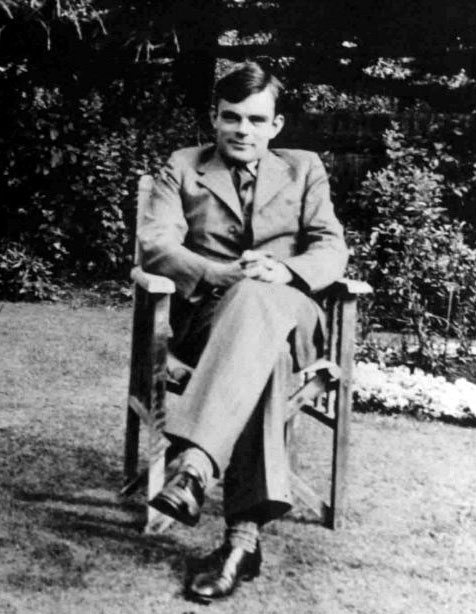
Alan Turning (Finally) Gets an Apology

Alan Turing

It's no exaggeration to say that Alan Turing was one of the greatest minds of the modern age. His work as a mathematician created the foundation for computer science. Even though crude computers were just being built, he came up with theories about Artificial Intelligence that are still influential. His contributions in other fields, such as Chemistry, that are also substantial.

His genius became essential to the Allied efforts to break the German Enigma Code in WWII. Working for the British Government, Turing created and refined methods to break the most complex cypher in use. it's difficult to imagine how difficult this problem was to solve, but to give you a sense: consider that there are 10 to the 22nd power possible combinations in the Enigma code. That means 1,000,000,000,000,000,000,000 possible codes. Turning figured out how to use a simple computer to test these possible solutions. To do this, he invented the logic behind "the bombe"--a cryptanalytic machine that tested possible Enigma code settings.

Professor Jack Good, cryptanalyst working at the time with Turing at Bletchley Park, later said: "Turing's most important contribution, I think, was of part of the design of the bombe, the cryptanalytic machine. He had the idea that you could use, in effect, a theorem in logic which sounds to the untrained ear rather absurd; namely that from a contradiction, you can deduce everything." (source)

Eventually his team was breaking 3,000 messages a day! We cannot underestimate how important this contribution was to the war effort.

Turing was relatively open about being homosexual during the war, but after the war was prosecuted for "Gross Indecency" and given the choice of chemical castration (through hormone injections) or jail. He chose castration and underwent the procedure. He was stripped of his security clearances. In 1954, a year after his conviction, he was found dead in his home from cyanide poisoning. The circumstances are ambiguous, which suggests that his death may have been accidental (from the careless handling of lab chemicals) or even murder. The assassination theory is based on the anxiety at the time of the KGB compromising people using homosexuality to entrap them. This was the time of the Cambridge Five, after all.

Suicide is the most likely answer. Indeed, he did report feeling hounded by the crown. The court-ordered hormone injections led to some disturbing side effects, like the growth of breasts, that he had to live with. He was only 41 when he died. Who knows what his contributions could have been had he lived longer.

Recently the British Government finally apologized for its treatment of Turing after the war. About time!

-t

Thursday, September 10, 2009

Peregrine wins the Jug!

Last night Skipper Dave pulled alongside the harbour pier city-side and trolled slow enough for Jonathan and I (his crew for last-night's race) to toss over our gear and then jump onto the boat. The wind was steady at around 12 knots and we knew we were in for a good race. We changed into our racing clothes and rigged the boat. I took the fore deck as usual while Jon worked the winches mid-ship. With about five minutes before our start (there are three start times to the races, our class starts second), we Jibed onto a starboard beam reach toward the start line. The key to "winning the start" is to be the first boat in your start to cross the line between the committee boat and the marker (i.e. "the line") after the horn blows to signal the start. If you cross early, the horn will blow and second time and the committee will announce over the radio who was over early. Violators must do a penalty turn.

So we were charging on a beam reach toward the line, and we reached the line with about 45 seconds to start. At this point we turned and started running down the line, parallel and about a boat length away. We dodged one boat by "dumping" wind from our Jib (letting it loose to flap around on purpose to slow down), but were windward of another boat. Now, in this situation the boat to leeward (away from the wind) has right of way over a boat to windward, so the guy could have turned up into into the wind (toward the start line) and forced us over early. But instead he started dumping wind from his Jib as well. In retrospect, we think he was afraid of going over the line early, too.

As it was, when the final 5 second countdown commenced Dave steered us into the wind so that we were close-hauled (i.e., wind coming at an angle of about 45 degrees to the front of the boat) and charging aggressively toward the start line. We were heeling heavily to port-side so that the rail of the deck was just inches above the water. I was on the bow trying to judge where the imaginary line was, and as the horn blew I was almost certain it would blow again to say we were over early, but it didn't. That means we were first over the start line. Pretty soon we were in the middle of the back, ducking and tacking the boats around us. As the race progressed we began to lag behind a bit. The fact is that the Peregrine was designed to be more of a cruiser than a racer, but there was still a lot of sailing to be done as we went around the triangle-shaped course four times.

Shortly after we rounded one of the marks we witnessed one of the larger boats (maybe 32 feet) collide with a smaller Star boat (about 20 feet) as they went around the mark behind us. No one was injured, but the skipper of the Star was rightfully furious. She had the right of way, and we suspect the larger boat simply didn't see her as we was dealing with two other boats in close proximity. After the collision he also hit the mark (an inflatable buoy in the water) which requires a penalty turn. He didn't do the turn, but perhaps he realized that he would be disqualified from the race for hitting another vessel, anyway.

The wind had been gradually tapering off as the race went on, so that by the time we rounded the last mark and headed to the finish line we were concerned that the race might end before we were able to cross the line. These races end at sunset, which was just minutes away. But when the time of official sunset came, there were no signals from the race committee boat. Indeed, as we crossed the line I could hear the committee call our time and saw one of the members write it down on a clipboard. Only after we had crossed did they blow the horn to indicate the end of the race, make an announcement over the radio, and hoist the end-of-race flag on the committee boat.

Yet when we arrived at the clubhouse were told that we had been given a "Did Not Finish" for the race! Naturally, we are protesting this as the race was not declared over until after we had finished. We'll see what happens. There was a another boat about five minutes after us and we would like to be scored ahead of them.

Still, because we were first over the start line we won the coveted "jug" of beer. We went for Wellington's Ale and drank it with glee!

There are two more races left in the season. I'll be out of town for one them, but am very much looking forward to the other.

-t

Wednesday, September 9, 2009

Some Summer Pictures

Betsy at 24 Weeks


It was Betsy's idea for me to stand in the smoke


At the helm on a beautiful day doing 6.5 knots


Sailing with some kids from church


-t

Monday, September 7, 2009

A Beautiful Day Sailing

Church went well on Sunday. Kind of an odd Sunday since we had a substitute musician to fill the one-Sunday-gap between Matthew and Eric. The fill-in was Kim Kendrick, our Cantor Laura's mom. I know Kim and her family from my St. Mary Magdalene days (she sings in the choirs there). She did well--it certainly is not easy to lead worship in music!

Attendance was good. Picking up now that summer is ending and kids are going back to school. My sermon was good, but short. But that's okay!

After church one of my parishioners invited out for a sail that afternoon. He was taking some kids out to see the Toronto Air Show from the water. We made arrangements for him to pick Betsy and I up at a certain pier on the city-side of the Inner Harbor. At the appropriate time the "nonsuch" sailboat pulled along side and we tied her up and Betsy and I got aboard. The wind was solid, so we didn't have to motor far before hoisting up the sail of the Nonsuch 30'. Once we got through the eastern gap of the harbor, the wind and the swells picked up. The F-18 jets from the air show were streaking overhead and skimming the water and trees. We ate sandwiches and enjoyed the air show. Pretty soon we were going between 6 and 7 knots (max 7.1 knts) and heeling pretty well. The surges were making it interesting as I took the helm. The skipper and his son were on the bow enjoying the surges and resultant sprays. Two of the girls were hanging onto the lifelines on the windward side in a way that made me kind of nervous. After heading south for a while I switched with the skipper and went up the bow. Lots of spray and ups and downs. Very fun. We headed back with plenty of wind all the way back to the harbor and near the channel to the boat slip inside the inner harbor. Back on land, we enjoyed a drink by the water's edge looking back towards the city. A lovely day on the water, to be sure.

Back at home, it didn't take long before I went down for a nap. Slept through 'till this morning. I managed to mow the lawn and do some minor errands. Betsy worked on some sewing projects. In the evening we had a baby shower with friends. A little TV and now thinking about bed. Tomorrow is a big day!

-t

Friday, September 4, 2009

Wedding Procession

Check this out. Now, if I was the Presider at this wedding you know I would have danced my pretty ass off coming in!


-t

Thursday, September 3, 2009

Sermon - Pentecost 13 2009

I was very pleased with how this sermon turned out. I was nervous to preach about sex. I thought about how I was really trusting the congregation not to freak out. Afterwards one person told me some stories about very personal anecdotes they had heard from the pulpit in years past. By comparison my little sermon was tame! So next time I could be more explicit without so much worry.

Still, one visitor told me that she came from a Pentecostal tradition and thought my sermon was just edgy enough for her! It's important to preach where people are at, ya know?

Preaching about something of such interest to me made this a very easy sermon to both write and deliver. Still, when I listen to it I can't help but think of all the stuff I could have/should have mentioned! Anyway, enjoy!


Here's the audio...


Here's a direct link to the MP3 file...

-t

Study: Home Births as Safe as Hospital Births

A new study done in British Columbia comparing 2,889 home births attended by licensed midwives with 4,752 planned hospital births also attended by midwives and 5,331 hospital births attended by a physician found that, for low-risk pregnancies, home birth is just as safe as hospital birth.
Planned home birth attended by a registered midwife was associated with very low and comparable rates of perinatal death and reduced rates of obstetric interventions and other adverse perinatal outcomes compared with planned hospital birth attended by a midwife or physician. (source)

The study only looked at low risk pregnancies, but found that the rate of infant mortality was slightly higher for hospital births (0.35 per 1000 for home births vs. 0.57 for hospital births with midwife vs. 0.64 for hospital births with an MD).

The use of interventions during birth was much lower for the home-birth group:
  • 0.32 times less likely to receive electronic fetal monitoring
  • 0.41 times less likely to have an assisted vaginal delivery
  • 0.41 times less likely to suffer third- or fourth-degree perineal tears
  • 0.62 times less likely to have postpartum hemorrhage
Interestingly, even the women that wanted a home birth but ended up in the hospital still have lower instances of intervention.

Also significant, babies born at home were 0.23 times less likely to require either resuscitation or oxygen after 24 hours and 0.45 times less likely to have aspirate meconium.

Now, the point of this study is not to say, necessarily, that women should give birth at home, but rather to assess the risk of that choice. The researchers wanted to know, "is it safe to give birth at home under a midwife's care," and the answer seems to be "yes." This has as much to do with the screening midwives to on candidates for home birth as with the inherent safety of one environment over the other.

It's very important to recognize the self-selecting bias of this study. Inherently, women choosing to have a home birth are doing so because they are healthy and show no risk factors. But this study shows that this choice does not increase the risk to baby or mother. It's one of the largest such studies done to date, and it's a real landmark.

While it might seem like having all the resources of a hospital would reduce risk, it is also true that certain aspects of hospital birthing also increase the risk in an off-setting way. For example, the higher-stress on the mother, the tendency of doctors to induce labour unnecessarily, and the disturbing trend of medically-unjustified C-Sections (Current Canadian rate of C-Sections is 28% vs. about 31% for U.S. and about 15% for the rest of the industrialized world).

There are a lot of reasons why the rate of C-Sections is so high in the U.S. and Canada, and lots of Doctors and others are worried about it. Many of these seem to be C-Sections-on-Demand--requested by the mother for reasons of convenience, the perceptional that a surgical birth is "easier" than vaginal delivery, etc. It's a major surgery that has the potential to cause a lot of complications. Indeed, it raises the risk for future pregnancies substantially.

The infant mortality rate for the U.S. is terrible: 6.3 per 1000 ranking them 33rd in the world. Canada is a little better: 4.8 per 1000 ranking us 23rd. But this is still far behind countries like Cuba (5.1 per 1000), Slovenia (4.8 per 1000), the Czech Republic (3.8), and world-leader Iceland (2.9 per 1000) source. That's right, a baby is twice as likely to survive in Iceland as the U.S. (FYI, the C-section rate in Iceland is rising, too, from 13.1% in 1987 to 17.9% in 2006. source) I don't know of a study has conclusively linked c-section complications with the higher-than-it-ought-to-be mortality rate in the U.S., but it's all part of the same puzzle.

Here's an excerpt from an article that appeared in the Vancouver Sun recently:
[Dr.] Christilaw says the only thing preventing Canada from seeing "horrific" complication rates from C-sections is the fact women are not having as many babies as they once did.

"A C-section can be a life-saving manoeuvre for a mother or baby. Nobody is saying differently," she says. "What we're trying to say to people is, a C-section is not a benign thing. If you need one, that's different. But you should not be doing this unless you absolutely have to."

C-sections are frequently the end result of a cascade of interventions that often starts with inductions.

Tens of thousands of women in Canada have their labours artificially induced every year, often via intravenous infusion of artificial oxytocin. Oxytocin is naturally produced by the human body. It's what creates contractions in labour. Today in Canada, one in five women who gives birth in hospital is induced.

What doctors fear are stillbirths. But alarmed by the rising rates of inductions, the Society of Obstetricians and Gynecologists of Canada recently urged doctors not to consider an induction until a woman is at least one week past her due date.

Claudia Villeneuve says that women are getting induced "if they're two, three, four days overdue."

"Inductions are rampant," says Villeneuve, president of the International Cesarean Awareness Network of Canada. "You have a perfectly normal mom who comes in with a perfectly normal baby, and now you put these powerful drugs into her system to force labour to start."

The "humane" thing is to offer an epidural, she says. With an epidural, a woman can't feel pain in the lower half of her body. But epidurals slow labour, sometimes so much that labour stops. "Now you have to get this baby out," Villeneuve says. Two-thirds of first-time C-sections are done for "failure to progress."

[Dr. Michael] Klein says epidurals are too often given before active labour is established.

"The majority of women today get their epidurals in the parking lot."

So the cascade continues: epidurals increase the use of electronic fetal monitoring, where electrodes are strapped to the woman's belly to monitor her baby's heart rate.

"It's hard to change positions when you have a fetal monitor on, and an epidural with its little things taped to your back, and an IV in your arm," [Professor of Perinatal Nursing Ellen] Hodnett says. "Why would labour progress normally, if you're stuck in a labour bed with all this machinery on you?"

What's more, EFM is an imperfect technology. It detects subtle changes that can't be picked up by just listening to the baby's heartbeat after contractions, "and those subtle changes are often false positives," Klein says. "In other words, the fetus is OK, you just think it isn't OK." (source)


There are lots of other factors behind the high C-section rate, of course, including the fear of malpractice suits. I'm just trying to make the point that the fewer interventions on mother and baby, the better off both will be. This goes against some of the prevailing wisdom that more medical intervention means lower risk.

A wiser answer to this question--"which is safer"--may simply be, "It depends." If baby and mom are happy and healthy and want a home delivery, there seems to be no medical reason to prevent it and some to recommend it. If, on the other hand, complications seem likely, than you may be better off in a hospital.

-t

Another Study about how Drinking can be Good for You

A new study just published in the American Journal of Geriatric Psychiatry analyzed the results of 15 previous studies to demonstrate the people over 60 who consume between 1 and 28 alcoholic drinks per week significantly reduce the risk of Alzheimer's and other dementias. For male drinkers the risk was reduced by 45 percent. Women saw their risk reduced by 27 percent.

Causation is difficult to determine, but probably has to do with how alcohol increases good cholesterol, increases blood flow to the brain, and decreases blood coagulation.

-t