Thursday, March 5, 2009

Healing Prayer Banner


I had this banner printed up and hung it on the Avenue Road side of the church to promote the Healing Prayer Service we started last week. I know it's not the most interesting design in the world, but without a volunteer with design skills to rely on I can only do what I can do. It's a start, at least.

So that covers one angle. Coming down the hill people will see the healing prayer service advertised on our main sign. Then I have it advertised again on A-frames along the sidewalk on the Dupont Road side of the church. So I have most of the angles covered. We'll see if it actually attracts anyone!

Some lessons learned: printing a banner like this is pretty easy. Kinkos just needs a PDF of the design. It runs about $15/square foot irregardless of the design's complexity, number of colours, etc. Turnaround is about 48 hours. Pretty straight forward.

-t

The Vicar's Study


This is from Dave Walker's Cartoon Church website. Yes, I have a license to use it. I was poking around a minute ago and found this disturbingly accurate depiction. My office indeed has
  • Person approaching door requiring $20 for train fare
  • Huge bunch of keys
  • Meaningful religious knick-knacks
  • Humourous religious knick-knacks
  • Chair for those seeking pastoral help
  • unopened bag of leaflets from resources exhibition
  • excessive quantity of computer equipment
  • An Immense number of books, designed to impress visitors. Most are paperbacks dating from the Vicar's time at theological college.


I think I'm especially guilty of the the "excessive quantity of computer equipment" crime. Sigh.

-t

Church Shopping in America

Ann W. passed along an article in Slate about Church shopping in the U.S. The article is arguing that the competition among churches in the U.S. has been good for religion in America and may even explain why something like 67% of Americans belong to a local church.
American faith comes in lots of flavors, but that doesn't necessarily mean that today's church shoppers are buying into a superficial, strip-mall faith. When the Barna Group studied what believers look for in a new church, doctrine and belief ranked at the top of the list of the most important factors, while more mundane or aesthetic concerns (music, parking, comfortable seating) were less important. And the free market in faith has been good for America's religious life. All that hopping across denominational lines likely helped produce a less rigid, better informed, more ecumenical religious culture. (source)

I do think we need to be careful about the the tendency to sell a Gospel of ease--selling out our integrity for the sake of growth--but I think we also need to recognize that people are hungry for a genuine encounter with God. The popularity of the Orthodox Church in certain circles is good evidence for how "approachability" or "high-barriers to entry" are perhaps not as important to church "consumers" as perceived authenticity or other, more spiritual values.

I remember more than one person at St. Mary Magdalene's that told me that they came and continued to come specifically because of their belief in Father Harold's spiritual integrity. That is a striking sentiment in a church that is trying hard to transcend individuality in liturgy. Harold is not the sort of priest that likes to preach about his "spiritual journey." Still, people came because they perceived that there was a genuine spiritual something at the heart of the SMM community.

Applied to Church of The Messiah, it's one the reasons why I'm so pleased that the community has grown so much more loving and connected in the last year. Really, love will get us there. Signs and websites and posters and all that are important, but if we don't have core spirituality we are dead in the water.

-t

Wednesday, March 4, 2009

Sermon - Lent 1 2009

My sermon from Lent 1, 2009. I talk about "desert spirituality" and the search for God in the ascetic path.


Here's a direct link to the MP3 file...

-t

Sermon - Ash Wednesday 2009

We had a quiet Ash Wednesday service this year. Here's my sermon...


Here's a direct link to the MP3 file...

-t

State of The Parish Address 2009

On the last Sunday of Epiphany we held our annual Parish Vestry Meeting. Because many people can't stay for the meeting, I give the "State of the Parish" address during the sermon time.


Here's a direct link to the MP3 file...

-t

The Holy Pretzel


Bob, my bro-in-law, points out this fascinating article about using the humble pretzel as a traditional symbol of Lent:
The pretzel has a deep spiritual meaning for Lent. In fact, it was the ancient Christian Lenten bread as far back as the fourth century. In the old Roman Empire, the faithful kept a very strict fast all through Lent: no milk, no butter, no cheese, no eggs, no cream and no meat. They made small breads of water, flour and salt, to remind themselves that Lent was a time of prayer. They shaped these breads in the form of crossed arms for in those days they crossed their arms over the breast while praying. Therefore they called the breads "little arms" (bracellae). From this Latin word, the Germanic people later coined the term "pretzel."

Thus the pretzel is the most appropriate food symbol in Lent. It still shows the form of arms crossed in prayer, reminding us that Lent is a time of prayer. It consists only of water and flour, thus proclaiming Lent as a time of fasting. The earliest picture and description of a pretzel (from the fifth century) may be found in the manuscript-codex No. 3867, Vatican Library. (source)

The article even includes a "Ceremony of the Pretzel" to use in Lent:

The Ceremony of the Pretzel

1. On Ash Wednesday, father or mother may explain the origin of the holy pretzel, so that the children will understand its significance.

2. The pretzel might be served on each plate for each evening meal until Easter.

3. Added to the grace before meals, is the "pretzel prayer."

PRAYER

We beg you, O Lord, to bless these breads which are to remind us that Lent is a sacred season of penance and prayer. For this very reason, the early Christian started the custom of making these breads in the form of arms crossed in prayer. Thus they kept the holy purpose of Lent alive in their hearts from day to day, and increased in their souls the love of Christ, even unto death, if necessary.

Grant us, we pray, that we too, may be reminded by the daily sight of these pretzels to observe the holy season of Lent with true devotion and great spiritual fruit. We ask this through Christ our Lord. Amen.

(source)


I'm touch by this--but I also think it would be excellent fodder for a Monty Python skit.

-t

Tuesday, March 3, 2009

General Tso Part 2

I made the General Tso's Chicken Recipe Number 1 last night night. It was good, but a little disappointing. The problem was that the sauce wasn't quite right. It lacks both the thickness and the sugar you would expect. So here's another recipe (by S. John Ross) that looks more promising, sauce-wise...

General Tso's Chicken Recipe Number 2


1 lb chicken thighs, boned and cubed
3 eggs, beaten
1/2 cup and 2 tsp cornstarch
5 dried pepper pods
1-1/2 tbsp rice vinegar
2 tbsp rice wine
3 tbsp sugar
3 tbsp soy sauce

In a large bowl, thoroughly blend the 1/2 cup of cornstarch and the eggs; add the chicken and toss to coat. If the mixture bonds too well, add some vegetable oil to separate the pieces.

In a small bowl, prepare the sauce mixture by combining the 2 tsp cornstarch with the wine, vinegar, sugar and soy sauce.

First-Stage Frying: Heat 1-2 inches of peanut oil in a wok to medium-high heat (350-400o). Fry the chicken in small batches, just long enough to cook the chicken through. Remove the chicken to absorbent paper and allow to stand (this step can be performed well in advance, along with the sauce mixture, with both refrigerated).

Second-Stage Frying: Leave a tablespoon or two of the oil in the wok. Add the pepper pods to the oil and stir-fry briefly, awakening the aroma but not burning them. Return the chicken to the wok and stir-fry until the pieces are crispy brown.

The General's Favorite Sauce: Add the sauce-mixture to the wok, tossing over the heat until the sauce caramelizes into a glaze (1-2 minutes). Serve immediately. Serves 4, along with steamed broccoli and rice.

Variations and Substitutions

Sherry substitutes well for the rice wine, but avoid "cooking sherry" if you can. Sugar in the sauce ranges from as little as a few teaspoons to a full half-cup in some recipes. Soy sauce, too, varies dramatically, rising as high as double that listed above. Nearly any sort of vinegar can be used. In some recipes, a tablespoon of soy sauce is added to the egg-and-cornstarch blend. In others, the chicken itself is marinated before being used, in either soy, wine, vinegar, or some combination of those.

Many recipes include a much lighter egg-and-cornstarch coating for the chicken (about 2 tbsp of starch and two eggs). I prefer the heavier coating; adjust to taste.

Optional Sauce Ingredients: A grind of fresh black pepper, a teaspoon of sesame oil, a teaspoon of MSG, a clove or two of garlic, a couple of fresh chopped scallions or green onions, 1-2 teaspoons of Chinese chili sauce, fresh ginger, a teaspoon of hoisin sauce, the minced rind of an orange, and many other items may be added to the sauce. Any vegetal additions should be added to the oil along with the chicken (the ginger can burn easily - add it last).

Light Tso Sauce: The traditional sauce for General Tso's is a heavy, spicy glaze, different from the lighter broth-based sauces found on most other Chinese dishes. Some prefer a lighter Tso sauce, too, and this can be achieved by tripling the cornstarch in the sauce and adding a half-cup of fluid. The "fluid" can be chicken broth, water, or even fruit juice (both orange and pineapple have been used). Cook the sauce only 'til it thickens, instead of waiting for a glaze. This version of the sauce is actually more common in the local restaurants; if you're a Tso fan, it might be what you're used to. (source)

Monday, March 2, 2009

The Economy, Faith, and Debt

Stanley Fish has a stunning article on his NYTimes Blog about the Christian discourse on debt. He talks about the two main Christian frameworks for understanding money and debt and explores their implications for the current financial crisis. This kind of frankly Christian essay in such a major venue (the New York Times) highlights one of the major differences between Christianity in America and Canada. People like Stanley Fish can still discuss theology openly down there in a way I don't think they can up here. I mean, the Christian heritage (if not the Christian faith itself) is still taken very seriously down there. But I'm still amazed that Stanley Fish, of all people, would write in such an apologetic mode.
The Bible, they tell us, contains 2,350 verses “that have to do with money and possessions.” If we attend to the lessons of these verses and learn how properly to husband the resources God has given us, we will be doing his work, for “God desires a life for us that is free of debt , and the entrapments and common pitfalls related to financial difficulties” (Cross). “The way out of debt,” Dayton teaches, “is not a declaration of bankruptcy, but surrender to the word of God.”

But in another popular Christian discourse, there is no way out of debt, and bankruptcy is the condition we are in from the moment of birth. This is a Calvinist discourse in which the language of money is allegorized. The debt we owe is owed to the God who made us in his image, an image defiled and corrupted by Adam and Eve, whose heirs in sin we all are. We may think that this unhappy inheritance could be overlain and covered by a succession of good deeds, but every deed we perform is infected by the base motives from which we cannot move one inch away. Every piece of currency we offer in payment of debt only increases it. The situation seems hopeless.

But it’s not, we are told, if we embrace bankruptcy rather than try (vainly) to extricate ourselves from it. The acknowledgment of bankruptcy and of the impossibility of working our way free of it is the beginning of wisdom.

....

This economy, in which funds depleted are endlessly replenished, is underwritten by a power so great and beneficent that it turns failures into treasures. Some economists identify that power as the market and ask us to have faith in it. God might be a better candidate. (source)


For good measure he quotes the wonderful poet-priest George Herbert:

REDEMPTION.


HAVING been tenant long to a rich Lord,
Not thriving, I resolved to be bold,
And make a suit unto him, to afford
A new small-rented lease, and cancell th’ old.

In heaven at his manour I him sought :
They told me there, that he was lately gone
About some land, which he had dearly bought
Long since on earth, to take possession.

I straight return’d, and knowing his great birth,
Sought him accordingly in great resorts ;
In cities, theatres, gardens, parks, and courts :
At length I heard a ragged noise and mirth

Of theeves and murderers : there I him espied,
Who straight, Your suit is granted, said, and died.
(source)


Does that poem not make your spine tingle?

-t

A Calm and Prayerful Night

Betsy went to the Bach Vespers at Redeemer this evening. She enjoyed it, and when she came home we talked and sipped tea. Later, as she and the cats slept, I read more of Kathleen Norris' recent book, Acedia and Me. It's a very grown up book that traces many decades worth of accumulated spiritual wisdom. It's the sort of book that goes to some pretty dark places, including her husband's history with depression and suicide attempts.

Reading her talk about the necessity of prayer inspired me to dust off my old pocket-sized (American) Book of Common Prayer. It was given to me by my parents when I was confirmed. I have prayed with it often throughout my life, but less since I moved to Canada and started saying the Office from the BAS or the Holy Cross Breviary. When I was a kid I would say Compline every night. So this prayer book is well-worn. But in recent years I've been doing most of my prayers "at the office" so to speak. That is, I've been praying at church. I know this is probably a mistake, one should allow prayer to infuse all life, but besides grace at meals and extemporaneous prayers in the shower or when the thought of someone in need of prayers strikes me, I haven't been indulging in something as well developed or rich as the little Compline Office in the '79 BCP. Picking up tonight just felt right, somehow, as a response to both Kathleen Norris and everything else.

Perhaps this is the way Lent is going to come at me this year--quiet moments sipping tea with my wife or reading a poet talk about her spiritual journey through life, marriage, and vocation. And then the prayers and now the blogging. I'm sipping warm milk and trying not to let my mind race ahead to all the things I want to get done on my day off!

It seems lately I've been having the the same conversation over and over with different people--a talk about surface versus depth. If I let my attention rest on the surface of the pond--worrying about who is in church and who isn't or how the roof is going to get fixed and why didn't more people come to Ash Wednesday--I'm going to be jostled by every little ripple and possible overwhelmed by every wave. But underneath that is something still and deep and dark and full of all the rich, squirmy life that we need. You catch fishes by letting down nets, I suppose.

Those crafty desert fathers knew this lesson well. I'm so young as a Christian I find the challenges of this life daunting to say the least. I can't imagine what I would do if I didn't have people like Bede and Kathleen Norris and the Desert Fathers and Eugene Peterson and the rest of the struggling saints!

Sigh. A night for prayer.

-t

Sunday, March 1, 2009

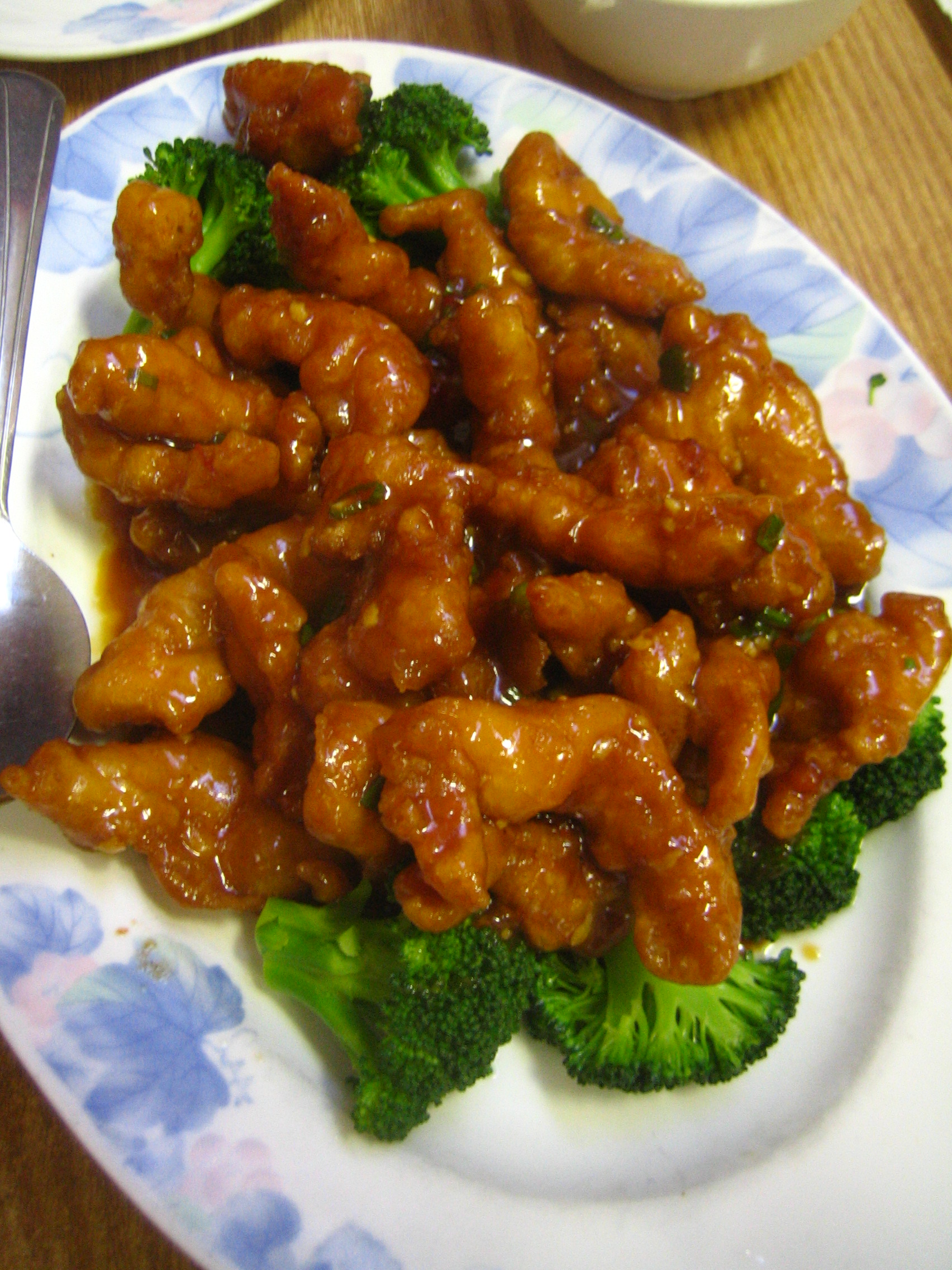
General Tso's Chicken


Who doesn't like General Tso's Chicken? It's a classic sweet and hot Chinese dish that combines the satisfaction of fried, crispy chicken and the flavor of a sugary, chili-based sauce. Betsy, who is partial to the dish, asked "Who is this General Tso, anyway"? Well, it turns out that this classic of Chinese cuisine isn't so classic after all. The dish is unheard of in China and appears to make it's first world appearance in New York in the 1970's. Two restaurants claim the invention: Peng Teng on East 44th Street and Shun Lee Palace. According to Wikipedia, Peng Teng's claim seems more likely. So what's with the name?
There are several stories concerning the origin of the dish. In her book The Chinese Kitchen, Eileen Yin-Fei Lo states that the dish originates from a simple Hunan chicken dish, and that the reference to "Zongtang" in "Zuo Zongtang chicken" was not a reference to Zuo Zongtang's given name, but rather a reference to the homonym "zongtang", meaning "ancestral meeting hall" (Chinese: 宗堂; pinyin: zōngtáng). Consistent with this interpretation, the dish name is sometimes (but considerably less commonly) found in Chinese as "Zuo ancestral hall chicken" (traditional Chinese: 左宗堂雞; simplified Chinese: 左宗堂鸡; pinyin: Zuǒ Zōngtáng jī). (source)


So what we have here is a Hunan-inspired Chinese-American dish that spread quickly through North America. Not as authentic as I had hoped to discover, but still delicious. I haven't tried making it myself, but since I have been cooking with the Wok a lot lately I thought I might give this recipe a try:

General Tso's Chicken


4 Chicken legs with thighs
1/2 c Soy sauce
1/2 c Distilled white vinegar
1 cl Garlic; minced
1 ts Ginger root; Peeled & minced
1 ts Cornstarch
1 lg Egg; beaten lightly
1/3 c Corn oil
4 Dried hot chilis; seeded

Bone the chicken legs, including the thighs by scraping the meat from the bone, working downward and keeping close to the bone. Pull the meat down over the bone (pulling it inside out like a glove) and cut it free from the bone. Discard the skin and cut the meat from each leg into 6 pieces.

In a bowl combine the soy sauce, vinegar, 1/2 c water, the garlic and ginger root.

In another bowl, combine the egg and cornstarch and dip the chicken pieces. Heat the oil in a wok or deep, heavy skillet until very hot, add the chicken and fry it for 4 to 6 minutes, or until it is crisp. Transfer the chicken with tongs to paper towels to drain and pour off all but 1 T of the oil from the wok. Add the soy sauce mixture, the chili peppers and the chicken and cook the mixture over moderately high heat for 2 minutes, or until heated through.

Transfer it to a heated serving dish. Serves 4. (source)


I'll report back with results when I've tried it!

-t

Is Food the New Sex?

George Will has an interesting editorial in the Washington Post about how food has become the new bell-weather of personal morality, replacing sex. This argument about how moral attitudes toward food and sex are being transposed is based on a policy-review document entitled "Is Food the New Sex" by Mary Eberstadt.

Essentially, the argument goes that Americans (and I presume they mean "North Americans") are increasingly loading food choices with moral implication. So people are becoming prudes about eating fair trade, organic, healthy, etc. food. But choices around sex seem to have less moral weight or meaning.
[Eberstadt] notes that for the first time ever, most people in advanced nations "are more or less free to have all the sex and food they want." One might think, she says, either that food and sex would both be pursued with an ardor heedless of consequences, or that both would be subjected to analogous codes constraining consumption. The opposite has happened -- mindful eating and mindless sex. (source).


How do we account for the imbalance of prohibition on two goods that, objectively speaking, are both harmful in excess? Why the the transposition of inhibition from one to the other?

But her argument goes much further than showing that this has happened--she wants to explore the relationship between the sexual revolution and our current attitudes toward food:
Today "the all-you-can-eat buffet" is stigmatized and the "sexual smorgasbord" is not. Eberstadt's surmise about a society "puritanical about food, and licentious about sex" is this: "The rules being drawn around food receive some force from the fact that people are uncomfortable with how far the sexual revolution has gone -- and not knowing what to do about it, they turn for increasing consolation to mining morality out of what they eat."

Perhaps. Stigmas are compasses, pointing toward society's sense of its prerequisites for self-protection. Furthermore, as increasing numbers of people are led to a materialist understanding of life -- who say not that "I have a body" but that "I am a body" -- society becomes more obsessive about the body's maintenance. (source)


It's a fascinating analysis of the relationship between two primal human drives. And who can resist reading an essay with section titles like "Broccoli, pornography, and Kant"?

-t